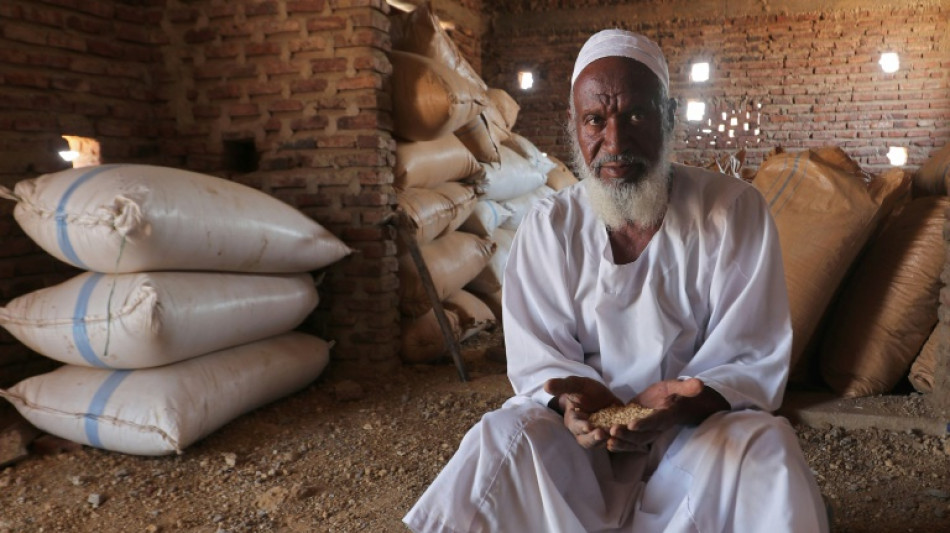
Sudan wheat harvest waits to rot as hunger crisis looms / Photo: ASHRAF SHAZLY - AFP

 Vietnam signs free trade deal with four European nations

 One million migrating raptors dodge illegal hunters above Georgia's Black Sea coast

 Rays defeat Guardians to level MLB playoff series

 Western brands under pressure as 'pre-owned' luxury booms in China

 'Never seen anything like it': mass looting grips Paris

 All Blacks back on track after South Africa wake-up

 Met Opera goes for big and bold, despite shaky finances

 Hollywood's fresh take on tech titans: from heroes to villains

 St. Louis City's unbeaten MLS run ends at 19, Union's reaches 15

 NFL Eagles bench Hurts at least a month with blood clot

 Across US, 'No Kings' events seek to boost early voting

 Tents spring up in Lisbon as Portugal housing protests spread

 'Best in world' Yamal powers Barca to Betis rout, Atletico strike late

 El Salvador's Bukele puts conditions on early release of gang prisoners

 Fire rages at town hall in France's Limoges after protests: authorities

 Unstoppable Barca thrash Betis to extend perfect start

 Maresca faces anxious wait over Haaland injury scare

 PSG fight back to beat Strasbourg after Dembele penalty miss

 Looting, blazes and clashes in France amid nationwide protests

 Walsh breaks her own 50 free world short course record

 Haaland brace extends Man City's winning start in Premier League

 'Special' Ombudsman storms to victory in Champion Stakes

 Brazil's right embraces election betting odds amid polls skepticism

 Four more Ebola cases detected in Kenya, bringing total to seven

 Clashes erupt in France as protesters vow to make government 'tremble'

Looking at the sacks of wheat stacked in Imad Abdullah's small home, no one would guess that Sudan's food security is hanging by a thread after an October coup and Russia's invasion of Ukraine.
But the wheat farmer fears that the grain will soon rot, after his country's cash-strapped government backed out of promises to purchase it at incentivising prices.
"It has been two months since I harvested the wheat and I can't store it in the house anymore," said Abdullah, pointing to the large sacks filled with ripened wheat crammed into his small house in Al-Laota, in Gezira state, south of Sudan's capital.
He is one of thousands of farmers who have cultivated the grain as part of Sudan's largest agricultural scheme, named Al-Gezira.
When Abdullah harvested in March, he was promised 43,000 Sudanese pounds ($75) per sack –- a price set by the government to encourage farmers to cultivate the grain.
"We used to sell the government our entire harvest. We never had to bring it home. We don't even have adequate storage places."
Sudanese officials have however declared in recent weeks that they will not be able to buy this season's entire harvest due to lack of funds.
Impoverished Sudan has for years been grappling with a grinding economic crisis, which deepened after last year's military coup prompted Western governments to cut crucial aid.
The October coup derailed a fragile transition put in place following the 2019 ouster of president Omar al-Bashir.
Over 18 million people, nearly half the Sudanese population, are expected to be pushed into extreme hunger by September, according to United Nations estimates.
Russia's invasion of Ukraine, both key grain suppliers, threatens to compound Sudan's existing food security troubles.
Wheat imports from both nations make up between 70 and 80 percent of Sudan's local market needs, according to a 2021 UN report.
- Empty coffers -
Last month, dozens of wheat farmers from Sudan's Northern State staged a protest outside the agricultural bank after it refused to take their harvest.
"I grew 16 acres of wheat this season, filling some 120 sacks amounting to a total of 12 tonnes," farmer Modawi Ahmed told AFP.
He said the bank only agreed to buy less than half of his harvest, and he now fears the rest will spoil.
Farmers working the fields as part of the Al-Gezira scheme have over the years contributed only a small portion of Sudan's annual wheat needs of 2.2 million tonnes.
This year, local wheat production was forecast to cover only a quarter of the country's needs, according to the UN's Food and Agriculture Organisation (FAO).
The finance ministry earlier this month said it was committed to building a strategic wheat reserve of up to 300,000 tonnes.
But the government "does not have the money to buy the harvest", said an official with Sudan's agricultural bank, which procures the wheat from farmers.
"We have asked the finance ministry and the central bank for funds but we got no response," the official told AFP on condition of anonymity.
An official with Sudan's finance ministry, who also spoke on condition of anonymity, confirmed the lack of funds.
Properly stored wheat can last up to a year and a half in silos with controlled temperature and humidity levels, according to agricultural expert Abdulkarim Omar.
But it "could spoil within as little as three months" in inadequate storage, he said.
Traders have offered to buy the farmers' wheat, but at far lower prices that barely cover the cost of production, according to Omar Marzouk, the governor of the Al-Gezira scheme.
As a result, he predicted that "farmers will opt against cultivating the grain next season".
- Risk to food security -
Now, as the new growing season starts, many frustrated farmers are leaving their lands untilled and unprepared.
Kamal Sari, leader of the farmers' association, fears that reluctance to prepare for the new season could affect "food provision for the Sudanese people".
Last week, two children in Sudan's Darfur region died "due to hunger-related causes", UK-based aid group Save the Children said, warning it was "an ominous sign of what is to come".
Sudanese households have come under increasing pressure in recent months due to spiralling fuel and electricity prices.
Prices of staple food items have also skyrocketed, with inflation recently surpassing 200 percent.
Rising bread prices due to slashed wheat subsidies sparked the political turmoil and mass rallies that led to the ouster of Bashir in 2019.
Given the economic crisis and the ongoing war in Ukraine, economist Mohamed al-Nayer said "the government should buy the wheat from farmers at any price".
Otherwise, he warned, "it complicates the situation in Sudan far more than it already is."
S.AbuJamous--SF-PST