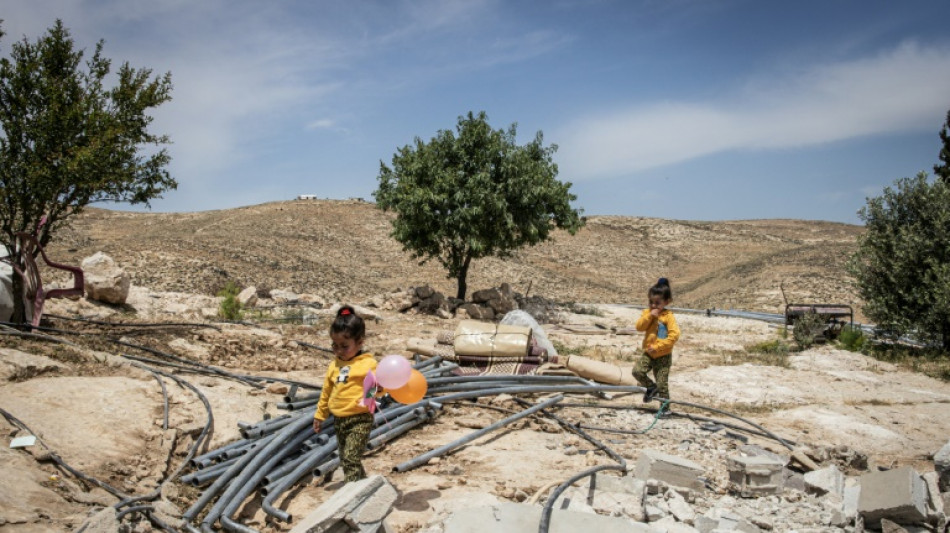
Palestinians in razed West Bank hamlet vow to stay / Photo: JOHN WESSELS - AFP

 Dawn of War 4 developers chose Adeptus Mechanicus for tactical variety

 Italy face unbeaten South Africa in Turin Nations Championship match

 ChatGPT interactive interface feature tested across six custom tools

 Freshways milk-price cut deepens pressure on UK dairy farms

 Labour and National remain virtually tied as New Zealand vote count advances

 The Good Daughter adapts Karin Slaughter thriller with Rose Byrne and Meghann Fahy

 Heavy-lift drone evacuates wounded Ukrainian soldier from frontline kill zone

 Morrison says West Brom recovered after pressure from successive derby losses

 Britain considers 2027 state visit for Ukraine’s Zelensky
 China and Gabon Upgrade Ties to 'Shared Future' Amid Strategic Pact

 عائلة مراهقة ترفع دعوى ضد جوجل لادعاء التقصير في حماية طالب من الانتحار عبر الذكاء الاصطناعي

 Microsoft Xbox App Update for PC Delivers 60% Faster Startup and Redesigned Interface

 بودكاست 'شتامبلايتس': تحليل أفضل تسديدة في الدوري الألماني
Standing in the rubble of used to be his home, Palestinian farmer Haitham Dababseh cleared stones to make space for a tent after Israeli army bulldozers destroyed his village in the occupied West Bank.
Residents of Khallet al-Dabaa and other hamlets in the West Bank's Masafer Yatta region have for years contended with violence from Israeli settlers and repeated demolitions.
But the bulldozers that descended on Khallet al-Dabaa on Monday carried out "the biggest demolition we've ever had", said Dababseh, razing to the ground the hamlet that is home to about 100 Palestinians.
Israeli forces "came here in the past, they demolished three times, four times", the 34-year-old farmer told AFP, but never entirely destroyed a hamlet this size in Masafer Yatta.
"I just have my clothes. Everything I have is under the rubble."
Behind him, his 86-year-old father struggled to move the house's former door out of the way so that they can set up their shelter.
Khallet al-Dabaa is one of several villages featured at length in the Oscar-winning documentary "No Other Land", recounting the struggles of the Palestinian residents of the area in the West Bank's south, a frequent target of settler violence and army activities.
Several of the communities shown in the documentary have experienced settler attacks or army demolitions since it won an Academy Award in March.
- No protection -
Several years after occupying the West Bank in 1967, the Israeli army had declared Masafer Yatta a restricted firing zone.
Israeli forces regularly demolish structures that the military authorities say were built illegally in the area, where about 1,100 Palestinians live across several hamlets.
"Enforcement authorities of the Civil Administration dismantled a number of illegal structures that were built in a closed military zone in the South Hebron Hills," the Israeli military told AFP in a statement on the Khallet al-Dabaa demolition.
"The enforcement actions were carried out after the completion of all required administrative procedures and in accordance with the enforcement priority framework previously presented to the Supreme Court," it added.
Some residents, and many of their ancestors, once lived in caves in the rocky terrain to escape the area's stifling summer heat, and built houses with stone and other materials after the Israeli firing zone designation in the 1970s.
Dababseh said he was the first member of his family to be born in a hospital and not a cave.
He lamented that the army had blocked the entry to the cave near the family home where his father and grandfather were born.
In the middle of Khallet al-Dabaa, what served as a health and community centre is now a pile of broken concrete with no walls.
A torn logbook that an aid organisation used to record residents' medical check-ups lay under dust.
On the outside wall of the only structure left standing, a painted mural read "Let me live".
Mohammed Rabaa, head of the nearby Tuwani village council which has jurisdiction over Khallet al-Dabaa, told AFP that the foreign aid his community received was useless if the world "can't protect it".
- 'I'm not leaving' -
According to Rabaa, "nine settler outposts were established in the Masafer Yatta area" since October 2023, when war began in the separate Palestinian territory of the Gaza Strip.
The West Bank is home to about three million Palestinians, but also some 500,000 Israelis living in settlements that are illegal under international law.
Settlement outposts, built without the authorities' prior approval, are considered illegal under Israeli law too although enforcement is relatively rare.
The settlers who live in the nearby outposts "attack homes, burn property, destroy and vandalise" with full impunity and often under army protection, said Rabaa.
To him, they aim to force Palestinians to leave and "do not want any Palestinian presence".
The day after Khallet al-Dabaa was razed, Israel's Finance Minister Bezalel Smotrich, a far-right politician who lives in a settlement, expressed his hope that the government would formally annex the territory soon.
Umm Ibrahim Dababseh, a 76-year-old woman who has lived in Khallet al-Dabaa for six decades, said she would not leave under any circumstances.
"I told them, 'make my grave right here'," she said of the Israeli soldiers, adding that they had to drag her out of her now ruined house.
"I didn't even get to wear my clothes properly," she said, sitting with her granddaughters on a rock under the shade of an olive tree.
Haitham Dababseh, a distant relative of Umm Ibrahim, said that hardships would not make him leave either.
"Last night, I slept there," he said, pointing to a bed exposed to the elements on the hilltop.
"I have a bed, okay, I will cover myself with the sky, but I'm not leaving."
H.Darwish--SF-PST