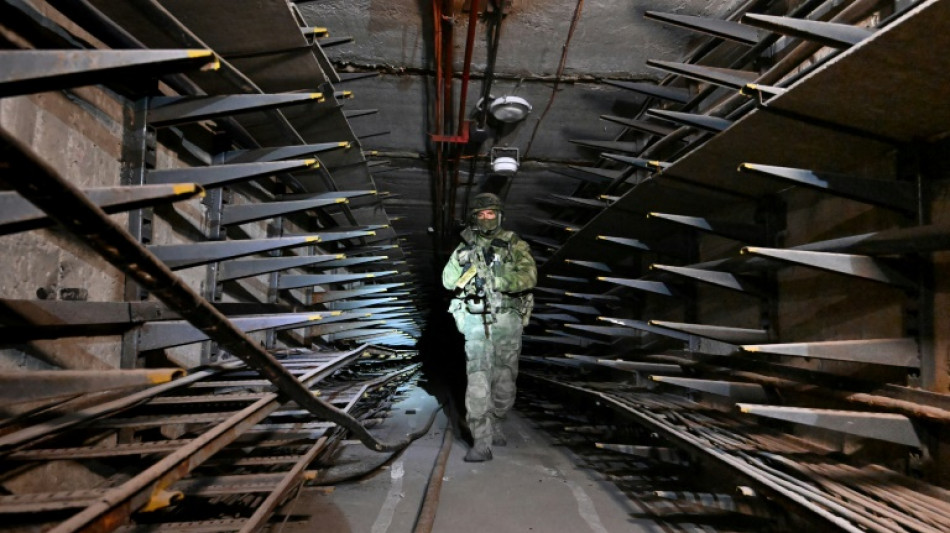
In the tunnels of Azovstal, traces of Ukraine's resistance / Photo: Yuri KADOBNOV - AFP

 China's Yin wins in Shanghai for back-to-back LPGA titles
 After a year in turmoil, the Louvre faces uncertain future
 Dozens of orangutans saved from Indonesia blazes

 Ordinary day, extraordinary times: Kyiv under Russian attack

 What is holding up the US-India trade deal?
 Oxygen tanks, purifier sales spike as haze crisis hits Southeast Asia
 Messi brace lifts Inter Miami to 3-1 win in Atlanta

 Japan to launch historic round-trip mission to Mars moon
 Musk back in the spotlight, but politics dims the awe

 England Rugby League World Cup hopes hang by a thread

 Williams lifts Valkyries past Dream in WNBA Finals opener

 Dubois destroys Wardley to retain WBO heavyweight crown
 Oregon families grapple with explaining school shooting to children
 Israeli settlers attack European diplomats, beat French mayor

 Town hall in Limoges 'largely lost' to blaze set during French protests

 US goes on the offensive in central Asia
 Emotional Lions come up short in Champions Cup as tributes paid to Andrews

 Diaz dazzles as Bayern batter Leipzig to go top

 Inter move clear at Serie A summit with Bologna win

 Liverpool still have 'lots to improve', says match-winner Isak
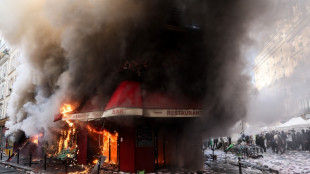
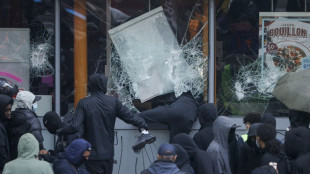 Looters ransack shops during France cost-of-living protests

 Leinster thump Clermont as grieving Lions set for Champions Cup debut

 Haaland stars in Man City win, Liverpool beat Brentford

 Dortmund go top despite Union Berlin stalemate
 Venezia upset Napoli for first Serie A win of season
Scrapped metal and concrete debris is all that remains of the Azovstal steel factory in Mariupol, a symbol of Ukraine's weeks-long resistance against the Russian army in the devastated port city.
The defenders of Mariupol made a last stand at Azovstal, taking shelter in a warren of underground tunnels beneath the steel plant before surrendering in May.
Now Russian soldiers and their separatist allies with white armbands patrol the ruins of the Soviet-era factory that was once the pride of Mariupol and employed more than 12,000 people.
AFP journalists were among the first reporters to go inside the bombed-out plant as part of a press tour organised by the Russian defence ministry.
Controlled explosions could be heard at regular intervals across the plant's vast territory as Russian soldiers carried out de-mining operations.
Reporters were taken down into the maze of tunnels where hundreds of Ukrainian defenders and civilians spent weeks holed up underground as the Russians bore down.
The Ukrainian troops finally surrendered in May, with President Volodymyr Zelensky saying the country needed its "heroes" alive.
The plant's network of tunnels and bunkers was built during the Cold War and designed to shield workers from a possible nuclear attack.
Inside one dark room, belongings and clothes look hastily abandoned, scrunched up on the floor and on the metal bunk beds with no mattresses.
Bullet casings lie scattered on the ground, while the tables are covered with bandages, cups, plates and photographs of soldiers, likely those who died in battle.
The organisers of the press tour said the rooms were occupied by fighters from the Azov regiment, a former paramilitary unit which has integrated into the Ukrainian armed forces.
Russia describes the regiment, which has previous links to far-right groups, as a neo-Nazi organisation.
On the walls of a staircase leading down into the tunnels, reporters could see graffiti resembling a "Black Sun", a Nazi symbol. It was not clear who drew it.
- Big role of fighter jets -
The fighters inside Azovstal withstood the attacks of the Russian army for over a month, while the rest of the city had already fallen under Moscow's control after a devastating siege.
Around 2,000 Ukrainian soldiers who surrendered to the Russian forces are believed to be in the custody of pro-Moscow separatists in eastern Ukraine, with Moscow insisting they should stand trial.
Ruslan, a pro-Moscow fighter who took part in the assault on Azovstal, praised the "big role" of fighter jets in the battle for the plant.
"I think that's why they surrendered," said the 34-year-old soldier with a salt-and-pepper beard who goes by the nickname "Wolf".
Originally from Transnistria, a pro-Russian separatist region in Moldova, Ruslan has been fighting in eastern Ukraine since 2014.
The Ukrainians were "trained, they felt comfortable here", he said.
"It was difficult for us because it was unfamiliar terrain and they had everything close at hand. In each room there were supplies of weapons, ammunition."
Another fighter, Andrei, said the tunnels also played a major role.
"It was convenient to hide there, defend themselves," said the 43-year-old, who hails from the region of Donetsk in eastern Ukraine.
The fighter also appeared to contradict the official Russian line that the majority of the "nationalist" fighters at the plant came from other regions.
"The people of Azov were 70 percent from Mariupol, locals," said the soldier who sported a scarf covering his face and wore a cap with the letter Z, a symbol of Russia's military intervention in Ukraine.
He said that because many were locals, they could "bring in" their families to shelter with them.
Hundreds of civilians, including women and children, had been evacuated from beneath Azovstal where they were sheltering with the soldiers.
Three months of fighting in Mariupol have sent hundreds of thousands of people running for their lives and caused untold suffering and death.
Those who stayed are now adjusting to a new life under Russian control.
Some told AFP their main difficulty was the lack of electricity and water.
M.AlAhmad--SF-PST