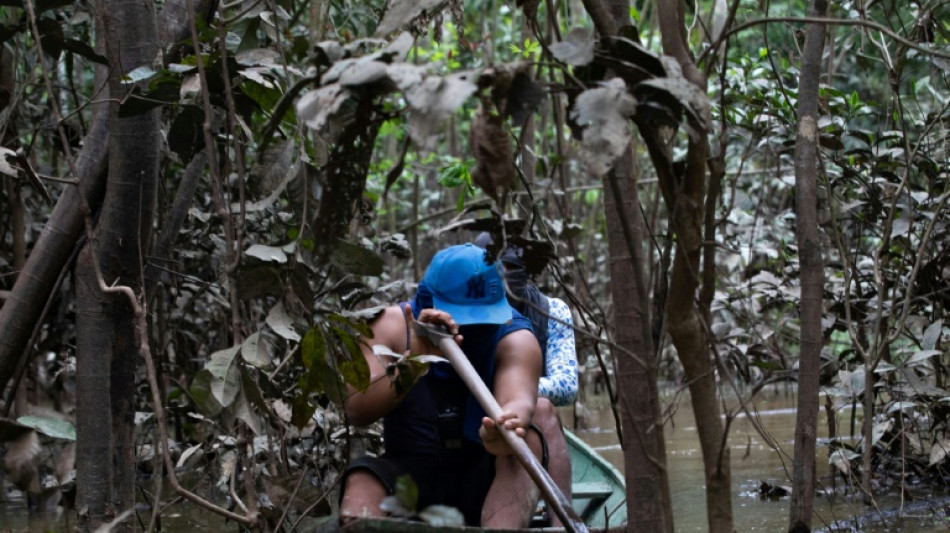
How Brazil's Javari Valley became a criminal haven / Photo: Joao LAET - AFP

 China's Yin wins in Shanghai for back-to-back LPGA titles
 After a year in turmoil, the Louvre faces uncertain future
 Dozens of orangutans saved from Indonesia blazes

 Ordinary day, extraordinary times: Kyiv under Russian attack
 What is holding up the US-India trade deal?

 Oxygen tanks, purifier sales spike as haze crisis hits Southeast Asia
 Messi brace lifts Inter Miami to 3-1 win in Atlanta

 Japan to launch historic round-trip mission to Mars moon

 Musk back in the spotlight, but politics dims the awe

 England Rugby League World Cup hopes hang by a thread

 Williams lifts Valkyries past Dream in WNBA Finals opener

 Dubois destroys Wardley to retain WBO heavyweight crown
 Oregon families grapple with explaining school shooting to children
 Israeli settlers attack European diplomats, beat French mayor

 Town hall in Limoges 'largely lost' to blaze set during French protests
 US goes on the offensive in central Asia
 Emotional Lions come up short in Champions Cup as tributes paid to Andrews

 Diaz dazzles as Bayern batter Leipzig to go top

 Inter move clear at Serie A summit with Bologna win

 Liverpool still have 'lots to improve', says match-winner Isak
 Looters ransack shops during France cost-of-living protests

 Leinster thump Clermont as grieving Lions set for Champions Cup debut

 Haaland stars in Man City win, Liverpool beat Brentford

 Dortmund go top despite Union Berlin stalemate
 Venezia upset Napoli for first Serie A win of season
The far-flung Amazon region where a British journalist and a Brazilian indigenous expert disappeared has become a haven for drug trafficking and environmental crimes because of increasing lawlessness and an absent state, experts say.
The Javari Valley, where veteran correspondent Dom Phillips and respected indigenous specialist Bruno Pereira disappeared on June 5, is one of the remotest places on Earth, a vast expanse of thick jungle in northwestern Brazil near the Peruvian and Colombian borders.
Phillips, 57, and Pereira, 41, were last seen boating up the Itaquai river just outside the Javari Valley Indigenous Reservation, a territory bigger than Austria that is home to an estimated 6,300 indigenous inhabitants, including 19 uncontacted tribes.
The region is suffering from a surge of criminal activity, blamed on drug gangs with links to other crimes including illegal fishing on indigenous lands -- something Pereira had long fought, making him a target of death threats.
The men's disappearance remains unsolved, but investigators have found their belongings and are analyzing suspected human remains, fueling fears they were murdered.
A suspect has been arrested.
Experts on the Javari Valley told AFP drug gangs and illegal mining, logging and poaching rings have capitalized on weaker enforcement by Brazilian authorities in recent years to expand their presence.
"What happened to Bruno and Dom is the result of an increase in organized crime, which is in turn explained by the absence of the state," said Antenor Vaz, head of Brazilian indigenous affairs agency FUNAI's operations in the region from 2006 to 2009.
- Attractive base -
The very things complicating the investigation are what make the region an attractive base for criminal operations.
The region is hard to reach, and harder to patrol: huge, remote, densely forested and criss-crossed by meandering rivers that flood the surrounding area for several months a year.
"By its very nature, the forest has always been an attractive space for drug traffickers, since they can camouflage drugs so easily," said Aiala Colares, a geographer and Amazon expert at the Federal University of Para.
Since the 1990s, drug gangs have used the region's rivers to ship cocaine and other drugs from Peru and Colombia, for both the Brazilian and international markets, he said.
That traffic has increased substantially over the past decade.
Drug gangs operating in the region are "multidimensional" outfits, with operations that also include illegal logging and fishing, Colares said.
The main group, "Os Crias," emerged in 2021 as a splinter from the Northern Family, one of the biggest criminal organizations in the Amazon basin.
They now dominate the triple border on the Brazilian side and the Javari trafficking routes, Colares said.
- Poverty, impunity -
The gangs feed off a long history of poverty and impunity in the region, now exacerbated by a power vacuum left by the state, said anthropologist Barbara Arisi of Vrije Universiteit in Amsterdam, a specialist in the indigenous peoples of the Javari Valley.
"A growing number of criminals, more and more organized and better-armed, are taking advantage of the lack of state structure," she said.
The gangs have even penetrated some indigenous groups, such as the Tikuna, she said.
Just like in big-city slums, "drug trafficking offers lots of young people a life they could never attain otherwise," she said.
Poverty has helped the gangs thrive.
The small city of Atalaia do Norte, the local outpost Phillips and Pereira were returning to, has the third-worst human development index in Brazil.
Enforcement operations by environmental authorities have meanwhile been reduced since President Jair Bolsonaro took office in 2019.
The far-right president, who has pushed to develop the Amazon -- "rich lands" with "poor Indians," in his words -- has also brought upheaval at FUNAI.
Since he replaced the indigenous affairs agency's leadership, many veteran officers have been forced out or quit.
That includes Pereira, the one-time head of FUNAI's Javari operations and its programs for isolated tribes, who was placed on administrative leave.
FUNAI's base in the area has meanwhile been a target of several shooting attacks in recent years.
In 2019, FUNAI's anti-logging and anti-poaching chief for the Javari Valley was shot dead in the city of Tabatinga.
The case remains unsolved.
M.AbuKhalil--SF-PST