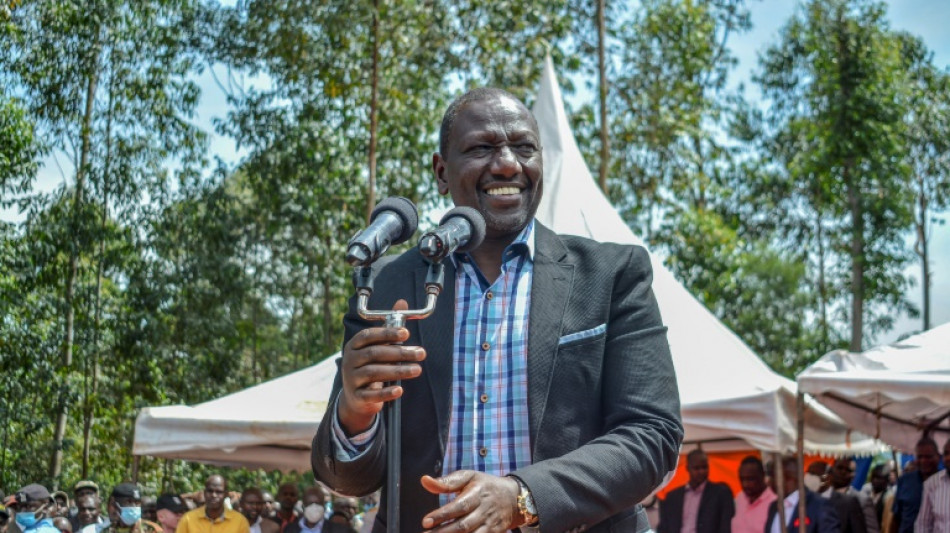
Kenya president still handing cash to churches despite his own ban / Photo: BRIAN ONGORO - AFP

 Two thirds of EU faced harmful ozone levels during heatwave: report
 Russia to take on World Athletics at CAS over ban
 600 dead in DR Congo Ebola outbreak

 'Total Eclipse' singer Bonnie Tyler, queen of the 80s power ballad, dies at 75
 Myanmar names Norwegian Andersen as head of national team
 Russell back as Scotland tackle world champions South Africa
 Tour de France yellow jersey protocol: 90 minutes of 'stress'

 Crude stabilises after US-Iran flare-up rocked peace hopes
 Playmaker Jalibert moves to fullback as France swing axe for Australia clash
 Australian sprint star Gout out of U20 worlds with hamstring tear
 Unions to protest as Volkswagen thrashes out job cut plans
 Teeth bared in Greece's bear-human showdown
 Alpacas, mini pigs on the loose after floods hit south China zoo
 All Blacks make five changes for Italy Nations Championship clash
 Western Europe records its hottest June as heatwaves surge: EU monitor
 Fashion's mystery man Margiela sells off his archives
 Nuclear test-scarred Marshall Islands criticises China missile

 Chip titan SK hynix to set price for mega US listing

 Crude extends rally as US-Iran flare-up rocks peace hopes

 Democrat accused of rape exits key US Senate race

 Japan student Ito keeps place against Ireland as Jones returns
 Belgium bid to crack Spain's ironclad defence in World Cup quarter-final
 US man sentenced after swapping 17th century manuscript
 US launches new strikes on Iran after Trump vows to hit 'hard'
 Taylor Swift fans pay $25 for garbage from outside wedding
Kenya's President William Ruto sparked protests recently after donating some $150,000 to a Nairobi church just months after saying such hand-outs fuelled corruption.
Ruto's pledge of 20 million shillings to the Jesus Winner Ministry Church led to protesters gathering there a week later, demanding the return of what they called "stolen tax money", only to be teargassed by police.
Church donations and fundraisers are a longstanding tradition in Kenya, and politicians often use pulpits to reach the masses in the predominantly Christian country.
It can become political theatre: last year, MP Oscar Sudi, a Ruto ally, drew cheers from the congregation when he delivered a sack containing three million shillings (around $20,000) to a church in Uasin Gishu county.
But the practice has become increasingly divisive since mass protests broke out last June against tax hikes, corruption and police brutality.
In the aftermath, Ruto banned government officials from participating in fundraising drives for churches.
"No state officer or public servant shall participate in public contributions or any harambees (fundraisers) going forward," he said in June.
"It is occasioning and it is breeding, if I may say, corruption," Ruto added.
But he appears to have forgotten his vow.
While police were teargassing youth outside the Jesus Winner Ministry Church, Ruto was at another church in the town of Eldoret, offering another 20 million shillings (around $150,000) and vowing to raise a further 100 million for Jesus Winner.
The president was defiant, dismissing critics of donations as "people who don't believe in God".
The government says the money comes from Ruto's personal funds but many are sceptical.
"Where is this money coming from? Bring us the receipts," said Mwabili Mwagodi, who has helped organise the "Occupy Church" movement which aims to "disconnect the church from politics".
The movement gained momentum last year after the church stayed silent during protests.
Preachers were ultimately forced to break that silence after activists organised flash mobs during services in Nairobi.
The Catholic Church of Kenya rejected a donation from Ruto after Mwagodi shared preachers' contact details online and organised a barrage of complaints.
"I am fighting to liberate the Church from political corruption in Kenya," Mwagodi posted on X.
- Money laundering -
A group of clergy has defended Ruto's donation, calling it a "Godly idea".
Catherine Njoroge, a worshipper at Jesus Winner told AFP: "He is filthy rich and can afford it."
The church leaders refused multiple requests to speak with AFP, and the premises were guarded by seven armed police officers on a visit this week.
Critics accuse the government of illegally diverting public funds to churches to win voters and fear the donations could be used for money laundering.
"Some churches use their huge congregations and platforms for purposes of giving politicians political capital," said Nairobi-based lawyer Javas Bigambo.
"It has been encouraging corruption," he told AFP.
The president himself used to agree, and last year introduced the Public Fundraising Appeals Bill -- still pending -- to enhance transparency, though it exempted funds raised by religious bodies.
His office insists the ban on fundraisers by politicians is still in effect, even though several Ruto allies have since publicly participated in them.
Spokesman Emmanuel Talam said Ruto's recent donation was a "personal contribution" but did not explain how this was different from fundraising.
- Selling voters -
In election years, Kenyan politicians flock to churches and give political speeches from the pulpit.
Some Christian politicians will even start praying in mosques on the campaign trail.
Reverend Timothy Njoya, a renowned Nairobi preacher, condemns the practice.
Njoya campaigned for political and social justice during the authoritarian rule of Kenya's second president, Daniel arap Moi (1978-2002), and bears the scars from beatings he received at protests.
He told AFP that donations by politicians have turned churches into "graveyards of spiritualism" and that preachers who accept the cash "are selling their members for votes".
Now retired, Njoya did not stand for such behaviour in his time.
"Politicians came to my church but they did not have the platform. I was the one preaching, not them. It was not their platform, it was God's platform," he said.
The National Council of Churches of Kenya recently barred politicians from addressing congregations or announcing monetary contributions from the pulpit.
But a defiant Ruto has insisted he will continue to "build churches".
L.AbuAli--SF-PST