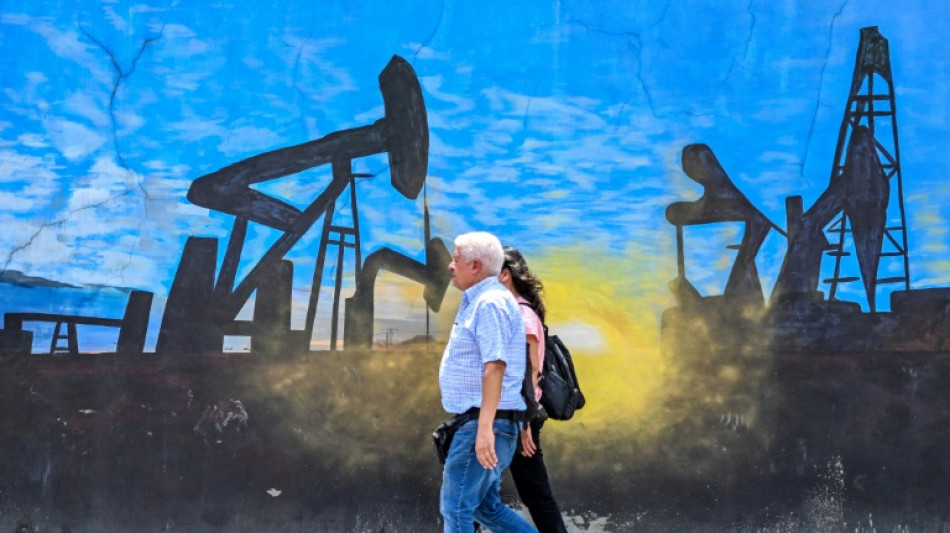
What next for Venezuela as Trump goes after oil revenues? / Photo: Juan BARRETO - AFP

 Two thirds of EU faced harmful ozone levels during heatwave: report
 Russia to take on World Athletics at CAS over ban
 600 dead in DR Congo Ebola outbreak
 'Total Eclipse' singer Bonnie Tyler, queen of the 80s power ballad, dies at 75

 Myanmar names Norwegian Andersen as head of national team
 Russell back as Scotland tackle world champions South Africa
 Tour de France yellow jersey protocol: 90 minutes of 'stress'

 Crude stabilises after US-Iran flare-up rocked peace hopes

 Playmaker Jalibert moves to fullback as France swing axe for Australia clash
 Australian sprint star Gout out of U20 worlds with hamstring tear

 Unions to protest as Volkswagen thrashes out job cut plans
 Teeth bared in Greece's bear-human showdown
 Alpacas, mini pigs on the loose after floods hit south China zoo
 All Blacks make five changes for Italy Nations Championship clash

 Western Europe records its hottest June as heatwaves surge: EU monitor
 Fashion's mystery man Margiela sells off his archives
 Nuclear test-scarred Marshall Islands criticises China missile
 Chip titan SK hynix to set price for mega US listing

 Crude extends rally as US-Iran flare-up rocks peace hopes
 Democrat accused of rape exits key US Senate race

 Japan student Ito keeps place against Ireland as Jones returns

 Belgium bid to crack Spain's ironclad defence in World Cup quarter-final
 US man sentenced after swapping 17th century manuscript

 US launches new strikes on Iran after Trump vows to hit 'hard'
 Taylor Swift fans pay $25 for garbage from outside wedding
President Donald Trump has revoked the licenses that allowed several transnational oil and gas companies to operate in Venezuela despite the country being under US sanctions.
After US energy giant Chevron, Washington has ordered a handful of other energy firms, including Spain's Repsol and France's Maurel & Prom, to cease operating in Venezuela.
Trump, who is seeking to force out authoritarian President Nicolas Maduro, has also announced plans for 25 percent tariffs on imports from any country buying Venezuelan oil and gas.
What's next for the struggling Caribbean country, which has the world's largest-known oil reserves but has become increasingly isolated since July 2024 elections that President Nicolas Maduro is accused of stealing?
- Will the oil stop flowing? -
In 2019, during his first term in office, Trump imposed an embargo on Venezuelan oil in response to 2018 elections that were already marred by fraud allegations.
Venezuela's state-owned PDVSA oil giant was in freefall at the time, beset by corruption scandals, mismanagement and a crippling lack of investment.
Oil output buckled under the weight of the sanctions, falling from around three million barrels per day at the start of the 2000s to below 400,000 b/d in 2020.
The sector recovered some ground after former US president Joe Biden in 2022 eased the sanctions in return for a promise by Maduro to allow fair elections.
Biden later reimposed most sanctions when it became clear that Maduro was not keeping his side of the bargain, but allowed Chevron to continue operations.
Today, Venezuela produces around 900,000 barrels per day of which Chevron contributes about 220,000, Repsol about 60,000, and Maurel & Prom between 20,000 and 25,000.
Washington has given Chevron and the other companies until May 27 to wind up their operations.
"PDVSA ...now has some operational capacity, although we don't know how big it is," Gilberto Morillo, PDVSA's former financial manager told AFP.
- Who will buy it? -
Even if PDVSA manages to keep pumping oil, finding a way to monetize it "is another matter," Morillo said, pointing to the threatened 25-percent US tariffs on countries that buy its crude.
In February, Venezuela exported approximately 500,000 barrels per day to China, 240,000 to the United States, and 70,000 to India and Spain.
In the past, sanctions forced PDVSA to discount the oil and to find partners to circumvent the sanctions.
Caracas also attempted to trade crude oil through a cryptocurrency scheme, which ended with then oil minister Tareck El Aissami being jailed for corruption in a case that cost the country more than $15 billion, according to media reports.
- What impact for the economy? -
The situation looks set to pile further misery on an economy already in tatters.
The price of dollars has soared on the black market as Venezuelans fear falling oil revenue will trigger another bout of hyperinflation and a return to the kind of deep recession the country experienced between 2014 and 2021.
The forced pullout of gas producers could also have an impact on the country's crumbling energy infrastructure, leading to more blackouts.
Repsol pointed out that 85 percent of its operations in Venezuela were related to the production of natural gas, which it warned "supports part of the electricity network."
The cancellation of the licenses will prevent PDVSA from using oil to pay the foreign energy companies for gas, as it had been doing, Morillo explained.
"If PDVSA can't pay them, then it generates a debt," he said.
But if the energy firms decide "ok, we'll close down and leave...they would lose their entire investment," he argued.
A.AlHaj--SF-PST