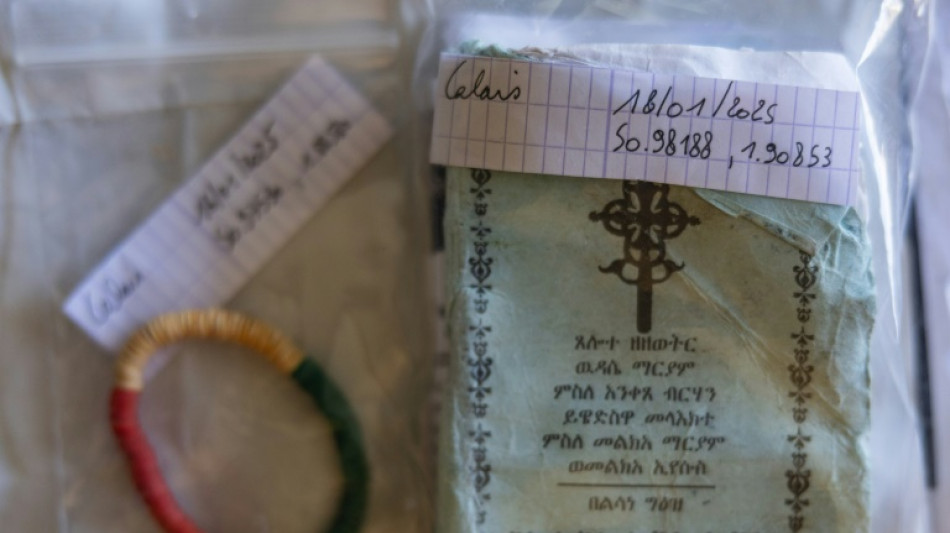
Beachcomber in France hunts fragments of migrant lives / Photo: Sameer Al-DOUMY - AFP

 Two thirds of EU faced harmful ozone levels during heatwave: report

 Russia to take on World Athletics at CAS over ban

 600 dead in DR Congo Ebola outbreak

 'Total Eclipse' singer Bonnie Tyler, queen of the 80s power ballad, dies at 75

 Myanmar names Norwegian Andersen as head of national team

 Russell back as Scotland tackle world champions South Africa
 Tour de France yellow jersey protocol: 90 minutes of 'stress'

 Crude stabilises after US-Iran flare-up rocked peace hopes

 Playmaker Jalibert moves to fullback as France swing axe for Australia clash
 Australian sprint star Gout out of U20 worlds with hamstring tear

 Unions to protest as Volkswagen thrashes out job cut plans

 Teeth bared in Greece's bear-human showdown

 Alpacas, mini pigs on the loose after floods hit south China zoo
 All Blacks make five changes for Italy Nations Championship clash

 Western Europe records its hottest June as heatwaves surge: EU monitor
 Fashion's mystery man Margiela sells off his archives

 Nuclear test-scarred Marshall Islands criticises China missile

 Chip titan SK hynix to set price for mega US listing

 Crude extends rally as US-Iran flare-up rocks peace hopes
 Democrat accused of rape exits key US Senate race

 Japan student Ito keeps place against Ireland as Jones returns

 Belgium bid to crack Spain's ironclad defence in World Cup quarter-final

 US man sentenced after swapping 17th century manuscript

 US launches new strikes on Iran after Trump vows to hit 'hard'

 Taylor Swift fans pay $25 for garbage from outside wedding

The sand-covered notes outlining a migrant's travel plan to a better life read like an itinerary of hope: from Ethiopia to Sudan, Libya, Italy, on to France and finally, England.
The document had travelled thousands of kilometres by the time it was picked up on a beach in Gravelines on France's North Sea coast by a Belgian who likes to scour the beach in search of interesting things to collect.
Aaron Fabrice de Kisangani, 27, who calls himself a "beachcomber" and a "citizen scientist", carefully unfolded the piece of paper that was soaked, dirty and covered in sand fleas, hoping for clues to the owner's life.
The item is one of many objects migrants leave behind when they board one of the small boats they hope will carry them to the English coast. Sometimes they lose things in the hurry, and sometimes they throw them away deliberately, to travel light.
This is how shoes, clothes, bags and documents belonging to migrants end up strewn on northern French beaches, along with things left by fishermen and visitors.
Over the past two decades, Fabrice de Kisangani has made some unusual finds, including exotic plant seeds and shark teeth. He never used to pay attention to objects left by migrants, until about a year ago.
"I started to think, why don't I take them, because otherwise they will be lost," he told AFP.
The written notes he found probably belonged to an Ethiopian woman called Rose I., at least that is the name scribbled at the top of the page.
Rose meticulously listed cities, journey times and means of transport, drawing arrows between each entry.
The itinerary starts with "A.A." for Addis Ababa, the Ethiopian capital. Eight hundred kilometres (500 miles) and 17 hours by car later comes Metema, on the Sudanese border. "Ten minutes on foot", Rose predicted, would take her to Gallabat on the other side.
- 'Humanise those people again' -
Then on to Khartoum, the capital of Sudan, followed by thousands of kilometres across sand, marked simply as "desert", to Tripoli, in Libya.
Next came the voyage across the sea to Italy, followed by a train journey to France. And then, at last, the final destination: "UK".
Fabrice de Kisangani found many other fragments of exile life during his morning search: a summons for a March 18 expulsion hearing for an Albanian in detention, or tickets from the Romanian capital Bucharest by plane to Paris, and then by train to Dunkerque in northern France.
These objects could help "humanise those people again", because they tell "their story", said Fabrice de Kisangani.
"I want to show the problem from another angle, as a beachcomber," he said, admitting however that he has not worked out yet what exactly to do with the objects.
But in the meantime, the finds taught him "a lot" about the migrants, "about how they travel and how fast", the beachcomber said, adding he often does research to find out more about their home countries and "why they are fleeing to the UK".
Walking back to his car, Fabrice de Kisangani saw a scene playing out in the distance that has become commonplace around here: dozens of migrants emerging from the dunes and running towards a boat waiting in the water. At first they were stopped by police but, in another attempt a few minutes later, most managed to climb aboard.
A child could be heard crying. A man, one of three members of a family who didn't make it, urged his mother to climb back off the boat, without success.
Such existential scenes, illustrating the undertaking's fragility, are never documented in the objects jettisoned on the beach. The final pieces of the puzzle remain elusive.
Did Rose, the travel plan author, ever make it to England? Did she stick to her itinerary?
On this, the notes are silent.
H.Jarrar--SF-PST