
Guinea ex-dictator sentenced for 2009 massacre pardoned: junta / Photo: SEYLLOU DIALLO - AFP

 Rene Eyre Revisits Autobiographical Performance 'Say A Little Prayer' in London

 UAE's HCT Holds Record Graduation and Announces Major Training Expansion

 NASA Awards $10B Lunar Contract Framework to SpaceX, Blue Origin

 Katy Perry Tells Fans Ex-Husband Russell Brand 'Should Be in Jail' During UK Concert

 South African election results renew debate over identity-based voting

 South African voters report smoother local election but declining IEC trust

 Dolly Parton museum and Nashville hotel open after singer’s death

 George and Amal Clooney attend New York political-comedy reading
 British buyers pay substantial premiums for period-home appearance

 Thomas Markle released to house arrest after child-abuse-image charge

 Dawn of War 4 developers chose Adeptus Mechanicus for tactical variety
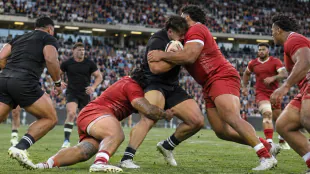
 Italy face unbeaten South Africa in Turin Nations Championship match

Guinea's ex-dictator Moussa Dadis Camara, who was sentenced to 20 years in prison over a 2009 massacre, was pardoned Friday for "health reasons" by the West African country's junta head, according to a decree read out on national television.
"Upon the proposal of the Minister of Justice, a presidential pardon is granted to Mr. Moussa Dadis Camara for health reasons," said the decree, read out on television by presidential spokesperson General Amara Camara late Friday.
Following a landmark trial, a court found Dadis Camara guilty of crimes against humanity last July and sentenced him to 20 years behind bars over what is considered one of the darkest pages of Guinea's history.
On September 28, 2009, at least 156 people were killed by gunfire, knives, machetes, or bayonets in a massacre at an opposition rally, according to a UN-mandated international commission of inquiry.
Hundreds more were wounded and at least 109 women were raped.
The abuses continued for several days against women who were held captive, and detainees were tortured.
Only 57 bodies out of at least 156 were recovered, according to families and human rights organisations, and the toll is believed to be far higher.
Dadis Camara was found guilty "on the basis of superior responsibility", a judge said, and was also guilty of "his intention to suppress the demonstration" and for failing to punish the perpetrators of the massacre.
Seven other people were also sentenced to prison terms of up to life imprisonment for their role in the massacre.
The Office of the Prosecutor of the International Criminal Court (ICC) had welcomed the verdict, calling it a "landmark moment in establishing the truth... and bringing to account those bearing the greatest responsibility for the atrocities committed".
Dadis Camara's pardon came after the junta's head General Mamadi Doumbouya announced Wednesday that the compensation costs for the victims of the September 28, 2009, incident would be covered.
The junta would implement the reparations ordered by the judge for the victims, ranging from 200 million Guinean francs ($23,100) to 1.5 billion Guinean francs ($173,300), depending on the case.
The junta, which came to power through a coup in 2021, had allowed this historic trial to take place.
This week's decrees come amid severe restrictions on freedoms in Guinea.
Many opponents of the junta have disappeared or are being questioned by the courts, demonstrations demanding the departure of the military are regularly banned, and several media outlets have been closed across the country.
D.Qudsi--SF-PST