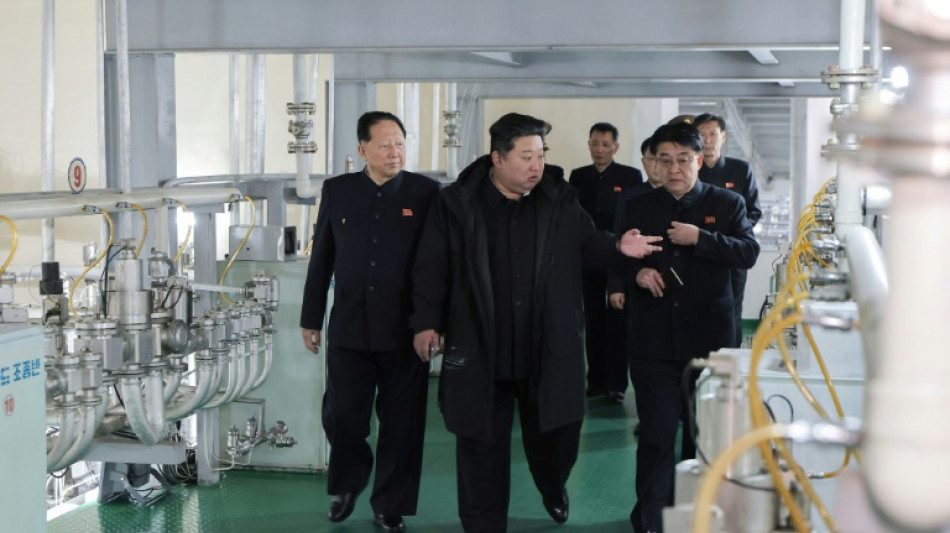
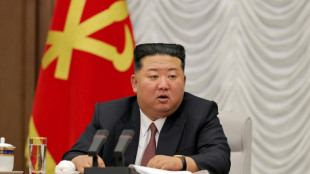
Trump prompts US allies to reopen nuclear weapons debate / Photo: STR - KCNA VIA KNS/AFP

 Hundreds welcome Salah's Egypt home after best World Cup run
 Piercing, matcha rituals lead Noskova in Kvitova's footsteps

 France wildfires burn twice as much land as last year: official

 Mandhana's fifty lights up inaugural women's Test at Lord's

 England World Cup winner Stiles died with brain injury, court told
 Stocks rise as SK hynix boosts AI trade

 England bowl against India in historic first women's Test at Lord's
 Eleven dead, 19 missing as wildfire roars through southern Spain
 EU tells Meta to change Facebook, Instagram's 'addictive design'

 EasyJet accepts rival takeover bid from US investor Apollo

 UK schools, mentors team up to rescue 'lost boys' with football

 India's choked pavements fail pedestrians
 It's coming home: Bayeux tapestry arrives in London in overnight operation

 Pacific Islands reject missile test in 'blue continent'
 Wallabies skipper Wilson has full faith in rookie flyhalf

 Landslide kills five in Philippines as biggest typhoon in decades nears Taiwan
 Modi visits New Zealand as trade deal sparks India pushback
 Bayeux Tapestry to arrive in London after epic journey from France
 Syria authorities say captured IS-linked cell behind blasts
 Table for one: how Japan's 'Solitary Gourmet' became a TV hit

 Australia's Big Bash League to open season in India

 Disappointment at Morocco's World Cup exit cannot mask pride
 In gas-rich Kazakhstan, many rely on lethal cylinders

 Chip titan SK hynix raises $26.5 bn in blockbuster US listing

 Venezuela quake tragedy threatens to set back democratic transition

Donald Trump's attacks on NATO and the established world order are undermining the confidence of its allies under the US security umbrella, fuelling fears of an eventual proliferation of nuclear weapons, experts told AFP.
Since his return to power in January, the US president has criticised the transatlantic alliance, reopened direct dialogue with Russia and flattered North Korea's Kim Jong-Un with warm words.
Trump's "provocative and inconsistent rhetoric", said Byong-Chul Lee, from the Institute of Far Eastern Studies at Kyungnam University, Seoul, has left allies' trust in the US deterrence "deeply shaken".
In recent times, the risk of nuclear proliferation has come from states such as North Korea or Iran but non-nuclear armed allies of Washington seem to want to now re-open the debate.
"We're seeing more and more friendly proliferator" speeches in Europe and Asia, even if they seem primarily aimed at putting pressure on Washington, said Heloise Fayet, a proliferation specialist at the French Institute of International Relations (ifri)
Artur Kacprzyk, an analyst at the Polish Institute of International Affairs, agreed.
"Policies of the new US administration increase the risk of nuclear proliferation by allies, although it is not a foregone conclusion, yet," he said.
The lack of confidence could not have come at a worse time, said Syed Ali Zia Jaffery, from the Center for Security, Strategy and Policy Research at the University of Lahore in Pakistan.
"The overall international security environment is deteriorating. We see raging conflicts in Europe and the Middle East. We also see a crisis-prone environment in South Asia," he added.
"And there are no reliable mechanisms in place to resolve those conflicts."
- Butt of the joke -
Other than the fear of being left high and dry in the event of attack, Washington's allies are concerned about Trump wanting to revive talks on arms control with Moscow and Beijing.
"The butt of the joke of an eventual agreement will very likely be Europeans and the United States' allies in Asia," said Fayet.
Jaffery said a lack of assurances from the United States makes it more likely that its allies could start looking at other options, including nuclear.
"Countries that are likely to face territorial aggression from nuclear-armed states would mull over having their own nuclear deterrents," he said.
Currently, only the US, Russia, China, France, the United Kingdom, Pakistan, India, Israel and North Korea are nuclear-armed powers.
Lee said that South Korea was arguably the "most likely" US ally to consider acquiring nuclear weapons given its proximity to North Korea.
"Public support for nuclearisation has remained consistently strong," he pointed out.
"However, South Korean elites remain wary of the strategic instability, diplomatic backlash and potential international sanctions that would follow a nuclear breakout."
In Europe, French President Emmanuel Macron has recommended discussion about extending France's deterrence to other European nations.
Poland is on the front line although Polish Prime Minister Donald Tusk has not announced a national nuclear military programme.
But Kacprzyk said: "He has not, nonetheless, excluded pursuing nuclear weapons in the future while noting it would be a long and challenging process."
- Multiple obstacles -
Proliferation is unlikely to come overnight, the analysts said.
US allies are linked by the 1968 Treaty on the Non-Proliferation of Nuclear Weapons -- the cornerstone of the global nuclear architecture.
It is possible to withdraw from it, although only North Korea has done so.
But Fayet said there are "regulatory, financial and technical constraints", and non-nuclear European countries are less advanced than South Korea or Japan.
Any military nuclear programmes could see rival nations attempt to hobble development.
In Europe, said Kacprzyk, "there's also the risk that Russia would try to derail such programmes, even by striking nuclear facilities", as Israel did against the Osirak reactor in Iraq in the 1980s.
Despite the obstacles, Jaffery said that "most of these countries have nuclear latency and when you have the capability and strategic need to develop a nuclear programme, you're more likely to succeed".
"Pakistan has demonstrated it's hard to impede a country committed to building nuclear weapons."
Another uncertainty is how the Trump administration would react to an about-turn from its allies.
"In practice, South Korea would not be able to go nuclear without at least tacit approval from Washington," said Lee.
"In the past, the US dealt with the risk of nuclear proliferation among allies by both exercising pressure and offering additional reassurance," said Kacprzyk.
"For example, it halted plans to cut its conventional troops in South Korea in the 1970s."
The War on the Rocks defence site said non-proliferation to both friendly and hostile nations has been a "core bipartisan pillar" of US foreign policy for decades.
But if that changes, "nuclear proliferation will haunt 'America First'", researchers Ankit Panda, Vipin Narang and Pranay Vaddi warned.
X.Habash--SF-PST