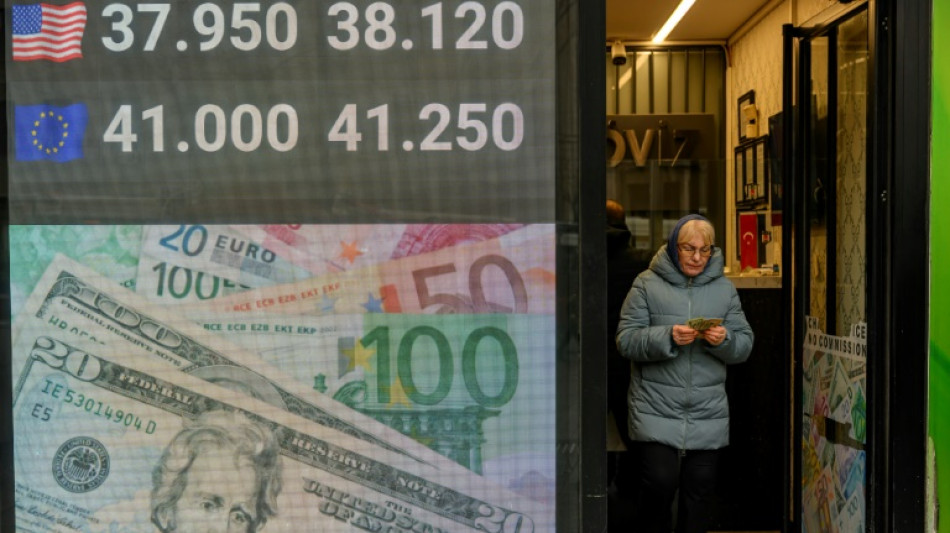
Crackdown on opposition tips Turkey into financial turbulence / Photo: Yasin AKGUL - AFP

 الأصدقاء الخياليون: كيف تعزز الكائنات غير المرئية القدرات العقلية للأطفال والبالغين

 London Museum Granted 24/7 License Ahead of November Opening

 Dana White Confirms Flight to Washington for Trump Meeting on Press Secretary Role

 Dengue Fever Expands Into High Himalayas as Climate Change Warms Nepal

 IoT Refrigerator Hacks Disrupt Blood Labs and Supermarkets Across Europe and US
 Post-election pressures complicate US and Israeli decisions on Iran
 UN members approve talks on treaty protocol against environmental crime

 Family-run West Sussex beach café prepares for first winter season

 CT scans reveal health and burial clues from Egypt’s Braided Lady mummy

 Oxford faces complaints over lecturer’s classroom attire
The arrest of Turkish President Recep Tayyip Erdogan's leading political opponent has sparked a financial firestorm and thrust the hardline leader's economic policies under scrutiny.
The stock market has plunged, the lira has plummeted and economists warn the ensuing panic will drive Turkey's sharp inflation rate back up just as it had started to rein it in.
The arrest of Istanbul's mayor Ekrem Imamoglu on March 19 in a graft and terror probe sparked fierce street clashes that have since seen more than 1,000 others detained.
"Erdogan started a new economic fire and turned the markets upside down," economist Mustafa Sonmez told AFP.
- Stock markets fall -
Turkey's BIST stock index fell 8.7 percent on the day of Imamoglu's arrest and 7.8 percent two days later, down more than 16 percent in a week -- its sharpest decline since the early days of the great world economic crisis in 2008.
It recovered by nearly three percent on Monday, remaining down more than 14 percent on the week overall.
Protests continued and European powers branded the arrest an affront to democracy.
The country's state-controlled financial authority tweaked its trading rules in a bid to stabilise the markets.
- Currency plunges -
The Turkish lira plunged, prompting the central bank to step in. Economists say it spent more than $20 billion buying up lira to try to prop up its value.
Despite this, the lira remained around its historic low of 38 to the dollar on Monday.
"The central bank and government is trying to calm the market and to limit volatility," said Emre Akcakmak, a portfolio advisor at investment group East Capital.
"It's very difficult to attract longer-term strategic foreign investors to Turkey in this kind of environment where even locals don't have a full understanding of what's happening."
- Inflation trap -
The lira's plunge raised fears that Turkey would falter in its recent fight against surging inflation, which has sharply driven up the cost of household items.
The inflation rate reached 85 percent in late 2022.
Erdogan, a conservative from the Islamist-rooted AKP party, had previously voiced the unorthodox view that raising interest rates drives up inflation -- rather than lowering it, as central bankers typically aim to do through rate hikes. Turkey nevertheless resorted to raising rates in 2023.
Inflation was hauled under 40 percent last month for the first time in two years and authorities were aiming to bring it below 24 percent by the end of this year.
"At times like these, those who have money run to foreign currencies, gold and real estate as a haven, and that feeds inflation," warned Sonmez.
- Investment worries -
The chaos caused by Imamoglu's arrest, along with the recent prosecution of two senior businessmen critical of the authorities, poses a challenge for Economy Minister Mehmet Simsek.
He has spent two years trying to draw back investors who had turned away from Turkey due to political tensions and Erdogan's unorthodox monetary policy.
"It was never an easy task for Simsek. It was always mission impossible -- and now this is just one more bump on his way," said Akcakmak.
"It's very difficult to attract longer-term strategic foreign investors to Turkey in this kind of environment where even locals don't have a full understanding of what's happening."
- Pressure on minister -
Simsek, a former economist of US bank Merrill Lynch, was forced on Sunday to deny opposition claims that he was going to resign.
"We are working on this and we will continue to take all measures necessary for the correct functioning of the markets," the minister wrote on X.
"I beg you not to believe false news."
Erdogan threw his full support behind Simsek on Monday.
K.AbuTaha--SF-PST