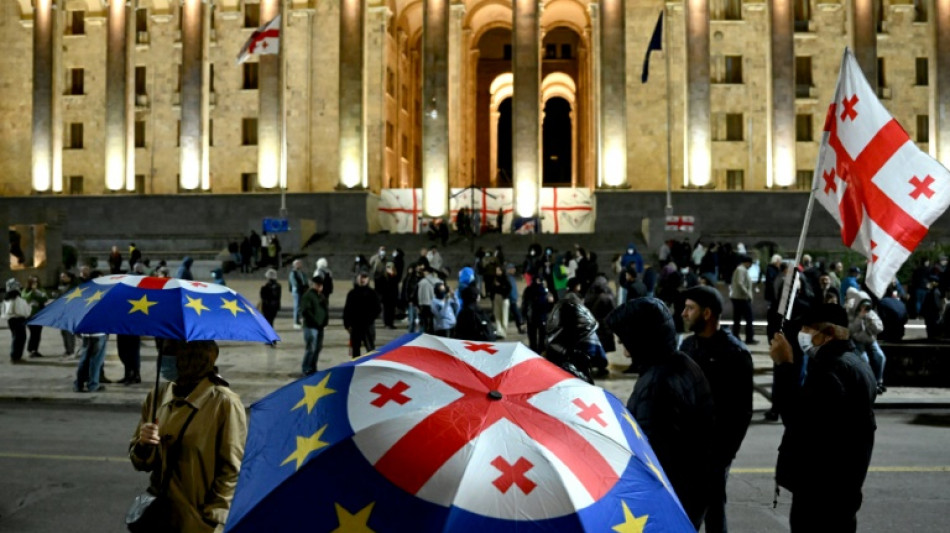
Georgia cracks down on pro-EU protests with crippling fines / Photo: Vano SHLAMOV - AFP

 Marquez snatches San Marino MotoGP sprint ahead of Bezzecchi
 Philippine ferry fire death toll climbs to 76 as identification process begins
 BRICS nations urge 'maximum restraint' in Middle East war
 Zelensky open to meeting Putin at G20 in Miami
 England survive scare to seal 3-0 sweep against Pakistan

 Trump says Irish unification would be 'fantastic'
 Bodies of Philippines ferry fire victims brought ashore as toll hits 35
 Flick warns Barca stars to keep focus after perfect start

 Trump in Ireland for golf tournament, diplomatic pleasantries

 French police suspect train derailment was sabotage

 Trump lands in Ireland for golf tournament, PM talks

 Xi lands in India for BRICS summit overshadowed by war

 From crime to the Arctic: ultramarathoner film debuts in Toronto

 Back to the drawing board for disappointed Tiafoe

 Lady Gaga welcomes first child with fiance: US media

 Shelton tops Tiafoe to book US Open title clash with Zverev

 Shelton powers past Tiafoe to book US Open title clash with Zverev

 Venice Film Festival: A look back on the highlights

 'Widow's Bay' and 'The Pitt' are favorites for Emmys night

 'Everything different' as Zverev returns to US Open final

 Top seed Zverev holds off Khachanov to reach US Open final

 James McAvoy brings new film 'Faith' to Toronto fest

 Faultless Duplantis, hungry Ingebrigtsen shine at inaugural Ultimate

 Roblox to launch wallet to pay creators faster and will allow off-platform gaming

 Springboks wary of new-look All Blacks in Baltimore test

Nadim Khmaladze has been joining thousands of fellow Georgians on the streets every evening since November, when Tbilisi's increasingly repressive government shelved EU membership talks.
The 60-year-old rights activist said he was "ready to face police violence" when he first joined the anti-government rallies in Tbilisi, but he never imagined that standing on the street for a few hours could cost him more than 22 months' salary.
Three months into the protests, he received a summons: a total of 45,000 lari (around $16,000) in fines for briefly blocking traffic along Tbilisi's central avenue.
"The government is using Russian-style methods to abolish freedom of assembly in Georgia," he told AFP.
Khmaladze is one of thousands of Georgian protesters facing crippling fines for taking to the streets.
Prominent writer Mikheil Tsikhelashvili, who returned to Georgia last year from emigration in Portugal to fight against the ruling Georgian Dream party's "pro-Russian policies," has been attending protests daily.
He says he and his girlfriend were each fined the equivalent of $1,850, in what he called a "financial terror aimed at extinguishing popular anger."
"I took the case to court," he said, adding however that he had "little hope in Georgia's justice system, which is fully controlled by the ruling party."
- Unprecedented protests -
Braving bitter frost, protesters continue to rally daily in Tbilisi and cities across the Black Sea nation, in what has become an unprecedented protest movement against Georgian Dream's perceived democratic backsliding and growing rapprochement with Moscow.
The mass protests first erupted following disputed parliamentary elections in October, which the opposition rejected as rigged in favour of Georgian Dream.
The movement intensified after Prime Minister Irakli Kobakhidze's November 28 announcement that his cabinet would not seek to open EU membership talks with Brussels until 2028 -- a move that shocked many.
Georgia is an official candidate for membership in the 27-nation bloc, a bid supported by more than 80 percent of the population, according to opinion polls, and enshrined in the country's constitution.
During the protests' initial phase, security forces used tear gas and water cannons to disperse demonstrators and made hundreds of arrests.
Georgia's top human rights official, ombudsman Levan Ioseliani, and Amnesty International have accused police of "torturing" detainees -- a charge the government denies.
Authorities have since resorted to harsh financial penalties and increased surveillance, deploying facial recognition technology to identify protesters and issue hefty fines.
- 'Slowly strangling' -
"After the bare violence proved ineffective, the government turned to intimidation -- televised police raids on activists' homes and anonymous threats over the phone," Salome Khvadagiani, the director of Liberty Institute rights group, told AFP.
"When that too failed to suppress the protest, the government moved to slowly strangling them -- financially," she added.
In December, fines for blocking roads were increased tenfold, to 5,000 laris ($1,850), leaving thousands facing "absolutely disproportionate financial sanctions" or, alternatively, 15 days in prison.
In January alone, the total amount of fines surpassed $6.5 million in the country of four million people, where the average monthly salary is some $740, according to the For Georgia opposition party.
The interior ministry said it only issues fines "when the number of demonstrators doesn't justify blocking the road" and a rally can be held without disrupting traffic.
To enforce these measures, authorities have expanded surveillance capabilities, including the deployment of facial recognition technology.
Rights groups said the government has drastically increased the number of high-resolution surveillance cameras in the streets of Tbilisi.
The widespread use of "facial recognition and remote biometric recognition technologies facilitates discriminatory targeted surveillance," said GYLA rights watchdog. "These practices undermine fundamental rights."
- 'We will never back down' -
In 2021, Amnesty International, along with several other international rights groups, called for "an outright ban on uses of facial recognition and remote biometric recognition technologies that enable mass surveillance and discriminatory targeted surveillance."
Khvadagiani of the Liberty Institute said the "campaign of mass and disproportional financial sanction has caused protests turnout to dwindle significantly over the last month."
But demonstrators are now "adapting to the situation" she said, filing court complaints that have overwhelmed the judicial system, "significantly delaying the enforcement of financial sanctions or even making them unenforceable."
"The government can't scare us," said Khmaladze, who fought for nearly two years on Ukraine's frontlines against invading Russian troops.
"We are taking to the streets for Georgia's democracy and will never back down," he said.
H.Darwish--SF-PST