Russian drones and glide bombs stretch Ukraine front / Photo: Tetiana DZHAFAROVA - AFP

 Marquez snatches San Marino MotoGP sprint ahead of Bezzecchi
 Philippine ferry fire death toll climbs to 76 as identification process begins

 BRICS nations urge 'maximum restraint' in Middle East war

 Zelensky open to meeting Putin at G20 in Miami

 England survive scare to seal 3-0 sweep against Pakistan

 Trump says Irish unification would be 'fantastic'

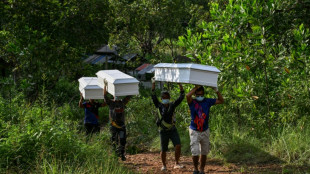 Bodies of Philippines ferry fire victims brought ashore as toll hits 35

 Flick warns Barca stars to keep focus after perfect start

 Trump in Ireland for golf tournament, diplomatic pleasantries

 French police suspect train derailment was sabotage

 Trump lands in Ireland for golf tournament, PM talks

 Xi lands in India for BRICS summit overshadowed by war

 From crime to the Arctic: ultramarathoner film debuts in Toronto

 Back to the drawing board for disappointed Tiafoe

 Lady Gaga welcomes first child with fiance: US media

 Shelton tops Tiafoe to book US Open title clash with Zverev

 Shelton powers past Tiafoe to book US Open title clash with Zverev

 Venice Film Festival: A look back on the highlights

 'Widow's Bay' and 'The Pitt' are favorites for Emmys night

 'Everything different' as Zverev returns to US Open final

 Top seed Zverev holds off Khachanov to reach US Open final

 James McAvoy brings new film 'Faith' to Toronto fest

 Faultless Duplantis, hungry Ingebrigtsen shine at inaugural Ultimate

 Roblox to launch wallet to pay creators faster and will allow off-platform gaming

 Springboks wary of new-look All Blacks in Baltimore test

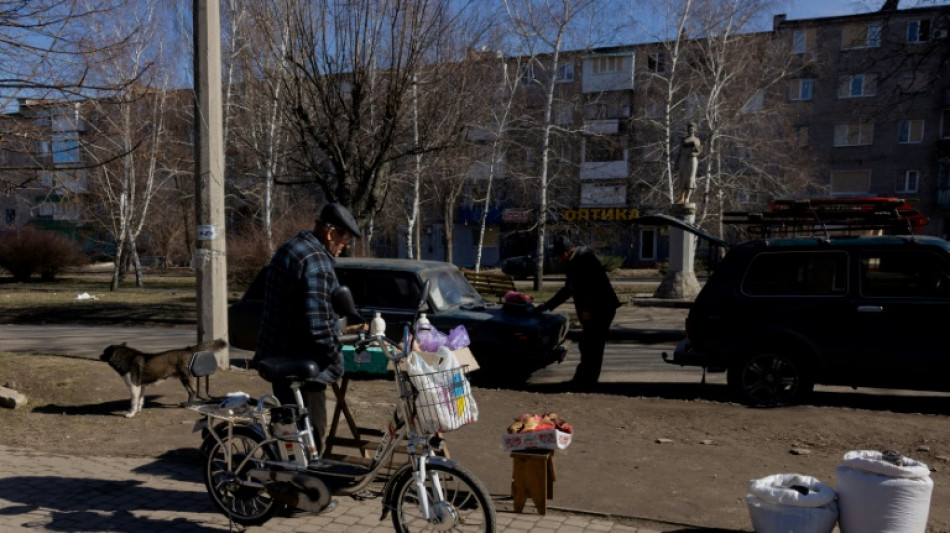
Living in the gutted-out eastern Ukrainian city of Kostyantynivka, Maryna has learned to recognise the sound of the devastating Russian glide bombs that have pounded her city for months.
Equipped with wings to help them glide over dozens of kilometres, the bombs are part of an arsenal developed by Russia to let it hit deeper into Ukrainian territory and stretch the front line.
Maryna recalled to AFP just one of the recent strikes.
"Six people didn't get back up. There was blood everywhere," she said.
Overhead, the threat of a fresh attack is constant.
In a recent visit to the city, AFP reporters saw Russian planes flying over frequently and a dozen strikes in the area in less than half an hour.
Each drop triggered a blast, seeming to unfold in slow motion, followed by a high column of black smoke.
Kostyantynivka used to be relatively sheltered, lying a dozen kilometres (7 miles) from the front line.
But Russian forces are now pounding the city with the cheaply made bombs.
Usually made from Soviet stocks and modernised with satellite control systems, each can carry up to a tonne of explosives.
The glide bombs themselves are mostly impossible to intercept for the Ukrainian airforce, whose only option is to try to shoot down the planes.
Throughout the three-year war, Russia has used them to devastating effect -- razing cities like Chasiv Yar to the ground and obliterating Ukrainian defensive positions across the front line.
- Attacks increased tenfold -
Selling produce from his farm on a folding table on the side of a damaged road, Maryna's husband Volodymyr said the explosions had crippled his business.
"My cow is producing less milk because of the blasts, and my pigs are having miscarriages one after the other," he said.
He also has fewer clients, as most civilians have fled.
Attacks increased tenfold in February, according to governor Vadym Filashkin, who is urging residents to evacuate.
Children and their guardians were ordered to leave the city in autumn 2024.
The eastern districts of the town, closer to the front, also face relentless drone attacks.
"I can hear them buzzing as soon as I leave the house," said Volodymyr, who barely escaped alive when his home was hit in a drone attack.
He recently counted 108 drones in one week.
"When you hear them, you raise your arms and wait," he said, explaining how he signalled to Russian drone operators that he was a civilian.
Ukraine, too, has used drones extensively throughout the conflict -- for frontline hits and reconnaissance for long-range strikes deep inside Russian territory.
A few kilometres from the front line, Ronin and Archie, two young Ukrainian soldiers, were training on first-person view (FPV) drones, which are piloted remotely by operators donning virtual reality-like goggles.
The relatively cheap drones are ever-present at the front, leading both sides to develop various electronic warfare tools to neutralise them.
To overcome jamming, both have developed fibre optic drones equipped with thin cables tethered to the operator, rendering them immune to radio or signal interference.
"The enemy has many more than we do. And they often use them successfully," 21-year-old Ronin said.
"We are more exposed and we spend more time holding our positions," Archie, 24, said.
- 'More exposed' -
The fibre optic drones can reach up to 20 kilometres.
Soldiers often resort to shotguns, whose multiple pellets are useful to shoot down the nimble drones.
The threat also complicates the provision of medical aid to wounded soldiers.
Cameras on drones can spot the ambulances -- now forced to work at night -- sent to collect wounded soldiers.
In a stabilisation point -- an emergency shelter to treat soldiers close to the front -- an anaesthetist who goes by "Frenchie" said the drones had expanded the danger zone.
"In 2022, being two kilometres from the line, it felt like we were on vacation," said the 31-year-old doctor, before running to attend to a soldier whose leg had been torn by a drone blast.
"I want to believe and believe in God, because we have no one else," Volodymyr said.
"Even if they have to negotiate for years, let them stop bombing people," Maryna said.
I.Saadi--SF-PST