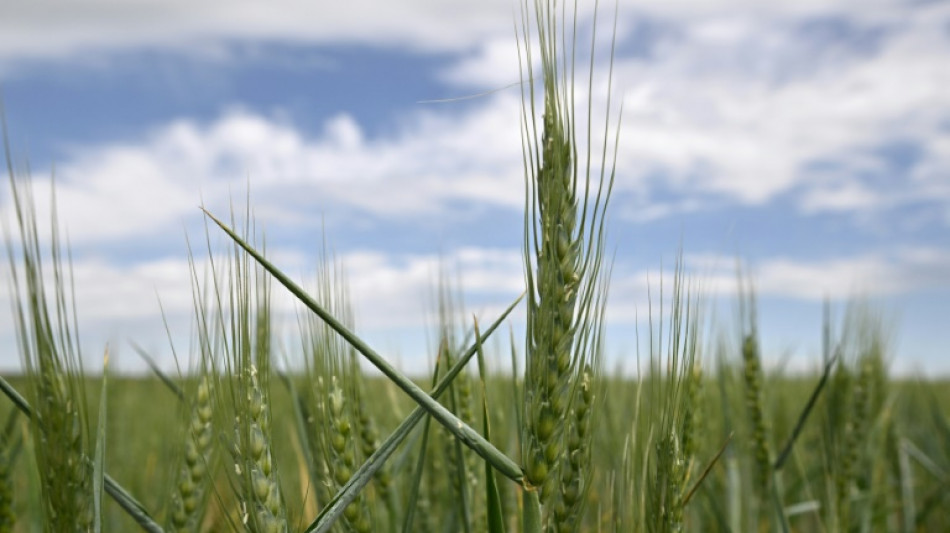
OECD sees lower world growth due to Ukraine war's 'hefty price' / Photo: Genya SAVILOV - AFP

 Kremlin says Ukrainian attacks won't change war aims as Kyiv hits Saint Petersburg

 Martinez starts for Man Utd after outburst
 Alberta separatists rally ahead of independence vote

 Bandhan Financial weighs health-insurance entry after acquisitions settle

 France assesses protest damage after 1,800 arrests

 Gord launches four AI tools for sustainability and emissions management

 Doha 2036 bid sets out sport-led social legacy

 Conservation teams rescue orangutans from Indonesian wildfires

 Truck ploughs into Hindu festival crowd in India, killing 13

 Kuwait announces maintenance closures in Nuzha, Surra and Rai

 Moody’s lifts OYO parent Prism outlook to positive before planned IPO

 Diesel shortage raises petroleum share of India’s exports to three-year high

 Premium products and financing drive Navratri appliance demand

 PNB expects festive demand to add up to two points to quarterly credit growth

 Robertson and Selby chase rare Home Nations sweep in Belfast

 Arteta backs Kai Havertz to become a 30-goal Arsenal forward

 Emiliano Martinez expects Chelsea return within weeks after surgery

 Sri Lanka choose to field against Pakistan in tri-series opener

 AP review finds racist and antisemitic posts in forum tied to Nevada candidate

 Cyient DLM drops 12% as margin concerns overshadow quarterly growth

 French authorities detain more than 1,000 after cost-of-living protests turn violent

 Tata Trusts plans network of 40 to 50 not-for-profit hospitals

 Bajaj Finance set to report second-quarter results on October 19

 Dozens of orangutans saved from Indonesia blazes as region grapples with haze
 Pope addresses crowd in Vatican after cancer surgery

The OECD warned Wednesday that the world economy will pay a "hefty price" for Russia's invasion of Ukraine as it slashed its 2022 growth forecast and projected higher inflation.
The Paris-based organisation, which represents 38 mostly developed countries, is the latest institution to predict lower GDP growth due to the conflict, which has sent food and energy prices soaring.
In its latest economic outlook, the Organisation for Economic Co-operation and Development said global gross domestic product would grow by three percent in 2022 -- down sharply from the 4.5 percent estimated in December.
The OECD also doubled its forecast for inflation among its members -- which range from the United States to Australia, Japan, and Latin American and European nations -- to 8.5 percent, its highest level since 1988.
"The world is set to pay a hefty price for Russia's war against Ukraine," wrote the OECD's chief economist and deputy secretary-general, Laurence Boone, adding that a "humanitarian crisis is unfolding before our eyes".
"The extent to which growth will be lower and inflation higher will depend on how the war evolves, but it is clear the poorest will be hit hardest," Boone said.
"The price of this war is high and will need to be shared."
Before the war broke out, the outlook had appeared "broadly favourable" for 2022-23, with growth and inflation expected to return to normal after the devastating Covid-19 pandemic, said the OECD.
However, "the invasion of Ukraine, along with shutdowns in major cities and ports in China due to the zero-Covid policy, has generated a new set of adverse shocks," it said.
- Food shortage risk -
The OECD was supposed to publish its outlook in March, but it delayed its detailed assessment until now due to uncertainty over the war. At the time, it said the conflict could cut global GDP growth by "over one percentage point".
The World Bank revised its own figures on Tuesday, lowering its global growth forecast from 4.1 percent to 2.9 percent. The IMF cut its forecast by nearly one point to 3.6 percent in April.
The OECD cut its growth forecast for the United States from 3.7 percent to 2.5 percent and that of China, the world's second biggest economy, from 5.1 percent to 4.4 percent. The eurozone's GPD is now seen growing by 2.6 percent instead of 4.3 percent while Britain's outlook was lowered to 3.6 percent from 4.7 percent.
The OECD noted that commodity prices had risen, hitting real income and spending, "particularly for the most vulnerable households".
"In many emerging-market economies the risks of food shortages are high given the reliance on agricultural exports from Russia and Ukraine," it said.
The report warned that the "effects of the war in Ukraine may be even greater than assumed", raising as an example a scenario of Russia cutting gas supplies to Europe.
As central banks tighten their monetary policies to counter inflation, the report said sharp increases of interest rates could also hit growth more than anticipated.
- Covid risk -
The Covid pandemic, meanwhile, could take another turn for the worse.
"New more aggressive or contagious variants may emerge, while the application of zero-Covid policies in large economies like China has the potential to sap global demand and disrupt supply for some time to come," the OECD said.
Faced with these challenges, governments needed to protect the most vulnerable from the economic shockwaves, it added.
In the short term, "temporary, timely and well-targeted" fiscal measures would help the poorest households, the OECD said.
Over the medium- and long-term, governments would have to invest more in clean energy and defence spending.
"The world is already paying the price for Russia's aggression," wrote Boone.
"The choices made by policymakers and citizens will be crucial to determining how that price will be distributed across people and countries."
O.Farraj--SF-PST