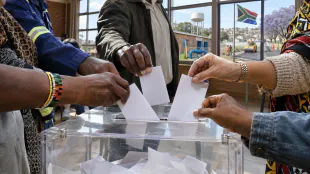
East DR Congo mines mint Rwanda-backed M23's fortune / Photo: Camille Laffont - AFP

 استشهاد 5 أشخاص بينهم أطفال بانهيار جرف رملي على خيام نازحين في دير البلح

 First Drive: 2027 BMW i760 xDrive Review
 الأصدقاء الخياليون: كيف تعزز الكائنات غير المرئية القدرات العقلية للأطفال والبالغين

 London Museum Granted 24/7 License Ahead of November Opening
 Dana White Confirms Flight to Washington for Trump Meeting on Press Secretary Role
 Dengue Fever Expands Into High Himalayas as Climate Change Warms Nepal

 IoT Refrigerator Hacks Disrupt Blood Labs and Supermarkets Across Europe and US
Mine shafts snake under the eastern Democratic Republic of Congo's mountains, but instead of the Congolese government their rich veins are making a mint for the Rwanda-backed M23.
In the tracts of land the M23 has seized following its 2021 resurgence in the eastern DRC, an area mineral-rich yet scarred by decades of conflict, the armed group levies high natural resource taxes.
The crown jewel in the M23's expansion is the DRC's largest coltan mine from which the group generates around $800,000 in revenue each month, according to UN experts.
Coltan is a mineral from which tantalum, commonly used in electronics such as mobile phones and laptops, is derived.
The armed group has controlled the Rubaya mine and surrounding areas of North Kivu province since 2024, setting up its own administration in the areas it has captured.
M23-appointed North Kivu governor Bahati Eraston made his first visit recently to the Rubaya mining town, with diggers downing tools after being told to attend a meeting with Eraston.
The M23 has launched a recruitment campaign in the area, hoping to draw in people to help it overthrow the government in the DRC's capital Kinshasa -- some 1,500 kilometres (930 miles) to the west.
"Where are the young people? Let them come and join us," Eraston said speaking into a microphone.
A few dozen young men and women pushed through the crowd to register to the cheers of spectators, although it was difficult to tell if their support was sincere.
"My job no longer allows me to support my needs, I have therefore decided to join the M23 to defend my country," Dieu Merci Bahati, an artisanal digger, told AFP.
- M23 pseudo-state -
The DRC's east is believed to hold between 60 and 80 percent of the world's coltan reserves.
With the M23 levying a $7 per kilogram tax on all coltan produced and traded, the mineral is lucrative business for the armed group.
Yet this represents only a small fraction of its tax revenues from trade, as the armed group looks to rule the east.
In Rubaya the M23 has set up its own administration "similar to that of a state", according to UN experts.
They said the group has created a "ministry responsible for the exploitation of minerals", which issues "permits to diggers and economic operators".
Since the start of the year, M23 fighters have captured Goma and Bukavu, North and South Kivu's main cities respectively, as part of a lightening offensive.
This means that the group now controls all commercial points in the DRC leading to the Rwandan border.
The M23 taxes each truck travelling to Rwanda several thousands dollars at the border posts near Goma, according to economic and security sources.
The eastern DRC depends largely on products imported from Rwanda.
But it also exports agricultural products to Rwanda and other countries in the Great Lakes region.
- 'Forced labour' -
Sources close to the Congolese government accuse Rwanda of leading a war for control of the region's particularly fertile agricultural land.
But the M23 said it has put an end to numerous taxes imposed by pro-Kinshasa armed groups on farmers and transporters that were hindering economic development in the area.
Workers at the mine, such as diggers, seem happy to have relative security while at their underground office.
Pro-Kinshasa militia "took money and phones from us, but since the M23 came I have never been the victim of an attack", said Grace Mugisha, a digger at Rubaya.
But that apparently improved security has brought new sorts of constraints.
In all the zones under its control the M23 has imposed "salongo" -- a type of unpaid community service which residents are made to do once a week.
For Germain Nkinzo, an M23 leader in Minova, a commercial lake port in South Kivu province, the "salongo" is about instilling "discipline" and "changing mentalities" in order to accelerate economic and social development.
But one resident, holding a shovel on her return from the community service, said "development must be the fruit of everyone's will, not forced labour".
X.Habash--SF-PST