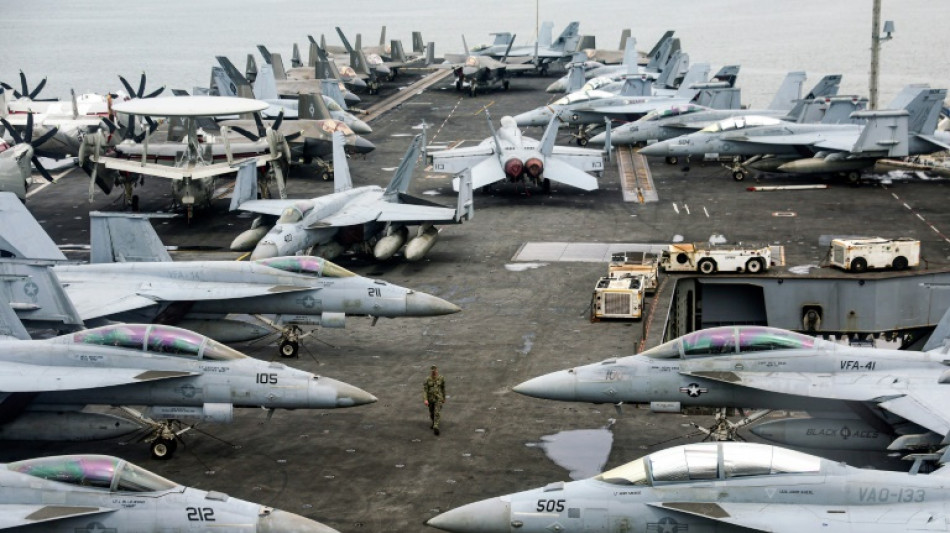
US takes rivalry with China to the high seas / Photo: FAZRY ISMAIL - POOL/AFP

 Rybakina reigns serene as new world number one

 South Africa defeat New Zealand 43-28 to complete 3-1 series victory

 Rybakina triumphs in US Open, denies Sabalenka three-peat

 Akron fan's honorary play-calling stint ends with opening-drive fumble

 Louisiana's developing roster faces USC as Trojans enter as heavy favorites

 Christa Pike seeks clemency before September 30 execution in Tennessee

 Utah hosts Arkansas as both programs begin seasons under new coaches

 Maryland groups seek statewide data center pause after local moratoriums spread

 Winston County trash-debt prosecutions face challenge from civil-rights lawyers

 Fifth Circuit upholds dismissal of Jackson residents' constitutional water claims

 Anthropic details Claude misuse as US targets major illicit online marketplace

 Japanese floating parking platform is designed to lift cars above floodwater

 Arteta blasts 'unacceptable' Sunderland penalty despite Arsenal win

 Mbappe at the double as Real Madrid sink Rayo

 Arsenal extend perfect Premier League start as Chelsea, Liverpool held

 US survive Spain scare to book World Cup final clash with France

 Celine Dion makes long-awaited return to stage in Paris
 Werro crowned Ultimate queen, US sweep 100m races

 Venezuelans outside Caracas say capital not sharing blackout burden

 Danish WWII drama wins top prize at Venice festival
 Chelsea boss Alonso yearns for 'boring game' after Hull make their point

 Werro outguns Hodgkinson to win women's 800m at Ultimate

 Moreira leads AC Milan fightback in Lazio draw

 Chelsea boss Alonso for yearns for 'boring game' after Hull make their point
 'Tired' Liverpool must adapt to schedule, says Iraola

The United States may still have the world's most powerful navy but it seems to have realised that this is no longer sufficient to reassert US supremacy over the high seas.
If President Donald Trump's pronouncements on shipbuilding, the Panama Canal and Greenland are anything to go by, he wants to increase US sea power on several fronts -- just as China is already doing.
Beijing's expanding influence on the world's oceans is a challenge to Washington's efforts to protect its interests.
While the United States still dominates the seas militarily, it is weaker in other maritime sectors, such as merchant shipping and shipbuilding itself, analysts told AFP.
Trump told the US Congress last week that his administration would "resurrect" the country's nautical construction industry "including commercial shipbuilding and military shipbuilding".
On China, he has complained that Beijing "controls" the Panama Canal and has refused to rule out military force to wrest control of a vital strategic asset.
The president has been equally blunt about wanting to take over Greenland, a Danish territory whose untapped mineral and oil reserves he covets.
And he wants to tax any Chinese vessel that docks in US ports.
Researcher Sophie Quintin, of Portsmouth University in the UK, said Trump's approach smacked of a return to "navalism" -- a theory stressing the importance of sea power espoused by 19th-century US naval officer Alfred Mahan.
On the other hand, Trump might just be appealing to his populist voter base, the Make America Great Again (MAGA) faithful.
"It's difficult to know if it's the fruit of a real strategic reflection," said Alessio Patalano, a specialist in maritime strategy at King's College, London.
"In the end, it doesn't matter. Serving the interests of MAGA voters by restarting naval shipyards or taxing Chinese boats leads to a navalist policy."
- Chinese sea power -
In any case, China understands the importance of sea power, said Nick Childs of Britain's International Institute for Strategic Studies.
At a Paris conference last month, Childs pointed to China's rapid expansion in maritime sectors other than its own navy.
"There are the investments we've been hearing about in global ports, global maritime infrastructure and the weaponising of the fishing fleet," he said.
Washington is concerned by the expansion of Chinese shipping companies, which they see as serving the interests of the Beijing government.
"Beijing's economic control of port operations at strategic chokepoints across the world -- many of which are part of the Maritime Silk Road initiative -- pose a threat to the United States and its allies," opined US think tank the Jamestown Foundation in February.
It cited in particular two state-owned firms, COSCO and China Merchant Ports.
Beijing could also exert "significant influence" on a third, the privately owned Hutchison Port Holdings, which controls two ports on the Panama Canal, it said.
But Paul Tourret, of France's Higher Institute of Maritime Economics (ISEMAR), cautioned against too "simplistic" a reading of China's maritime policy.
"COSCO, for example, follows a financial logic. It merely delivers to the United States the goods that Americans consume," he said.
Nevertheless, pressure from Washington seems to have had some effect.
Hutchison announced last week it had agreed to sell its lucrative Panama Canal ports to a US-led consortium, although it insisted this was a "purely commercial" decision.
- Gaps in US presence -
While the United States may have the world's most powerful navy, its merchant fleet is not in such good shape, said Quintin.
"US shipping companies have significantly declined and what remains of its commercial fleet is ageing," she said.
"That has repercussions for its strategic fleet," she added, referring to civilian ships used for military transport.
"Furthermore, the shipbuilding sector is in crisis."
Tourret agreed: "There's no way the US can build ships quickly."
"The problem with US shipbuilding is that they don't have the know-how of the Japanese and Koreans, and they don't have the scale of the Chinese, who churn ships out like biscuits," added Patalano.
"When Europe is one year behind on a military programme, the US is three or four years late," said a European industry source on condition of anonymity.
Trump's avowed desire to seize control of Greenland and Canada can also be viewed as a bid to regain US dominance over the seas.
Global heating is melting Arctic ice at an alarming rate, endangering natural ecosystems and contributing to further climate change.
But that melting could also open up the region to vessels -- both commercial and military -- and to oil and mineral exploration.
Those prospects have not been lost on China, Russia or the United States.
"The Arctic space will become increasingly important for power projection, especially for missile-launching submarines," said Patalano, who sees these as "an essential component of deterrence".
Here again, "the United States is lagging behind", said Quintin.
"While China is capable of deploying three icebreakers, the US Coast Guard struggles to keep its two ageing vessels in service," she said.
I.Saadi--SF-PST