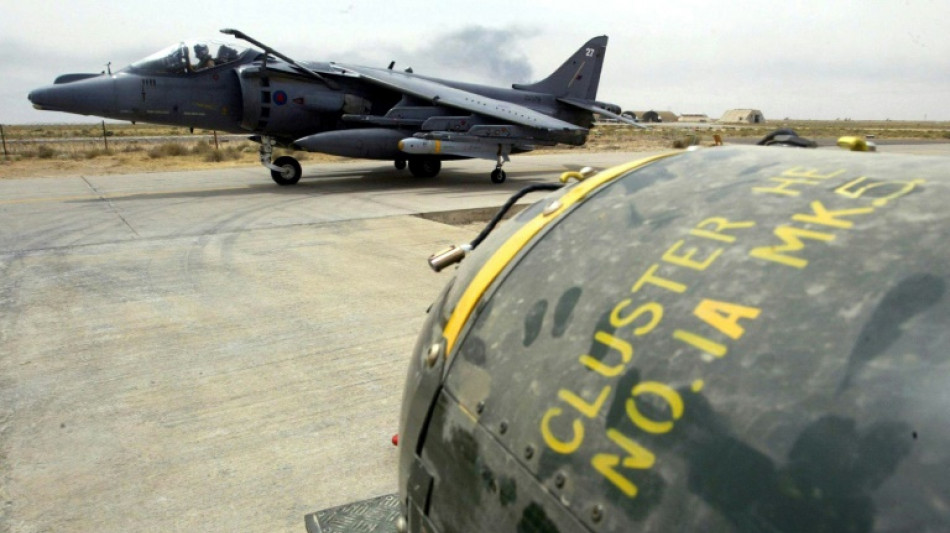
Walkouts on global disarmament treaties / Photo: RUSSELL BOYCE - POOL FILES/AFP/File

 Garcia keeps WBC welterweight title by stopping Benn
 Lights out in Laos as electricity exports surge

 'This is the test': All eyes on US Fed to tackle high inflation

 Scars of Marawi siege linger as Philippines poll nears

 Trump turns to golf, family business on Irish visit's second day

 Defiant Sabalenka motivated by US Open defeat

 Houthis say hit Saudi base after renewed fighting with Yemeni govt forces

 Gilbert Arenas questions Jonathan Kuminga's decision to join Minnesota

 Cristian Mungiu's Fjord examines a family's conflict with Norwegian child authorities

 United States beats Spain 76-66 to set up World Cup final against France

 Queens residents seek renewed enforcement along Roosevelt Avenue

 Marmot research gains over $140,000 from meme-coin fees alongside wildlife contest

 Roadless Rule repeal proposal raises concerns over Midwest forests and fire risk

 KFF journalists discuss opioid funds, suicide prevention and gaps in care

 Steven Strogatz weighs AI mathematics advances and their consequences for researchers

 GTA VI draws political criticism online as preorder estimates exceed five million

 Mini 1998 GT pairs 161-hp engine with John Cooper Works chassis hardware

 Attissogbe double inspires Pau to Top 14 summit

 Guimaraes strike lights up Arsenal win over Sunderland

 Israeli-made Gaza documentary wins Venice special jury prize

 De Zerbi apologises to fans after Spurs' stalemate extends goal drought

 Lowry takes four-shot lead as Trump jets in for Irish Open

 Harrison, Skupski win US Open men's doubles title

 Verstappen fears overtaking will be 'tough' at Spanish GP

 Argentina revives plan for South Atlantic naval base amid Falklands tensions

Lithuania will become the first country in the European Union to officially leave a multilateral arms regulation agreement when it withdraws on March 6 from the international treaty prohibiting the use of cluster munitions, citing a heightened security threat.
Since the United Nations was created 80 years ago there have been just five formal withdrawals from such multilateral treaties, but three of those -- all by Russia -- have come since 2021, according to an AFP analysis of the UN disarmament office registry.
Lithuania's controversial move comes at a time of heightened tensions in international relations over its neighbour Russia's invasion of Ukraine, with several countries criticising disarmament treaties.
Here is a summary of some key arms treaties and which countries have abandoned them.
- Cluster munitions -
Before Lithuania's move planned on Thursday, no country had pulled out of the Convention on Cluster Munitions, nor from the other four humanitarian disarmament treaties.
Cluster munitions can be dropped from planes or fired from artillery, exploding in mid-air and scattering bomblets over a wide area -- effectively acting as landmines that can go off years later.
Lithuania had signed and ratified the Convention on Cluster Munitions in 2011, committing to eliminate the weapons from its arsenal, and ceasing to produce or sell them.
But on September 6, 2024, it officially announced its withdrawal, citing "the evolving regional security dynamics and geopolitical threats".
The current security environment, it said, "necessitates maintaining a full spectrum of defensive tools, including cluster munitions, to ensure national security and protect our citizens".
Neither Russia nor Ukraine, which use cluster munitions in the war that began in 2022, are among the 111 remaining parties to this treaty.
The United States, Iran, Israel, and the two Koreas are not signatories either.
- Russia and US -
In November 2023, a year into its war with Ukraine, Russia raised global alarm with two major walkouts from international treaties.
It revoked its ratification of the Comprehensive Nuclear Test Ban Treaty and the Treaty on Conventional Armed Forces in Europe, which limits the deployment of troops and equipment from the Atlantic to the Urals.
Moscow had already in 2021 quit the Open Skies treaty, which allows states to conduct planned observation flights over the territory of other countries.
The United States had also left that treaty in 2020 during the first term of President Donald Trump.
- Bilateral accords -
Among other withdrawals from bilateral accords, the United States in 2002 left the Anti-Ballistic Missile Treaty, prompting the end of that agreement with Russia.
In 2019, the two powers also withdrew from the landmark 1987 Intermediate-Range Nuclear Forces treaty which limited the use of medium-range missiles, both conventional and nuclear.
The last remaining strategic arms control agreement between Russia and the United States -- the New START Treaty -- is set to expire in February 2026.
Without any renewal there will be no nuclear arms control structure in place between the former Cold War rivals for the first time since 1972.
- North Korea -
North Korea declared its withdrawal from the Treaty on the Non-Proliferation of Nuclear Weapons in 2003, but it is still listed as an official signatory.
Pyongyang did not comply with the three-month notice period required in the text, so its announcement was not considered an official withdrawal.
J.AbuHassan--SF-PST