Proposed 'weather control' bans surge across US states / Photo: Jon Cherry - GETTY IMAGES NORTH AMERICA/AFP

 Crash and burn: Pakistan cricket at a new low after England humiliation
 'Second life': Nepal tunnel survivor recalls ordeal

 Hong Kong homes flattened for US$28 bn high-tech hub
 'Be careful what you wish for': 'Obsession' director and star reflect on success
 Messi scores but Miami held by Nashville
 US Open champ Rybakina on top of world after injury scare
 Rybakina reigns serene as new world number one

 South Africa defeat New Zealand 43-28 to complete 3-1 series victory

 Rybakina triumphs in US Open, denies Sabalenka three-peat

 Akron fan's honorary play-calling stint ends with opening-drive fumble

 Louisiana's developing roster faces USC as Trojans enter as heavy favorites

 Christa Pike seeks clemency before September 30 execution in Tennessee

 Utah hosts Arkansas as both programs begin seasons under new coaches

 Maryland groups seek statewide data center pause after local moratoriums spread
 Winston County trash-debt prosecutions face challenge from civil-rights lawyers

 Fifth Circuit upholds dismissal of Jackson residents' constitutional water claims

 Anthropic details Claude misuse as US targets major illicit online marketplace

 Japanese floating parking platform is designed to lift cars above floodwater

 Arteta blasts 'unacceptable' Sunderland penalty despite Arsenal win

 Mbappe at the double as Real Madrid sink Rayo

 Arsenal extend perfect Premier League start as Chelsea, Liverpool held
 US survive Spain scare to book World Cup final clash with France

 Celine Dion makes long-awaited return to stage in Paris

 Werro crowned Ultimate queen, US sweep 100m races

 Venezuelans outside Caracas say capital not sharing blackout burden
Fake stories that atmospheric experiments are triggering natural disasters have led to US states pushing blanket bans on weather modification, which experts say may jeopardize current local scientific programs and hinder future research.
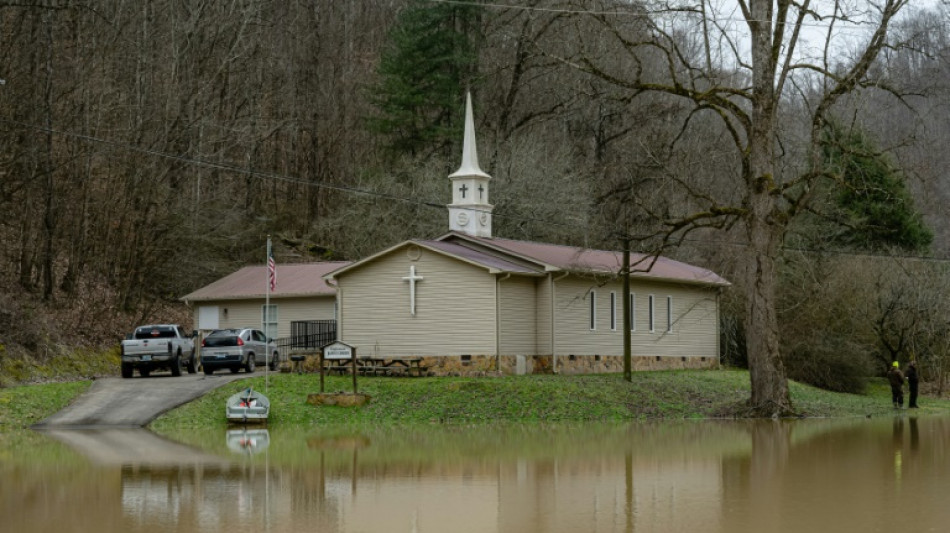
From recent deadly flooding in Kentucky to the Florida and North Carolina monster hurricanes of 2024, Americans have amplified increasingly conspiratorial explanations for extreme weather events -- even blaming manufactured clouds blocking sunlight for the devastation.
In response, lawmakers are moving to criminalize legitimate scientific experiments in the atmosphere.
In Kentucky, Republican John Hodgson told AFP he introduced a bill because his constituents "do not want to allow any government attempts to modify the solar radiation or weather."
But no such government program played a role in the state's weather whiplash.
"None of this is government control," said Shane Holinde, a meteorologist at the Kentucky Climate Center.
"It is all Mother Nature," he told AFP of the "rollercoaster of a month."
The severe weather events claimed 23 lives across the state, according to Democratic Governor Andy Beshear.
The actions in Kentucky and other states highlight how misinformation has become entrenched in political discourse, driving legislative efforts in response to conspiracy theories.
Tennessee is the first and only state to have passed such a law, despite witness testimony citing chemtrails -- a conspiracy that purports toxic chemicals are being sprayed from aircraft.
Kentucky bill co-sponsor, Republican Steve Rawlings, also alluded to them, telling local media his efforts address constituents' concerns of "streaks in the skies."
The efforts reflect general confusion over beneficial, small-scale activities, such as targeted cloud seeding programs in the arid West and large-scale geoengineering projects that are still decades away from possible implementation.
For example, the text targets stratospheric aerosol injection -- a futuristic technique that the wider public knows little about.
Scientists hope the method might allow them to shift the total energy balance between the Earth and the Sun and reduce some of the most blatant effects of climate change, including supercharged floods and storms, but it is currently only at a research stage.
The Kentucky legislation mirrors bills advancing in Florida and Arizona since the start of the year.
Edward Parson, environmental law professor at UCLA, said such bills often seek "to prohibit something that is not happening."
He warned that as more states consider these laws, people will be misled to believe they are "a sensible, legitimate" issue.
- Blanket bans -
As global warming makes weather extremes more likely, each new natural disaster brings further pushback against "weather control" from an increasingly loud crowd, including prominent political figures such as Republican Congresswoman Marjorie Taylor Greene.
Blanket bans also run the risk of hindering projects shown to benefit farmers by managing hyper-local precipitation and reducing crop losses from hail.
"These state legislations feel a little bit like a knee-jerk reaction," said Deborah Sivas, environmental law professor at Stanford University, while cautioning regulation around larger geoengineering experiments may prove necessary on an international scale.
"There is a bigger conversation to be had about if you can do things to manipulate weather patterns" over the ocean or other large shared areas, she said.
Dana Willbanks of Columbia University's Climate Science Legal Defense Fund is tracking science-silencing initiatives nationwide.
She pointed to a surge of climate-skeptic discourse and censorship at all levels of government since the start of the second Trump administration, down to city councils and school boards.
"We are going to start seeing more and more outrageous bills" like bans on weather control, she said.
O.Farraj--SF-PST