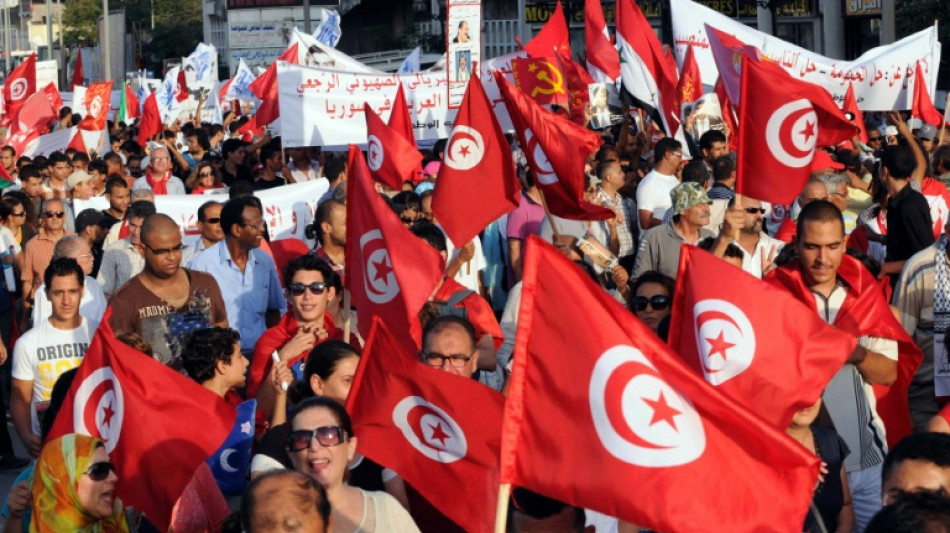
Eight sentenced to death for 2013 murder of Tunisia opposition leader / Photo: SALAH HABIBI - AFP/File

 Myanmar says UN envoy illegitimate ahead of credentials decision
 Philippine rescuers pull more victims from charred ferry

 دول عربية ومنظمات تدين استهداف خط أنابيب في السعودية

 Crash and burn: Pakistan cricket at a new low after England humiliation
 'Second life': Nepal tunnel survivor recalls ordeal

 Hong Kong homes flattened for US$28 bn high-tech hub

 'Be careful what you wish for': 'Obsession' director and star reflect on success
 Messi scores but Miami held by Nashville
 US Open champ Rybakina on top of world after injury scare

 Rybakina reigns serene as new world number one

 South Africa defeat New Zealand 43-28 to complete 3-1 series victory
 Rybakina triumphs in US Open, denies Sabalenka three-peat

 Akron fan's honorary play-calling stint ends with opening-drive fumble

 Louisiana's developing roster faces USC as Trojans enter as heavy favorites

 Christa Pike seeks clemency before September 30 execution in Tennessee

 Utah hosts Arkansas as both programs begin seasons under new coaches

 Maryland groups seek statewide data center pause after local moratoriums spread

 Winston County trash-debt prosecutions face challenge from civil-rights lawyers

 Fifth Circuit upholds dismissal of Jackson residents' constitutional water claims

 Anthropic details Claude misuse as US targets major illicit online marketplace

 Japanese floating parking platform is designed to lift cars above floodwater

 Arteta blasts 'unacceptable' Sunderland penalty despite Arsenal win

 Mbappe at the double as Real Madrid sink Rayo

 Arsenal extend perfect Premier League start as Chelsea, Liverpool held

 US survive Spain scare to book World Cup final clash with France

A Tunisian court sentenced eight defendants to death on Tuesday over the 2013 assassination of leftist opposition figure Mohamed Brahmi, according to local reports.
Charges included "attempting to change the state's nature" and "inciting armed conflict", local media reported.
Three of the defendants also received additional death sentences for "deliberate participation in premeditated murder", according to the reports.
A ninth, who is on the run, was sentenced to five years in prison for "failing to report terrorist crimes to the authorities", said the reports.
Tunisia still hands down death sentences, particularly in "terrorism" cases, even though a de facto moratorium in effect since 1991 means they are effectively commuted to life terms.
The verdict marked the first set of rulings in the case of Brahmi's assassination, which took place outside his home on July 25, 2013, amid Tunisia's turbulent post-revolution political landscape.
Demonstrators took to the streets across the country, as Brahmi's distinctive round face and thick mustache became symbols of protest against jihadist violence.
Brahmi, a nationalist left-wing leader of the People's Movement and member of Tunisia's Constituent Assembly, was an outspoken critic of the Islamist-inspired government dominated by Ennahdha at the time.
His assassination further shocked the nation as it came less than six months after the killing of another prominent leftist figure, Chokri Belaid, who was also gunned down outside his home.
- 'Martyrs' -
Brahmi had been elected in Sidi Bouzid, the birthplace of the 2011 revolution that toppled ex-president Zine El Abidine Ben Ali and later swept through the Arab World.
He was shot 14 times by two assailants in front of his wife and children.
His family had long accused Ennahdha of being behind the murder, but the then ruling party denied the allegations.
It had also pushed back against accusations of excessive leniency, blacklisting the formerly legal Salafist movement Ansar al-Charia as a terrorist organisation.
Jihadists affiliated with the Islamic State (IS) claimed responsibility for both the Brahmi and Belaid assassinations.
The aftermath of the 2011 revolution saw a surge in Islamist radicalism in Tunisia with thousands of jihadist volunteers leaving to fight in Syria, Iraq and neighbouring Libya.
Tunisia faced heightened security threats, with armed groups operating from the Chaambi Mountains near the Algerian border, primarily targeting security forces and the military.
In 2015, jihadist attacks in Sousse and the capital Tunis killed dozens of tourists and police, although authorities say they have since made significant progress against the extremists.
In recent years, Tunisian authorities claim significant progress in combating jihadist violence, but the country remains under a state of emergency.
In 2022, President Kais Saied -- who has framed the murders of Brahmi and Belaid as national issues and often called them "martyrs" -- dismissed dozens of judges after alleging they had obstructed investigations.
The high-profile killings, and the mass protests they drew, ultimately forced Ennahdha to relinquish power to a technocratic government following the adoption of a new constitution.
The crisis had nearly derailed Tunisia's fragile democratic transition.
But political dialogue led by four civil society organisations, including the Tunisian General Labour Union (UGTT), helped restore stability and earned the nation of 12 million the 2015 Nobel Peace Prize.
X.AbuJaber--SF-PST