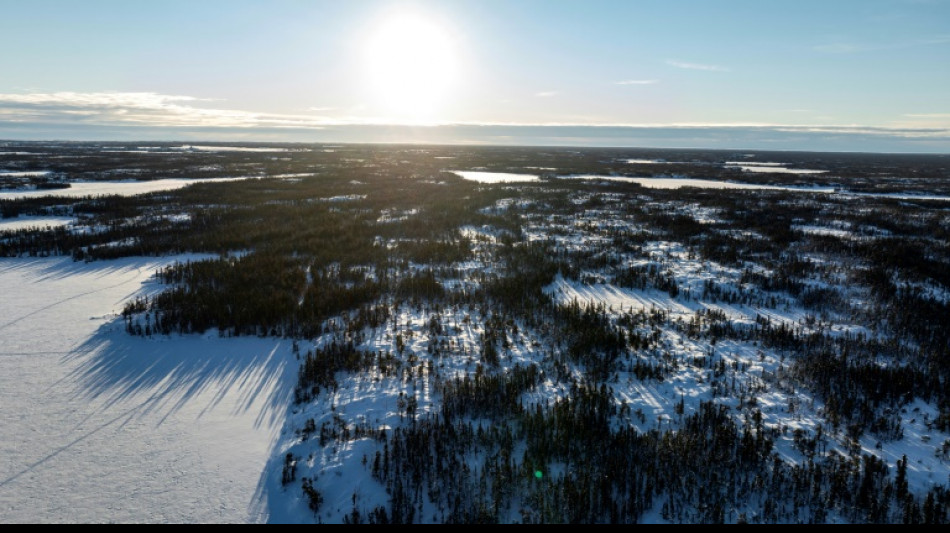
'All eyes on Arctic': Canada boosts its northern force / Photo: Sebastien ST-JEAN - AFP

 Myanmar says UN envoy illegitimate ahead of credentials decision

 Philippine rescuers pull more victims from charred ferry

 دول عربية ومنظمات تدين استهداف خط أنابيب في السعودية
 Crash and burn: Pakistan cricket at a new low after England humiliation
 'Second life': Nepal tunnel survivor recalls ordeal

 Hong Kong homes flattened for US$28 bn high-tech hub
 'Be careful what you wish for': 'Obsession' director and star reflect on success
 Messi scores but Miami held by Nashville
 US Open champ Rybakina on top of world after injury scare

 Rybakina reigns serene as new world number one

 South Africa defeat New Zealand 43-28 to complete 3-1 series victory
 Rybakina triumphs in US Open, denies Sabalenka three-peat

 Akron fan's honorary play-calling stint ends with opening-drive fumble

 Louisiana's developing roster faces USC as Trojans enter as heavy favorites

 Christa Pike seeks clemency before September 30 execution in Tennessee

 Utah hosts Arkansas as both programs begin seasons under new coaches

 Maryland groups seek statewide data center pause after local moratoriums spread
 Winston County trash-debt prosecutions face challenge from civil-rights lawyers

 Fifth Circuit upholds dismissal of Jackson residents' constitutional water claims

 Anthropic details Claude misuse as US targets major illicit online marketplace

 Japanese floating parking platform is designed to lift cars above floodwater

 Arteta blasts 'unacceptable' Sunderland penalty despite Arsenal win

 Mbappe at the double as Real Madrid sink Rayo

 Arsenal extend perfect Premier League start as Chelsea, Liverpool held

 US survive Spain scare to book World Cup final clash with France

In the mess hall of a Canadian military base a few hundred kilometers south of the Artic Circle, Brigadier-General Daniel Riviere pointed to a map highlighting the region that is becoming a national priority.
"All eyes are on the Arctic today," said Riviere, who heads the Canadian Armed Forces Joint Task Force North.
Thawing ice caused by climate change is opening up the Arctic and creating access to oil and gas resources, in addition to minerals and fish.
That has created a new strategic reality for Canada, as nations with Arctic borders like the United States and Russia intensify their focus on the region.
China, which is not an Arctic power, sees the area as "a new crossroads of the world," the United States warned in the final weeks of president Joe Biden's administration.
Ottawa has responded by announcing plans to reinforce its military and diplomatic presence in the Arctic, part of a broader effort to assert its sovereignty in a region that accounts for 40 percent of Canadian territory and 75 percent of its coastline.
Canada needs to act now because "the Northwest Passage will become a main artery of trade," Riviere said, referring to the Arctic connection between the Atlantic and Pacific oceans.
Plans to bolster Canada's Arctic presence include deploying new patrol ships, destroyers, icebreakers and submarines capable of operating under the ice cap, in addition to more planes and drones to monitor and defend territory.
- 'Assert sovereignty' -
At the Joint Task Force North's headquarters in Yellowknife, the capital of Canada's Northwest Territories, huge hangars house planes capable of landing on frozen lakes.
There is equipment designed to filter salt water from ice floes, and tents made for temperatures of -50 degrees Celsius (-58 degrees Fahrenheit).
Moving military resources around the area is complex work that is carried out by Twin Otters, a strategic transport aircraft that can operate in rugged environments.
On the tarmac after a flight over vast expanses of snow, forests and frozen lakes, Major Marlon Mongeon, who pilots one of the aircrafts, told AFP that part of the military's job is "to assert sovereignty of our borders and land."
Canada has only a handful of northern military bases.
To monitor the north, it relies on Canadian Rangers, reservists stationed in remote areas throughout the Arctic, many of whom are from the country's Indigenous communities.
They're known as "the eyes and ears of the north," and some say their numbers need boosting in order to meet Canada's evolving challenges.
The Rangers monitor more than 4 million square kilometers (1.5 million square miles), relying on their traditional knowledge of survival in this inhospitable area combined with modern military techniques.
They have been patrolling the country's farthest regions since the Cold War began in the late 1940s, when military officials realized the Arctic was a vulnerable access point.
- 'Most hostile threat' -
"Having people from the area who know the land and the hazards, especially in the barren lands up there, to help assist you to get somewhere is vital," said Canadian Ranger Les Paulson.
Because the military can't deploy full-time soldiers across the entire region, the Rangers offer a rapid response option in remote communities, including to "a breach of sovereignty" or airplane or shipping accidents, explained Paul Skrypnyk, 40, who is also a Ranger.
Climate change has made the Northwest Passage, increasingly accessible to ships for navigation during summer months.
That promises to shorten voyages from Europe to Asia by one to two weeks, compared to the Suez Canal route.
Increased traffic, including among cruise ships, has compelled Canada to boost its capacities in the region to respond to accidents or emergencies.
In Yellowknife, training is being stepped up to prepare for a range of significant events, including how to respond to a fall into icy waters.
Among those training was Canadian Ranger Thomas Clarke.
Still soaked from his jump into a hole dug in the sea ice, Clarke said that in the Arctic, the environment remains the greatest danger.
"Mother nature... is the most hostile threat," he told AFP. "Mother nature will try to end you, before anything else."
B.Mahmoud--SF-PST