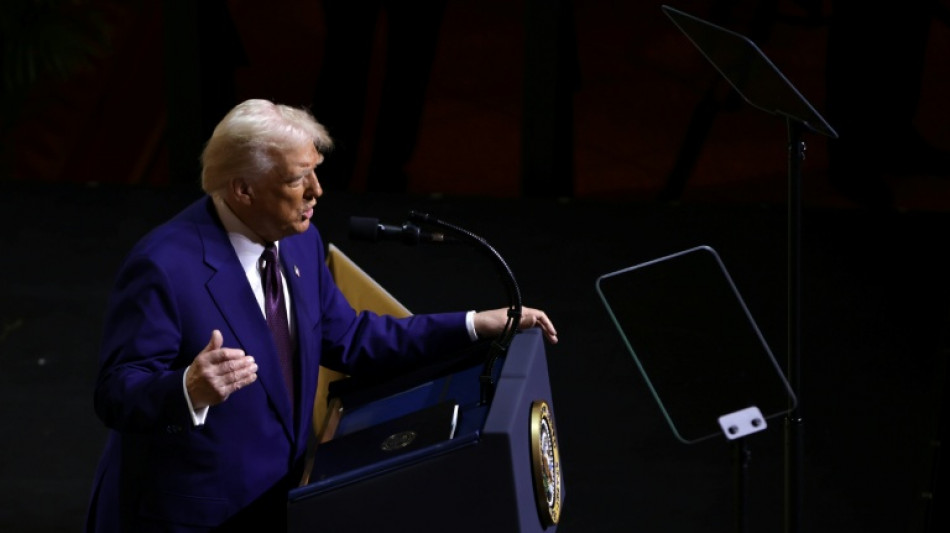
Tech, auto, medicines: who will pay Donald Trump's tariffs? / Photo: Samuel Corum - AFP/File

 Macron, Carney to visit French islands after Trump's map post

 حمزة قورقماز يناقش العلاقة بين وضوح المبادئ واحترام الاختلاف

 اليورو يستقر في البنوك المصرية وأعلى سعر للبيع 59.85 جنيه

 Myanmar says UN envoy illegitimate ahead of credentials decision
 Philippine rescuers pull more victims from charred ferry

 ستاندرد آند بورز تثبت تصنيف السعودية عند A+
 Crash and burn: Pakistan cricket at a new low after England humiliation

 'Second life': Nepal tunnel survivor recalls ordeal

 Hong Kong homes flattened for US$28 bn high-tech hub
 'Be careful what you wish for': 'Obsession' director and star reflect on success
 Messi scores but Miami held by Nashville

 US Open champ Rybakina on top of world after injury scare
 Rybakina reigns serene as new world number one

 South Africa defeat New Zealand 43-28 to complete 3-1 series victory

 Rybakina triumphs in US Open, denies Sabalenka three-peat

 Akron fan's honorary play-calling stint ends with opening-drive fumble

 Louisiana's developing roster faces USC as Trojans enter as heavy favorites

 Christa Pike seeks clemency before September 30 execution in Tennessee

 Utah hosts Arkansas as both programs begin seasons under new coaches

 Maryland groups seek statewide data center pause after local moratoriums spread

 Winston County trash-debt prosecutions face challenge from civil-rights lawyers

 Fifth Circuit upholds dismissal of Jackson residents' constitutional water claims

 Anthropic details Claude misuse as US targets major illicit online marketplace

 Japanese floating parking platform is designed to lift cars above floodwater
 Arteta blasts 'unacceptable' Sunderland penalty despite Arsenal win

After steel and aluminium, US President Donald Trump has set his sights on slapping 25 percent tariffs on semiconductors, cars and pharmaceuticals.
Trump has already slapped additional 10 percent tariffs on goods from China and has also threatened tariffs on Canada and Mexico, plus ordered a study into putting into place reciprocal tariffs.
Here's a look who would be hit the hardest if US import tariffs on semiconductors, cars and pharmaceuticals go into force.
- Semiconductors: Asia in the crosshairs
Semiconductors, or microchips, are the brains in our electronic devices and demand has soared with the development of AI, which relies on thousands of them to crank through reams of information.
Asia is a major centre of manufacturing of semiconductors.
The United States exported $70 billion of electronic components last year, but imported double that amount, according to the US Commerce Department.
Imports from Taiwan alone represented nearly $37 billion.
The island is home to chip manufacturing giant TSMC and a big portion of its factories. Tariffs could encourage it to diversify its production sites further. It already has plans to build three new factories in the United States.
Taiwanese President Lai Ching-te said last week that Taiwan would "expand investment and procurement in the United States to promote bilateral trade balance".
South Korea, home to Samsung, saw its exports of electronic components double last year to more than $8 billion, according the country's customs data. Its components are the country's second-largest export item to the United States behind cars.
"Disrupting the supply chain... would create serious challenges for the whole world, including the United States," said an executive of the trade association for South Korea's electronics industry.
- Everyone impacted by car tariffs -
The United States, the world's number two auto market behind China -- imported $269 billion in vehicles last year according to US Commerce Department figures.
Of those, $95 billion came from Mexico. Japan, South Korea, Canada and Germany are also major importers of vehicles into the United States.
US auto exports totalled only $72 billion.
Additional tariffs would affect all carmakers, with US automakers having factories in Mexico and Canada. US carmakers would also be affected through components suppliers located abroad, noted Matthieu Noel at the Roland Berger consultancy.
Laurel Broten, who heads up Canada's agency that attracts foreign investment, Invest in Canada, gave an example of an auto component that crossed the US-Canadian border eight times before being installed into a vehicle.
"Tariffs on 'Canadian cars' are also tariffs on US players in the supply chain," she told AFP.
Moreover, carmakers from all countries, including the United States, built factories "in Mexico to tap into lower wages", noted Noel.
For US consumers, "the price of vehicles will rise considerably. When one adds 25 percent import tariffs that can't be totally absorbed by margins," he said.
But many international brand cars are now made in the United States.
The world's largest carmaker, Japan's Toyota, sold 2.3 million vehicles in the United States last year. But more than half were manufactured in the United States, where it will soon open its eleventh factory.
German carmakers Volkswagen, BMW and Mercedes already manufacture SUVs in the United States.
Stellantis, which owns the Jeep, Ram, Dodge and Chrysler brands in addition to a number of European marques -- said it wants to boost its US production even before Trump's latest announcements.
- Pharmaceuticals: limited impact? -
Ireland alone accounted for 30 percent of US pharmaceutical imports in 2024. The country's favourable tax rates have attracted drugs manufacturers, including US firms.
Italy was the top source for US antibiotics imports, followed closely by China.
Nearly a quarter of Germany's pharmaceutical exports -- in particular vaccines and immunology products, head to the United States.
Some products are in very high demand by Americans, particularly the weight-loss treatments Ozempic and Wegovy made by Danish drugmaker Novo Nordisk.
But the drugs market is not like others, noted analysts at Moody's.
"Patients' medical needs, lack of substitutes, insurance coverage and doctor preferences limit the effects of price changes on demand," it said in a recent note.
"Most branded pharmaceutical companies have diversified manufacturing, including US facilities, and can absorb tariff increases thanks to high profit margins," it added.
US consumers might see more price increases on generic drugs made abroad as manufacturers have tight margins and would likely pass on the cost of tariffs.
B.AbuZeid--SF-PST