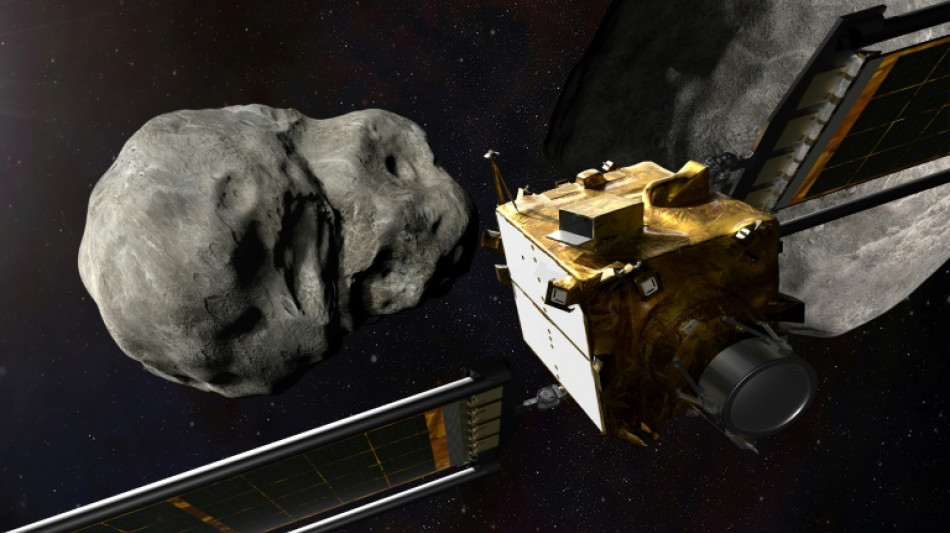
Do look up: How Earth can defend itself against asteroid / Photo: Handout - NASA/AFP/File

 Iran's economic ties to Dubai hard to break despite war

 iPhone 18預購後出現可疑扣款 四間銀行調查未授權交易

 《浪花男女》辦特別謝票場 馮志強談票房與導演客串拍攝

 Former captain De Villiers hails 'fantastic' Springboks

 Galaxy Tab S12系列效果圖曝光 Ultra擬配雙鏡頭及瀏海螢幕

 اليورو يستقر في البنوك المصرية وأعلى سعر للبيع 59.85 جنيه

 حمزة قورقماز يناقش العلاقة بين وضوح المبادئ واحترام الاختلاف

 Altman tells Fortune OpenAI will not go public in 2026

 China, Russia, India seek economic cooperation at BRICS
 الأرصاد السعودية تتوقع سيولاً وأمطاراً رعدية في خمس مناطق
 ستاندرد آند بورز تثبت تصنيف السعودية عند A+

 One dead, 102 rescued from stricken ferry off Indonesia's Java
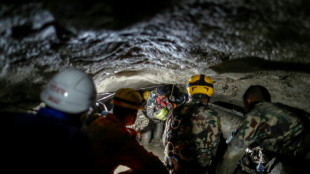
 Garcia keeps WBC welterweight title by stopping Benn

 Lights out in Laos as electricity exports surge

 'This is the test': All eyes on US Fed to tackle high inflation

 Scars of Marawi siege linger as Philippines poll nears

 Trump turns to golf, family business on Irish visit's second day

 Defiant Sabalenka motivated by US Open defeat

 Houthis say hit Saudi base after renewed fighting with Yemeni govt forces

 Queens residents seek renewed enforcement along Roosevelt Avenue
 Roadless Rule repeal proposal raises concerns over Midwest forests and fire risk

 KFF journalists discuss opioid funds, suicide prevention and gaps in care

 Utah hosts Arkansas as both programs begin seasons under new coaches

 United States beats Spain 76-66 to set up World Cup final against France
 Steven Strogatz weighs AI mathematics advances and their consequences for researchers

There is a very small chance that an asteroid capable of taking out an entire city could strike Earth in less than eight years. But even if this asteroid is hurtling our way, humanity is now able to defend itself against such a threat, experts say.
The odds that the recently discovered asteroid will hit Earth on December 22, 2032 have now risen to 3.1 percent, NASA said on Tuesday, the highest probability for an impact by such a large space rock in modern forecasting.
"Don't panic," Richard Moissl, head of the European Space Agency's planetary defence office, told AFP.
As astronomers gather more data, the odds of a direct hit are widely expected to edge upwards before rapidly dropping down to zero.
However, even in the unlikely event that the probability does keep rising up to 100 percent, "we are not defenceless", Moissl emphasised.
Here are some of the ways that humanity could deflect or destroy the asteroid known as 2024 YR4.
- Smash a spacecraft into it -
Only one planetary defence strategy has been tried out on an actual asteroid.
In 2022, NASA's Double Asteroid Redirection Test (DART) deliberately smashed a spacecraft into the 160-metre-wide Dimorphos asteroid, successfully altering its orbit around a larger space rock.
An advantage of this plan is that we could hit the 2024 YR4 asteroid with multiple spacecrafts, observing how each one changed its trajectory, Bruce Betts, chief scientist for the nonprofit Planetary Society, told AFP.
The asteroid discovered in December is estimated to be 40-90 metres wide -- roughly half the size of Dimorphos.
"You have to take care not to overdo it," Moissl warned.
If the spacecraft partially destroyed the asteroid, it could send "bits flying off" that still head towards Earth, he said.
If this kind of mishap changed the eventual impact site on Earth -- for example, "from Paris to Moscow" -- that would likely cause major problems back home, Betts added.
- Tractor, ion beams, paint -
A separate idea called a gravity tractor involves a large spacecraft flying up near the asteroid and -- without touching it -- using its gravitational pull to tug it away from Earth.
Another non-contact plan would put a spacecraft near the asteroid armed with thrusters that would exert a "constant stream of ions" to shove the asteroid off course, Moissl said.
Scientists have also considered spray painting one side of the asteroid white, increasing its reflectiveness so it slowly changes trajectory.
These subtler strategies would require reaching the asteroid sooner than for some more severe options.
- The nuclear option -
Or we could also just blow it up with a nuclear bomb.
Rather than drilling a nuclear weapon deep into an asteroid -- as depicted in the 1998 sci-fi action movie "Armageddon" -- this would likely involving detonating a bomb nearby.
Last year, US researchers testing out this theory on a marble-sized mock asteroid in the lab found that the x-rays from a nuclear blast would vaporise its surface and send it shooting off in the opposite direction.
Even setting aside the ethical, political and legal issues of sending nukes into space, this is considered more of a last-ditch plan for kilometres-wide asteroids like the one that killed off the dinosaurs.
And again, there is a risk that a nuclear explosion could still send unpredictable chunks hurtling towards Earth.
- Lasers -
Along less dangerous but similar lines, another idea is to shoot laser beams from a spacecraft to vaporise the side of an asteroid, pushing it away.
Lab experiments suggest this plan is viable, but it is not one of the "top techniques" being looked at, Betts said.
- If all else fails -
If necessary, deflecting this asteroid is "doable, but it depends on the speed at which we move as a planet", Moissl said.
While experts and space agencies will make their recommendations, ultimately the decision on how to tackle the asteroid will be made by world leaders.
If all else fails, we will have a good idea of the strike zone of the asteroid -- which is not a "planet killer" and at most could threaten a city, Moissl said.
This means that preparing for impact, potentially including evacuation if the area is populated, will be the last line of defence.
"Seven and a half years is a long time to prepare," Moissl said, re-emphasising that there is a roughly 97 percent chance the asteroid will miss Earth.
W.Mansour--SF-PST