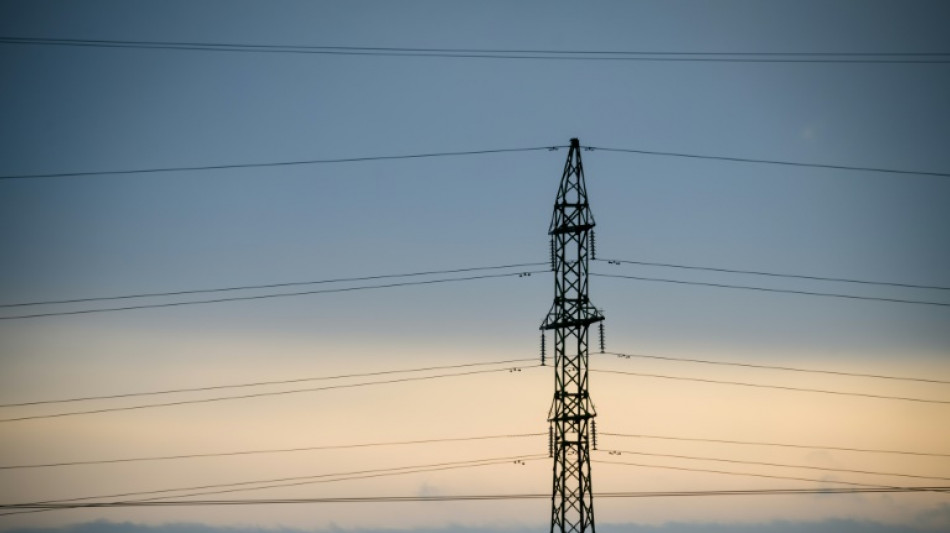
Baltic nations switch off Russian power grid / Photo: Gints Ivuskans - AFP

 Lobotka eases pressure on Allegri with Napoli winner
 Trump watches as Lowry wins Irish Open in record-breaking style

 Poland, Ukraine slam Russian strikes near border as 'escalation'

 Haaland fires 10-man Man City to memorable win over Man Utd
 I miss the adrenaline, but it's not my moment - Bolt

 Championship leader Antonelli to 'keep pushing' for title

 Yamal double helps Barca edge Levante thriller

 دراسة على مستفيدي ميديكيد ترصد فجوة في العمر المتوقع للمصابين بالتوحد

 Brighton run rampant against 10-man Coventry

 Late Mbappe goal sends Lille top of Ligue 1

 Five-star Brighton crush 10-man Coventry

 Team Europe beat United States to reclaim Solheim Cup

 US House Speaker warns curbing AI too sharply could leave China ahead

 張國榮70歲誕辰音樂會西九舉行 唐鶴德錄音致意
 Iran's economic ties to Dubai hard to break despite war
 iPhone 18預購後出現可疑扣款 四間銀行調查未授權交易

 《浪花男女》辦特別謝票場 馮志強談票房與導演客串拍攝

 Former captain De Villiers hails 'fantastic' Springboks

 Galaxy Tab S12系列效果圖曝光 Ultra擬配雙鏡頭及瀏海螢幕
 بزشكيان يؤكد رفض الاستسلام وسلطات إيران تعلن مقتل شخص في استهداف سفينة

 حمزة قورقماز يناقش العلاقة بين وضوح المبادئ واحترام الاختلاف

 Altman tells Fortune OpenAI will not go public in 2026
 China, Russia, India seek economic cooperation at BRICS
 ستاندرد آند بورز تثبت تصنيف السعودية عند A+

 دول عربية ومنظمات تدين استهداف خط أنابيب في السعودية
Three Baltic states on Saturday cut ties with Russia's power grid to join the European Union's network, the culmination of a years-long process that gained urgency with Moscow's invasion of Ukraine.
Estonia, Latvia and Lithuania -- all former Soviet republics now in the European Union and NATO -- had wanted to block Russia's ability to geopolitically blackmail them via the electricity system.
"We have removed any theoretical possibility of Russia using energy (grid) control as a weapon," Lithuania's Energy Minister Zygimantas Vaiciunas told AFP on Saturday.
EU foreign policy chief Kaja Kallas -- Estonia's former prime minister -- had on Friday hailed the grid switch as "a victory for freedom and European unity".
Vaiciunas said the Baltic states had completed the disconnection process at 9:09 local time (0709 GMT) on Saturday.
"We have been waiting for this moment for a long time," he told reporters, after speaking with his Estonian and Latvian counterparts.
"The energy system of the Baltic states is finally in our own hands. We are in control," he added of the "historic" moment.
He said the Baltics were now operating in so-called "isolated mode", before they integrate with the European grid on Sunday.
Official celebrations are planned across the Baltics, and authorities were on guard for any potential cyber-attacks linked to the grid switch.
Latvia will physically cut a power line to Russia later Saturday and European Commission president Ursula von der Leyen is to attend a ceremony with Baltic leaders in Vilnius on Sunday.
The Baltics have long prepared to integrate with the European grid but faced technological and financial issues.
The switch became more urgent after Russia invaded Ukraine in 2022, spooking the Baltic states into thinking they could be targeted.
They stopped purchasing Russian gas and electricity after the invasion but their power grids remained connected to Russia and Belarus, controlled from Moscow.
This left them dependent on Moscow for a stable electricity flow, which is crucial for factories and facilities requiring a reliable power supply.
- 'Possible provocations' -
The Baltic states will operate in "isolated mode" for about 24 hours to test their frequency, or power levels, according to Lithuania's state-run grid operator Litgrid.
"We need to carry out some tests to assure Europe that we are a stable energy system," Litgrid head Rokas Masiulis had said last month.
"We'll switch power stations on and off, observe how the frequency fluctuates and assess our ability to control it."
The states will then integrate into the European power grid via Poland.
Authorities have warned of potential risks linked to the change.
"Various short-term risks are possible, such as kinetic operations against critical infrastructure, cyber-attacks and disinformation campaigns," Lithuania's state security department told AFP.
Poland's power grid operator PSE had said it would use helicopters and drones to patrol the connection with Lithuania.
Latvian President Edgars Rinkevics told LTV1 the countries could not "rule out possible provocations".
In Estonia, police and volunteer defence corps will man critical electrical infrastructure until next weekend because of the risk of sabotage.
Several undersea telecom and power cables have been severed in the Baltic Sea in recent months. Some experts and politicians have accused Russia of waging a hybrid war, an allegation Moscow denies.
- 'People won't feel it' -
A total of 1.6 billion euros ($1.7 billion) -- mostly EU funds -- have been invested in the synchronisation project across the Baltic states and Poland.
Lithuanian President Gitanas Nauseda was sure the switch would go smoothly, telling reporters: "People won't feel it, either in terms of their bills or any inconvenience."
Estonia's climate ministry urged everyone to carry on as usual as "the more regular and predictable the behaviour... the easier it is to manage the power grid".
But some consumers worried about power cuts and home improvement stores in Estonia had noted a sharp increase in sales of generators.
After the Baltic decoupling, the energy system in the Russian enclave of Kaliningrad will lose its grid connection to mainland Russia.
Kaliningrad has been building up power generation capacity for years and Kremlin spokesman Dmitry Peskov dismissed all concerns.
Asked about the cut-off last week, he said: "We have taken all measures to ensure the uninterrupted reliable operation of our unified energy system."
Y.Shaath--SF-PST