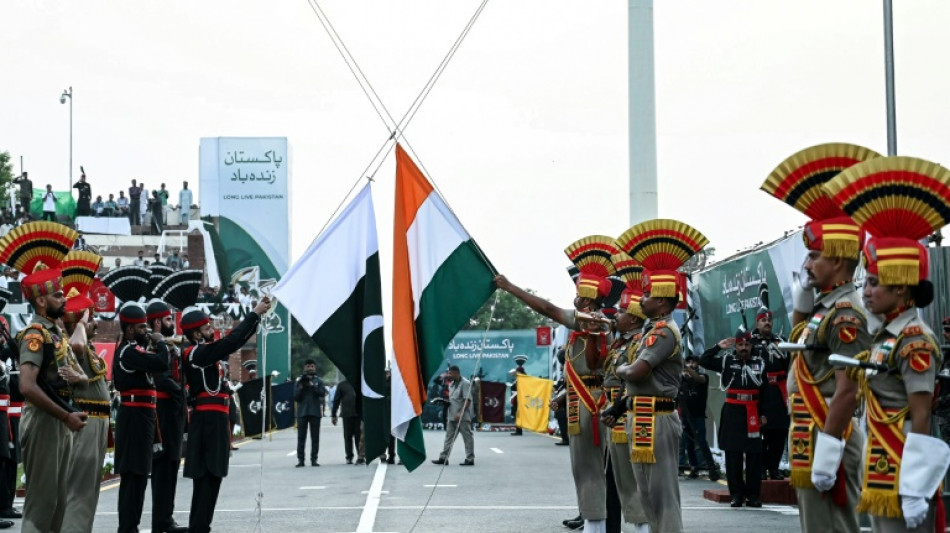
Old India-Pakistan rivalry drives South Asia diplomatic reshuffle / Photo: Narinder NANU - AFP/File

 Zverev holds off Shelton to win US Open title

 Torres fires PSG to first win of Ligue 1 season

 Toulouse back on track after hammering Bordeaux

 Referee body admits 'error' for Haaland goal in Manchester derby

 Sweden's election too close to call as far right loses ground

 Is it possible to slow down the development of AI?

 Jefferson-Wooden bags searing sprint double, Dos Santos on fire

 'Practical Magic 2' breaks Spidey spell over N. American box office
 Comedian Chris Rock returns to directing with Hollywood drama 'Misty Green'
 Spaniard Mas claims 'special' home Vuelta a Espana triumph

 Jefferson-Wooden, Bednarek claim classy Ultimate sprint doubles

 Britain's Kerr wins men's Ultimate 1,500m

 Luckless Norris wants change in safety car rules

 Spaniard Enric Mas wins home Vuelta a Espana
 Mercedes boss Wolff says long future for 'cucumber cool' Antonelli

 Kane edges Bayern past Elversberg in Bundesliga

 Trump administration reluctant to slow AI, Democrats see urgent need

 Five-star Leipzig return to form with Hamburg thumping

 Spain beat Germany to claim women's World Cup bronze

 أمودي يقترح رقابة مستقلة وتنسيقاً دولياً لضبط تطوير الذكاء الاصطناعي

 Antonelli profits from safety car pause to win Spanish GP

 Trump chastises Zelensky over Russian refinery strikes during Ireland visit

 World championship leader Antonelli wins Spanish GP

 Resurgent Marquez powers to San Marino win to take MotoGP lead

 Vuelta finale neutralised after rider safety concerns

Old rivalries between India and Pakistan are driving a shift in regional ties, with New Delhi courting Afghanistan's Taliban while Islamabad befriends the new leaders of post-revolutionary Bangladesh.
Diplomatic dynamics in South Asia are rooted in long-running distrust between the region's two most populous nations.
Nuclear-armed India and Pakistan -- carved out of the subcontinent at the chaotic end of British colonial rule in 1947 -- have fought multiple wars and remain bitter foes.
The rivalry shows no sign of abating, with New Delhi denying in January it had launched covert operations to kill anti-Indian militants on Pakistani soil.
"You can't have snakes in your backyard and expect them to only bite your neighbours," Indian Foreign Ministry spokesman Randhir Jaiswal told reporters in dismissing the allegations.
Relations between Afghanistan and Pakistan have also worsened since the Taliban returned to power in Kabul nearly four years ago.
Islamabad has accused Taliban authorities of failing to rein in militants they say are using Afghan territory to stage attacks that have killed thousands of Pakistani security personnel.
Pakistan launched deadly air strikes in Afghanistan border regions in December, with subsequent cross-border exchanges of fire.
The Taliban's austere interpretation of Islamic law seems at first glance an unlikely pairing for the Hindu nationalism of Prime Minister Narendra Modi, but India has nonetheless moved to exploit the opportunity.
"India has been pursuing this path quite consistently for quite some time," international relations professor Hassan Abbas of the National Defense University in Washington told AFP.
"They don't want the Taliban to give space to any group that is going to ultimately be a bigger threat to India," he said, adding that the prospect of "annoying Pakistan" was also appealing for New Delhi.
- 'Want to do more' -
India's top career diplomat, Vikram Misri, met with Taliban foreign minister Mawlawi Amir Khan Muttaqi in Dubai in January.
Jaiswal described the meeting as the "highest level of engagement" yet, adding that New Delhi was determined to "strengthen our longstanding relationship with the people of Afghanistan".
Muttaqi had in turn "expressed his hope for the expansion of relations", a spokesman for his ministry said.
Jaiswal said it was agreed at the meeting to "promote the use" of India's $370 million development of Iran's Chabahar container port "for supporting trade and commercial activities" to landlocked Afghanistan.
Chabahar is just west of Pakistan's Gwadar port, which is considered a cornerstone of the infrastructure expansion of China's Belt and Road Initiative in Pakistan.
India has long been wary of China's growing regional clout and the world's two most populous countries compete for influence in South Asia, despite a recent diplomatic thaw.
The Times of India said in an editorial after the Dubai meeting that New Delhi's "quiet yet deliberate engagement" with the Taliban was reshaping strategic regional ties.
"Despite not officially recognising the Taliban government, India understands the importance of maintaining a foothold in Afghanistan," the newspaper wrote.
"The move also aligns with India's broader regional strategy, which seeks to counter China's Belt and Road Initiative and its influence in neighbouring Pakistan," it said.
- 'Enemy of my enemy' -
At the same time, old enemies Pakistan and Bangladesh now speak of "friendly" ties.
Pakistan and Bangladesh were once one nation but split in a brutal 1971 war, with Bangladesh then drawing closer to India.
However, long-time Bangladeshi premier Sheikh Hasina was ousted in an August 2024 revolution, fleeing by helicopter to her old ally India, where she has defied Dhaka's extradition requests to face charges including mass murder.
Relations between India and Bangladesh's new government have been frosty since then, allowing Islamabad and Dhaka to slowly rebuild ties.
The first cargo ship in decades to sail directly from Pakistan to Bangladesh successfully unloaded its containers in the port of Chittagong in November.
Bangladesh's interim leader Muhammad Yunus also met with Pakistan's Prime Minister Shehbaz Sharif in December, saying he had "agreed to strengthen relations".
Top Bangladeshi army commanders later visited Pakistan, discussing training programmes and praising the "friendly relationship" between the nations.
Dhaka University professor Amena Mohsin told AFP that the sudden closeness reflected one of the oldest dictums in international diplomacy.
"The enemy of my enemy is my friend," she said.
burs-pjm-gle/pbt/mtp
Z.AbuSaud--SF-PST