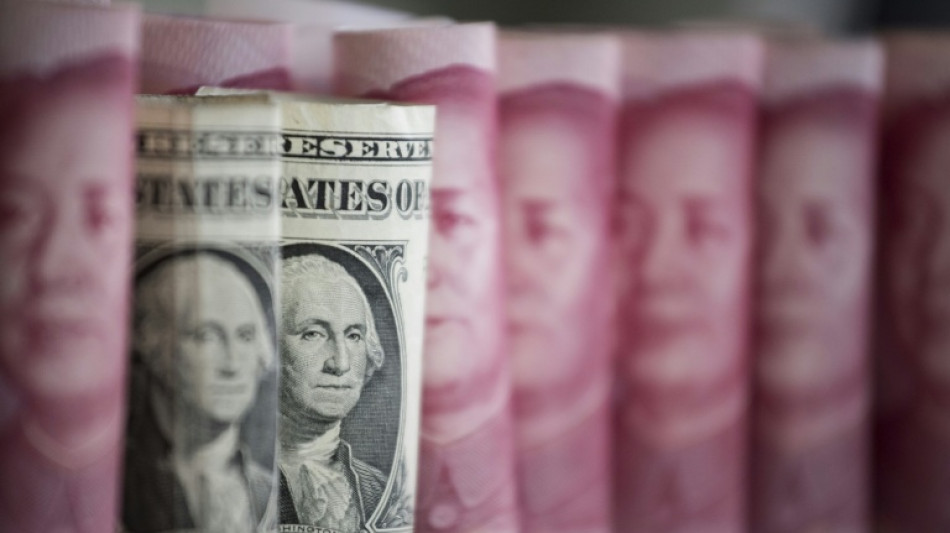
Weak yuan, Trump tariff threats confound Beijing's economic puzzle / Photo: FRED DUFOUR - AFP

 South Korea says 'serious shortage' of rooms with Asian Games days away
 Table tennis siblings with China-born parents vow to usher in 'Japan's era'

 Bougainville leader says violence won't stop Panguna mine re-opening

 South Korea aims to save seniors lost in digital age

 Russia's Stalin-admiring provincial leader waging an ultra-conservative crusade

 Marcelo Gallardo appointed as new Ecuador head coach
 'Widow's Bay' and 'The Pitt' tipped for success at Emmy Awards

 For club and comfort: Rodman makes it to Shelton's US Open final
 Houthis say Saudi Arabia launched over 50 strikes against them in 24 hours

 'Fed up': Thousands march against Sinaloa Cartel violence

 Controversial Zverev: from tennis nearly-man to multiple Grand Slam winner

 Swedish left-wing cheers far-right decline amid tight election race

 Yamal double helps Barca beat Levante, Atletico triumph

 Sassuolo stun Juve, Lobotka eases pressure on Allegri with Napoli winner

 Bills beat Texans and Ravens roll Colts in NFL openers

 US fight off spirited France to win 12th World Cup

 Drivers give cool reception to new Madring circuit

 Maresca makes flawless Man City start to leave Man Utd trailing

 Dozens arrested in major anti-LGBTQ raids in Turkey

 Leftwing opposition seen leading Sweden election, far-right losing ground

 Senegal goalkeeper Mendy retires from international football

 Carrick 'worried' by decision to award Man City winner

 Lobotka eases pressure on Allegri with Napoli winner

 Trump watches as Lowry wins Irish Open in record-breaking style

 Poland, Ukraine slam Russian strikes near border as 'escalation'

Higher US tariffs under President Donald Trump could accelerate a slump in the value of China's currency, complicating recent efforts by Beijing to kickstart a rebound in its struggling economy, analysts warn.
Just days after beginning his second term in the White House last week, Trump said he would impose a 10 percent levy on all Chinese products from February 1, while leaving the door open for negotiations.
If implemented, the duties will likely exacerbate the yuan's weakness, just as Chinese leaders work to shore up an economy beset with challenges including sluggish domestic consumption and a prolonged debt crisis in the property sector.
Economists say this year could see the yuan fall to the lowest level against the US dollar since Beijing scrapped its fixed exchange rate two decades ago.
"The combination of looming tariffs, looser monetary policy and a slower pace of rate cuts in the United States will weaken the yuan," said Harry Murphy Cruise, an economist at Moody's Analytics.
A depreciated currency enhances the competitiveness of exporters by lowering the prices of their goods and services overseas.
This could encourage Beijing to allow the yuan to decline further in order to support its foreign trade and reduce deflationary pressure at home, notes Alicia Garcia Herrero of Natixis.
- 'Catch-22' -
But a weaker yuan "could exacerbate trade tensions with the United States, hindering negotiations to bring tariffs back down", said Murphy Cruise.
He added that a "rapid drop" in its value could trigger large-scale capital outflows, similar to those that occurred in 2015 as uncertainty regarding China's economy swirled.
Above all, a major depreciation would run counter to the strategic objective of President Xi Jinping to ensure a "strong currency" and make China a "financial power".
But a stronger yuan would require sacrificing China's currency advantage in trade -- a vital lifeline for the economy at a time of sluggish domestic spending.
"It is a Catch-22 situation," wrote Garcia Herrero.
For now, Beijing's strategy is to prioritise the yuan's stability, with the ambition of ultimately making it a major global reserve currency, analysts from Macquarie Group noted.
The exchange rate could slide to 7.45 yuan per dollar by the end of 2025, from 7.24 currently, noted Murphy Cruise.
While China's central bank cannot put a full halt to the yuan's slump, it "will likely intervene in the foreign exchange markets to ensure that the depreciation... is gradual", he said.
Surpassing the symbolic marker of 7.5 yuan per dollar could cause "panic", sparking an even more rapid spiral, Wang Guo-Chen of the Taiwan-based Chung-Hua Institution for Economic Research told AFP.
Authorities may initially orchestrate a slight devaluation in response to US tariffs, but "they will eventually pull back" he said.
- 'Tricky balance' -
The People's Bank of China (PBoC) has recently introduced what it hopes will be hefty support for the yuan, including the issuance of six-month central bank bills in Hong Kong totalling a record 60 billion yuan.
The PBoC has also recently injected tens of billions of dollars into financial circuits in order to stabilise markets and prevent activity from screeching to a halt during the Lunar New Year.
But such moves may come into conflict with Beijing's efforts elsewhere to boost an economy that is struggling to regain momentum.
"It's a very tricky balance: if domestic liquidity is increased, the currency will depreciate," said Wang.
The PBoC's approach so far has been to alternate between liquidity injections and withdrawals, he told AFP.
Beijing has pledged to continue providing major economic support for the domestic economy in 2025, boosting fiscal stimulus and encouraging consumption through measures such as subsidies for household goods.
But the spectre of heightened trade tensions with the United States continues to darken the horizon.
"Domestic consumption sentiment is unlikely to improve meaningfully amid trade disputes," warned Kiyong Seong, macro strategist at Societe Generale.
E.Qaddoumi--SF-PST