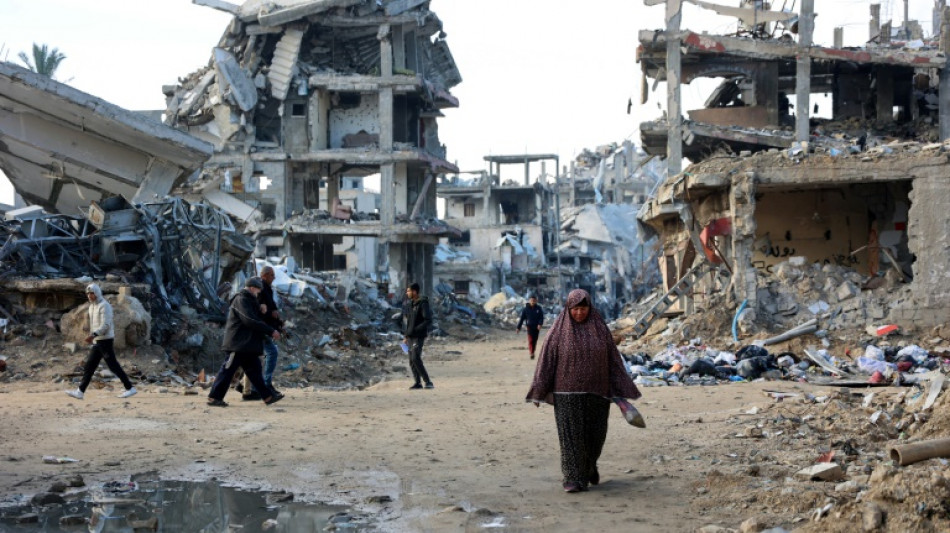
Gaza development put back 60 years by war: UNDP chief / Photo: Omar AL-QATTAA - AFP

 In DR Congo streets, ex-hoods get tough on litter -- and locals

 Surfer hospitalised after shark attack in Western Australia

 South Korea says 'serious shortage' of rooms with Asian Games days away

 Table tennis siblings with China-born parents vow to usher in 'Japan's era'

 Bougainville leader says violence won't stop Panguna mine re-opening

 South Korea aims to save seniors lost in digital age

 Russia's Stalin-admiring provincial leader waging an ultra-conservative crusade

 Marcelo Gallardo appointed as new Ecuador head coach

 'Widow's Bay' and 'The Pitt' tipped for success at Emmy Awards
 For club and comfort: Rodman makes it to Shelton's US Open final
 Houthis say Saudi Arabia launched over 50 strikes against them in 24 hours

 'Fed up': Thousands march against Sinaloa Cartel violence

 Controversial Zverev: from tennis nearly-man to multiple Grand Slam winner

 Swedish left-wing cheers far-right decline amid tight election race

 Yamal double helps Barca beat Levante, Atletico triumph

 Sassuolo stun Juve, Lobotka eases pressure on Allegri with Napoli winner

 Bills beat Texans and Ravens roll Colts in NFL openers

 US fight off spirited France to win 12th World Cup

 Drivers give cool reception to new Madring circuit

 Maresca makes flawless Man City start to leave Man Utd trailing

 Dozens arrested in major anti-LGBTQ raids in Turkey

 Leftwing opposition seen leading Sweden election, far-right losing ground

 Senegal goalkeeper Mendy retires from international football

 Carrick 'worried' by decision to award Man City winner

 Lobotka eases pressure on Allegri with Napoli winner

The Israel-Hamas war has put back development in Gaza by 60 years and mobilising the tens of billions of dollars needed for reconstruction will be an uphill task, the United Nations said.
Around two-thirds of all buildings in the Gaza Strip have been destroyed or damaged, and removing the estimated 42 million tonnes of rubble will be dangerous and complex, the head of the UN Development Programme told AFP.
"Probably between 65 percent to 70 percent of buildings in Gaza have either been entirely destroyed or damaged," Achim Steiner said in an interview at the World Economic Forum annual meeting in the Swiss ski resort town of Davos.
"But we're also talking about an economy that has been destroyed, where we estimate that roughly 60 years of development have been lost in this conflict over 15 months.
"Two million people who are in the Gaza Strip have lost not only their shelter: they've lost public infrastructure, sewage treatment systems, freshwater supply systems, public waste management. All of these fundamental infrastructure and service elements simply do not exist."
And for all these towering numbers, Steiner stressed: "Human desperation is not just something that you capture in statistics."
- 'Years and years' -
The fragile ceasefire agreement between Israel and Hamas in the Gaza war took effect on Sunday.
Steiner said it was difficult to put a timeframe on reconstruction due to the "volatile" nature of the ceasefire, and because the UN's immediate focus is on life-saving aid.
"When we talk about reconstruction, we are not talking about one or two years here," he said.
"We are talking about years and years, until you even come close to rebuilding, first of all, the physical infrastructure, but it's also an entire economy.
"People had savings. People had loans. People had invested in businesses. And all of this is lost. So we are talking about the physical and economic, and in some ways even the psychosocial phase for reconstruction."
He said the physical reconstruction alone would cost "tens of billions of dollars", and "we do face an enormous uphill struggle on how to mobilise that scale of finance".
- 'Extraordinary' destruction -
The estimated volume of rubble may yet rise and will leave the reconstruction effort with vast challenges.
"This is not a simple undertaking of just loading it and transporting it somewhere. This rubble is dangerous. There are often still bodies that may not have been recovered. There's unexploded ordnance, landmines," Steiner explained.
"One option is recycling. With reconstruction, there is a significant degree to which you can recycle these materials and use them in the reconstruction process," Steiner said.
"The interim solution will be to move the rubble into temporary dumps and deposits from where it could then later be either taken for permanent processing or disposal."
In the meantime, if the ceasefire endures and firms up, Steiner said huge amounts of temporary infrastructure would be needed.
"Virtually every school and every hospital has been either severely damaged or destroyed," he said.
"It's an extraordinary physical destruction that has happened."
C.AbuSway--SF-PST