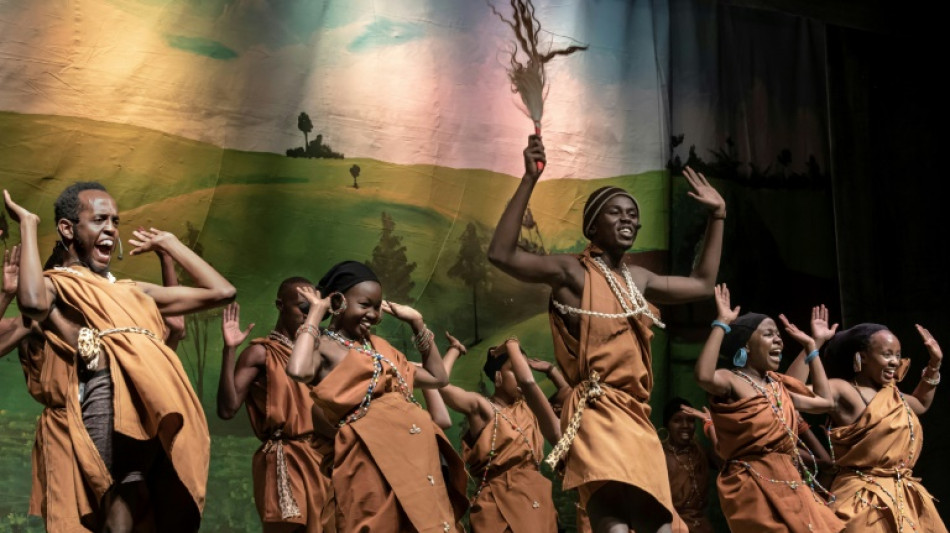
Kenya's most famous play comes home after 45-year wait / Photo: Tony KARUMBA - AFP

 Mbappe hits two as Real Madrid rout Sevilla

 Browns edge Ravens for division lead, Texans beat Jags

 Lyon go top of Ligue 1 as Monaco fall to first defeat of the season

 Venezuela opposition alliance reaffirms Nobel laureate Machado as leader

 'Street Fighter' wins N. America box office, buzzy doc stuns in 2nd

 NFL: Paris game to go ahead despite protests in France

 Arteta hails Arsenal 'finishers' after Madueke fells Forest

 Trump backs ally Netanyahu ahead of Israel's tight election

 Madueke strikes late as below-par Arsenal sink Forest

 Second day of street clashes in Milan

 Dupont's Toulouse hold off Exeter as English Champions Cup woes continue

 Zelensky speaks to US envoys amid Trump spat

 Paris police in new battles with protesters and looters

 Multiple deaths, injuries at western Canada military base: minister

 Boland strikes twice for Australia in rain-hit South Africa Test

 Marseille put Angers to the sword in Ligue 1

 Albanian PM refuses to quit as violent protests enter sixth day

 Chwalinska fights back to win Wuhan Open in title breakthrough
 Kulusevski on brink of return for Spurs after 17-month absence

 Ukraine sets Saint Petersburg refinery ablaze in large-scale drone attack

 Spain's in-form Chacarra wins DP World India Championship

 Robertson and Selby chase rare Home Nations sweep in Belfast

 Arteta backs Kai Havertz to become a 30-goal Arsenal forward

 Emiliano Martinez expects Chelsea return within weeks after surgery

 Sri Lanka choose to field against Pakistan in tri-series opener

It was banned for years and its authors -- including the celebrated Ngugi wa Thiong'o -- imprisoned, but after more than four decades, Kenya's most famous play is finally home.
As the lights dim and a hush settles over the Nairobi audience, the theatre explodes into song and actors dance down the aisle.
It is a scene few could have imagined.
Although "Ngaahika Ndeenda" ("I Will Marry When I Want") occupies a special place on the Kenyan stage, the drama's tumultuous history means it has not seen the light of day since 1977, when it was performed by peasants and factory workers in the central town of Limuru.
Its withering take on the exploitation of ordinary Kenyans by the country's elite hit home and the government wasted no time in shutting down the show, banning Ngugi's books and jailing him and the play's co-writer, Ngugi wa Mirii.
Following a year in Kamiti Maximum Security Prison, Ngugi was released but "virtually banned from getting any job", he told AFP in an interview from California, where he lives in self-imposed exile.
After Kenya embraced democratic reforms, he returned home in 2004 and was mobbed by fans at the airport.
But the visit quickly turned ugly, when he was beaten by armed men and his wife raped in their Nairobi apartment. It has never been established if robbery was the sole motive behind the attack.
"The play has had all these consequences on my life... my life would not (let) me forget it even if I tried," the 84-year-old said.
- 'Spiritual experience' -
Born into a large peasant family in 1938, Kenya's most feted novelist and perennial Nobel Prize contender launched his writing career in English.
But it was a decision in the 1970s to abandon English in favour of his native Kikuyu that cemented his reputation as a writer willing to risk his literary future to preserve African languages.
It comes as little surprise then that the play, which tells the story of a poor Kenyan family battling a land-grab by their wealthy compatriots, is also being staged in Kikuyu, with some shows in English.
"It's been a spiritual experience for me to be on that stage," said Mwaura Bilal, who plays the protagonist Kiguunda, a farmer fighting to hold on to his culture and his tiny plot of land.
"There's an intrinsic human need to connect with who you are, especially in Africa, where we have been taught that English, French, German are marks of superiority, of intelligence," the 34-year-old Kikuyu actor told AFP.
The production, which runs until the end of May, relied heavily on collaboration, its British director Stuart Nash told AFP.
The process involved him directing the actors in English who would then apply the instructions to their Kikuyu performance as well.
"It wasn't so much the language that was challenging but as someone who is not Kenyan or Kikuyu, there's a cultural subtext which isn't always clear," Nash said.
The team took pains to make the production feel as authentic as possible, peppering the English version with Swahili and including traditional Kikuyu songs in both performances.
- Troubling relevance -
Many of the issues highlighted by the playwrights still persist in Kenya and beyond, from widening economic inequality to the lingering trauma of racism.
The play's troubling relevance, decades on, isn't lost on the cast, the director or its creator.
"I am an activist, I want to see change," Ngugi said.
Nearly 60 years after winning independence from Britain in 1963, Kenya has struggled to bridge the inequality gap and is now preparing for a presidential election that pits two multi-millionaires against each other.
"Nothing has changed," said Nice Githinji, who portrays the show's female lead Wangeci, seeking a better life for her daughter.
"Perhaps that was why the play was banned -- so nothing would change," Githinji, 36, told AFP.
Nevertheless, the play's triumphant return to the country that forced its creators to choose between silence or exile is itself cause for some optimism.
Over four decades after Ngugi took the fateful decision to stop writing fiction in English, overturning "the hierarchy of language" remains at the heart of his efforts to fight inequality.
Even today, Kenyan children are sometimes bullied by teachers for speaking their mother tongue instead of English at school, in a disturbing echo of the pre-independence era.
"It is very important to instil pride in one's language," Ngugi said.
"I hope we can continue striving for that world. We cannot give up."
Q.Bulbul--SF-PST