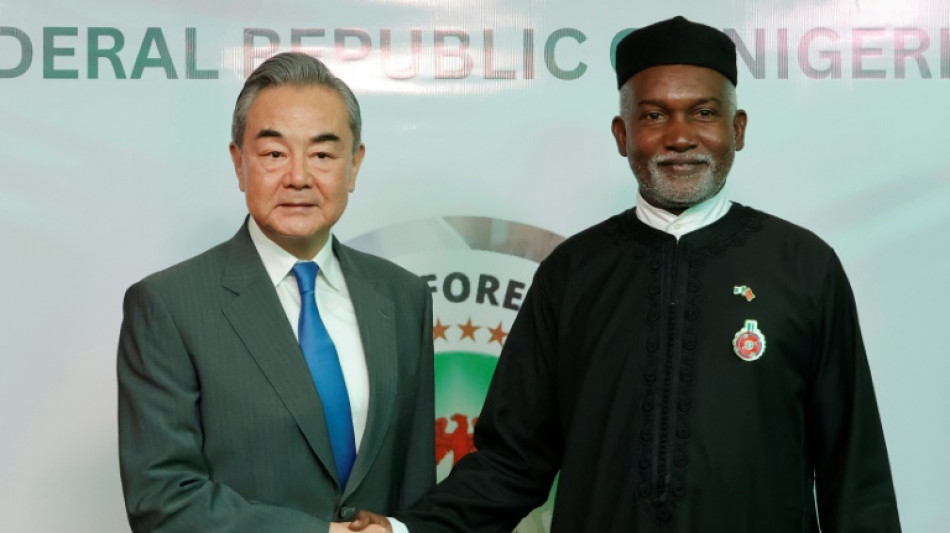
Chinese foreign minister pledges military aid for Africa / Photo: Kola Sulaimon - AFP

 Bahrain MPs Approve Five-Year Wait for Repeat Hajj Pilgrims

 David Walliams Identified as Celebrity in Sexual Misconduct Allegations After Legal Bid

 Texas Gov.-elect Hinojosa Plans Rate Freeze Amid Legal Concerns

 Elijah Moore Scores Career-High 29 as McNeese Sets School Records in 135-87 Win

 ترمب يعلن عن رغبة قوية لإنهاء حرب أوكرانيا قبل محادثات أبوظبي
 Honolulu Voters Reject Ranked Choice Voting in Election

 Panthers expected to begin 2027 NRL season away from new stadium

 Sweet As app launches restaurant discovery platform

 MLA seeks inquiry into reported sectarian gestures on Ormeau Road

 Louise O’Reilly attacks Simon Harris over unemployment remarks

 Virginia overwhelms Arkansas 91-72 behind balanced scoring
Chinaese Foreign Minister Wang Yi on Thursday pledged Beijing's full support and military aid for the world's poorest continent as he wrapped up his Africa tour in Nigeria.
Wang began an Africa tour on January 6, visiting Namibia, the Republic of Congo and Chad before winding up his tour in Nigeria, where he held talks with Nigerian President Bola Ahmed Tinubu and Foreign Minister Yusuf Tuggar in the capital Abuja.
"China will firmly support Africans in addressing African issues in the African way, African people are the real masters of this continent," Wang said after talks with Tinubu.
He pledged one billion yuan ($136 million) in military aid to Africa and said China would help train 6,000 troops and 1,000 police officers across the continent.
"China supports Nigeria in rallying countries in the region to achieve strength through unity, to build synergy through reconciliation, and to promote security through cooperation," Wang said Thursday.
Wang on Wednesday visited the Chadian capital N'Djamena just hours before two dozen armed assailants tried to storm the presidential palace in a failed bid that left 20 dead.
One of China's key trade partners in sub-Saharan Africa, Nigeria exports gas and oil to Beijing and imports manufactured products from the country.
Trade trade between the two nations amounted to $22.6 billion in 2023, according to Abuja.
- Geopolitical rivalry -
The geopolitical rivalry that has played out in Africa between former colonial rulers and nations like China, Russia and Turkey, has intensified since a wave of military coups toppled leaders in multiple West African countries in recent years.
Many former French colonies have severed ties with Paris and looked increasingly towards Moscow, Beijing, Ankara and Tehran.
China is Africa's top business partner, with $167.8 billion worth of trade in the first quarter of 2024, official Chinese media reported.
Beijing has sent hundreds of thousands of workers and engineers to Africa and gained strategic access to its vast mineral riches including copper, gold and lithium.
Chinese public bank loans have helped African nations finance construction projects and build infrastructure but the funds have led to deepening debt in some countries.
Chinese President Xi Jinping in September met with about 50 African leaders, including Nigeria's head of state, in a China-Africa cooperation summit during which he promised the continent $50 billion in aid over three years.
Analysts say Beijing's largesse towards Africa is being recalibrated in the face of economic trouble at home and that geopolitical concerns over a growing tussle with the United States may increasingly be driving policy.
R.AbuNasser--SF-PST