The quiet financier: Islamic State's elusive strongman / Photo: SIMON MAINA - AFP

 US House backs data center power cost bill amid midterm backlash
 US Congress passes sweeping Russia sanctions bill
 Barca hit Racing for seven as Atletico crush Osasuna

 US Fed raises rates to tackle 'too high' inflation, irking Trump
 Man Utd misery mounts after League Cup collapse against Brighton
 Turkey releases 106 protesters, jails more LGBTQ activists
 US Fed raises rates to tackle 'too high' inflation in move sure to rile Trump
 England were 'waiting for death' in World Cup semi-final defeat: Tuchel

 NFL star fined for displaying name of slain Palestinian girl
 Witsel retires from internationals after 18-year Belgium career
 US Fed raises rates to battle inflation in move likely to rile Trump

 Fitzpatrick 'not comfortable' over Dubai golf finale
 Gaza apartment block collapse kills 21, including 12 children
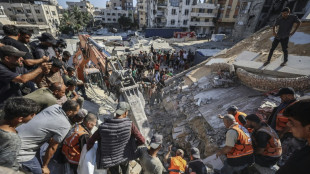 Gaza apartment block collapse leaves 21 dead
 US House targets data centers as midterm backlash grows

 French ex-minister Dati goes on trial in Renault-Nissan corruption case
 'Being Heumann' captures joy in fight for disability rights
 Retired great Nadal to play in exhibition matches
 IR-MED and Dice Technologies Announce collaboration to Evaluate and Advance Pressure-Injury Prevention Platform in Japan

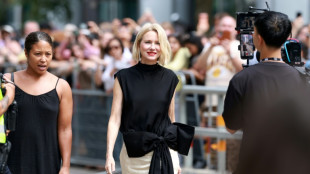 Watts, Pitt, Cruz to light up Spain's top film festival

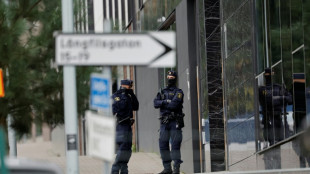 Sweden expels Iran embassy employee over anti-Jewish threats
 Toogood Gold's Table Mountain Sits in the Shadow of a Nevada Gold Rush

 MEXC July–August Security Report: 38.66M USDT in Risk Funds Intercepted, Futures Insurance Fund Hits 792M USDT

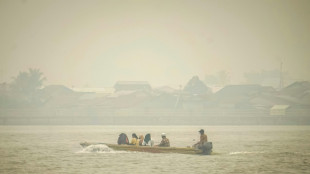 'Breathing toxin every day': Indonesians choked by haze feel helpless
 Stocks edge higher ahead of US Fed rate call
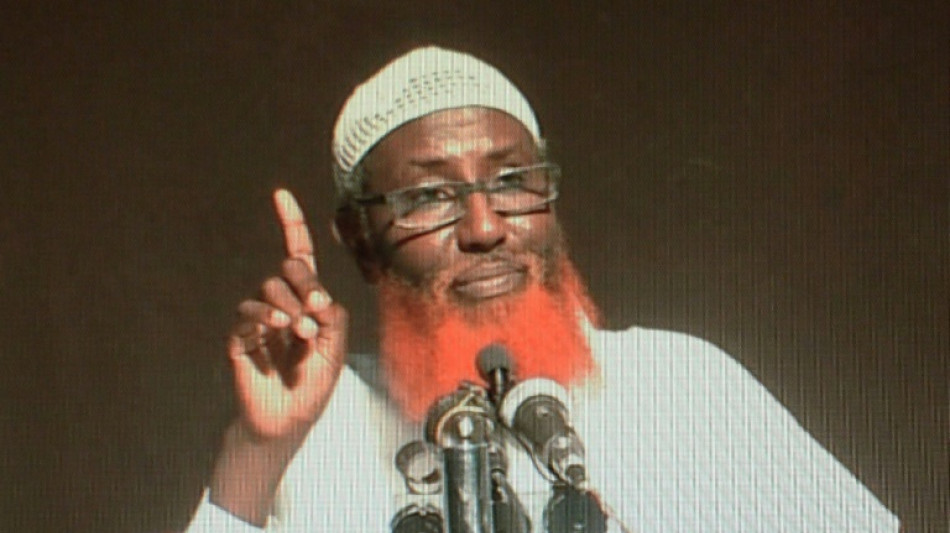
His orange henna-dyed beard and striking eyewear would make him easy to pick out in a crowd, but Abdul Qadir Mumin has remained elusive.
The Somalian leader of the Islamic State (IS) group has in all likelihood risen to the status of strongman of the entire organisation, even if he lacks the official title, analysts say.
While observers wonder who is behind IS-designated caliph Abou Hafs al-Hachimi al-Qourachi -- the would-be leader of all Muslims -- or whether such a person actually exists, Abdul Qadir Mumin may already be running IS's general directorate of provinces from Somalia.
"He is the most important person, the most powerful one, he is the one controlling the global Islamic State network," said Tore Hamming, at the International Centre for the Study of Radicalisation (ICSR).
In this opaque structure where the leaders get killed one by one by the United States, Mumin is among the few "senior guys who managed to stay alive the entire time until now, which does give him some status within the group", Hamming told AFP.
A few months ago it was thought that an American strike had killed him. But since there was never any proof of his demise, he is considered to be alive and active.
"Somalia is important for financial reasons," said Hamming. "We know that they send money to Congo, to Mozambique, to South Africa, to Yemen, to Afghanistan. So they have a good business model going."
The transactions are so shadowy that even estimating the amounts is impossible -- as is determining the exact routes the money takes from place to place.
- Small territory, big appeal -
Born in the semi-autonomous region of Puntland in Somalia's northeast, Sheikh Mumin lived in Sweden before settling in England, where he acquired British nationality.
In London and Leicester, he built a reputation in the early 2000s as a fiery preacher in radical mosques, but also in online videos.
He is said to have burned his British passport upon his arrival in Somalia, where he quickly became a propagandist for the Al-Shabaab group, linked to Al-Qaeda, before announcing his defection to IS in 2015.
"He controls a small territory but has a big appeal. He distributes volunteers and money," said a European intelligence official, who declined to be named, claiming that an IS attack in May in Mozambique "was carried out by Maghreb and African militants".
Mumin also finances the Ugandan rebels of the Allied Democratic Forces (ADF) -- affiliated with IS in the Democratic Republic of Congo -- "who now number between 1,000 and 1,500," the official said. With Mumin's help, "they have recently turned to the jihad" seeking "radicalism, weapons, and funding".
Some observers have described him as the caliph of the jihadist command structure. However, such an official designation would signal an ideological reversal for the group with deep roots in the Levant, the territory of the IS caliphate that lasted from 2014 to 2019 and spanned Iraq and Syria.
"That would create some kind of uproar within the community of supporters and sympathisers of IS," said Hans-Jakob Schindler, director of the Counter-Extremism Project (CEP) think tank.
- Shift toward Africa -
In theory, the caliph has to be an Arab from a tribe linked to the prophet. The supreme leader of a group so concerned with its ideological foundations "cannot be just any Somali with an orange beard," Schindler told AFP.
Especially because leaders of operationally active IS affiliates, such as IS-K in Afghanistan or ISWAP in western Africa, could lay claim to the position.
While the Somalian does not meet traditional leadership criteria, his geographical location brings some advantages.
"The Horn of Africa may have offered welcome insulation from instability in the Levant and greater freedom of movement," said CTC Sentinel, a publication on terrorism threats, at the West Point military academy.
"This profile of leadership parallels that of another jihadi leader -- Osama bin Laden -- who saw that funding his war was most central to winning it," it said.
Mumin's rise to the top, despite the small number of fighters under his command, also reflects two internal dynamics within IS.
The first, said Hamming, is that "the caliph is no longer the most important person in the Islamic State".
And the second is that IS is indeed pursuing a gradual strategic shift toward Africa.
"Ninety percent of violent images on jihad consumed in Europe come from Africa," said the European intelligence official.
Nonetheless, the organisation's leadership remains centralised in the Middle East, wrote CTC Sentinel.
"In this sense, much is business as usual," it said.
S.Abdullah--SF-PST