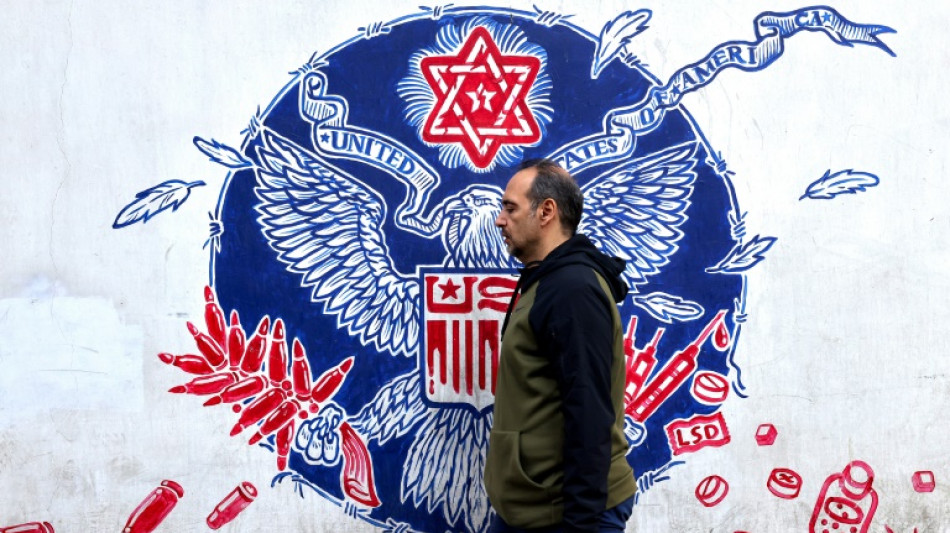
In Iran, late Jimmy Carter remembered as 'architect of sanctions' / Photo: ATTA KENARE - AFP

 NFL Chiefs' Kelce among investors bilked in Ponzi scheme
 Trump threatens EU over 'hostile' Canada association plan
 Argentine judge orders suspension of Falklands oil project
 Carrick takes the blame as troubled Man Utd suffer League Cup misery
 Barcelona hit seven in Racing Santander rout
 Amorim's Milan beaten by Benfica, Sunderland make dream European return

 US stocks fall, dollar gains after Fed lifts interest rates
 Seahawks rule out Darnold for Sunday game at Arizona
 Mbappe explains Ceuta shirt stance after criticism

 Improving Atletico cruise to comfortable win over Osasuna
 Candidate for UN chief calls for AI regulation akin to nuclear weapons
 O'Neill expects Celtic recovery after Old Firm misery
 Man City midfield trio backed to emulate Rodri and Silva
 'We're losing control,' AI pioneer Yoshua Bengio tells AFP
 WHO eyes 'encouraging' signs in DRCongo fight against Ebola
 Liga boss criticises Real Madrid trio for Ceuta shirt incident
 WTA Finals moved to Charlotte from 2027

 Almost 8,000 excess deaths in France's scorched summer: statistics

 Ex-president's lengthy war crimes sentence shocks Kosovo
 US House faces test on sweeping Russia sanctions bill

 British PM says to make 'difficult decisions' as inflation rises

 TotalEnergies pumps up controversy in France with cut-price gas
 Global fuel price demos: a round-up

 Leverate Launches MCP for Traders to Connect AI Assistants With Trading Platforms

 MEXC Launches $1M "Discover Your Wall Street DNA" Campaign to Help Traders Find Their Market Fit
Iran played a central role in Jimmy Carter's presidency, but in Tehran, where state television branded him the "architect of economic sanctions", many have far from fond memories of the late US president.
The former US president and Nobel Peace Prize laureate, who passed away on Monday at the age of 100, left behind a legacy of punitive measures whose impact on Iran has endured since the 1979 Islamic Revolution.
"Carter had a bad character," said Hassan Taherifar who works at a Tehran bazaar outside the former US embassy in Tehran, known locally as the "Den of Spies".
"Instead of supporting our nascent revolution, he opened a spy centre in our country," Taherifar added.
Others expressed stronger emotions. "He will rot in hell," one man in his 50s who did not give his name said outside the building.
Iran's state TV announced Carter's death by describing him as the "architect of economic sanctions" on the Islamic republic.
"Carter's failure... to properly deal with Iran, made his presidency short, only one term," said the reporter.
Under Iran's last shah, Mohammad Reza Pahlavi, Iran and the United States enjoyed close relations. During a 1977 visit by Carter to Iran, he called it "an island of stability in one of the more troubled areas of the world."
However, relations dramatically soured after the 1979 Islamic Revolution led by Ayatollah Ruhollah Khomeini.
On November 4, 1979, students loyal to Khomeini stormed the US embassy in Tehran, taking 52 staff hostage, an event that has shaped Iran-US relations for decades.
They demanded Washington hand over the recently toppled shah, who was being treated in the United States for cancer.
The hostages were held for 444 days, a period including the 1980 US presidential elections that Carter went on to lose.
The hostage-taking placed immense pressure on Carter, who authorised in April 1980 a top-secret military rescue mission that ended in disaster with the killing of eight US servicemen.
Washington officially broke off relations with Tehran in 1980, midway through the crisis, and they have never been restored.
The hostages were finally freed on January 20, 1981, on the day Carter's successor, Ronald Reagan, was sworn in as president.
Today, the former US embassy building serves as a museum, with a portrait of Carter still hanging on the wall of what was once the ambassador's office.
"Carter wasn't good to us," said 60-year-old Alireza, who runs an insurance company.
"This incident (the hostage crisis) had a great impact on relations between Iran and America and Carter's role was negative," he added.
While US sanctions on Tehran outlasted Carter, the late president backed a landmark nuclear deal with Iran in 2015 which provided sanctions relief in exchange for limits on Iran's nuclear programme.
The deal fell apart after then-president Donald Trump unilaterally withdrew the United States in 2018 and reimposed heavy sanctions on Iran.
In a 2014 interview with CNBC, Carter said he could have been re-elected to a second term if he had taken military action against Iran during the hostage crisis.
"It would have shown that I was strong and resolute and manly," the former president said.
"I could have wiped Iran off the map with the weapons that we had."
"But in the process, a lot of innocent people would have been killed, probably including the hostages."
U.Shaheen--SF-PST