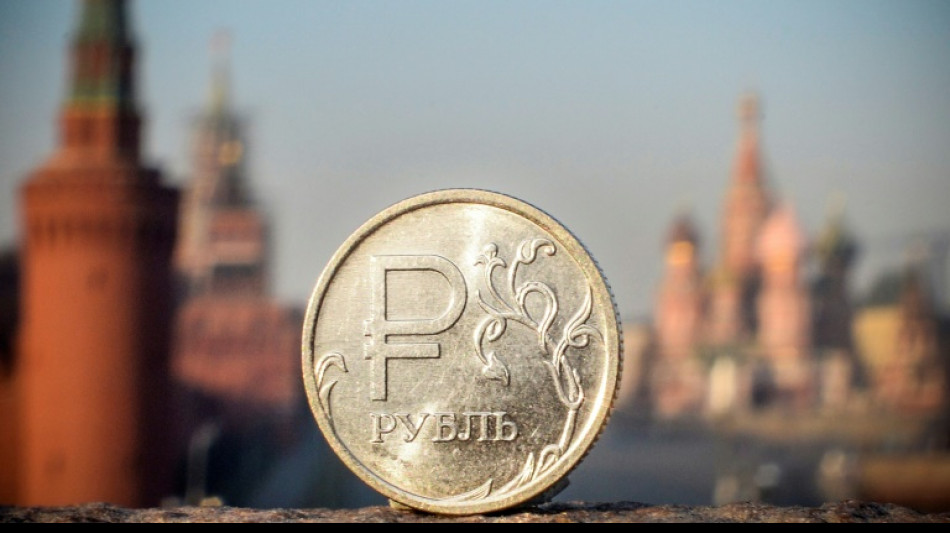
Economic woes mount for Russia's war machine / Photo: Alexander NEMENOV - AFP/File

 'Vande Mataram': Why is India's freedom song in spotlight?

 Counterculture pop artist Peter Max dies at 88: US media
 Asian Games chief defends 'functional' rooms after backlash

 Leader's sister says only 'idiots' think N. Korea to give up nukes
 World's water cycle becoming more unpredictable, UN warns
 Where the US-China tariff row stands ahead of White House summit
 Croc-habitat gets green light for 2032 Olympic rowing
 Indonesia cash-for-photos scheme turns animal hunters into protectors
 'Left-field' life: Briton becomes Thailand's top foreign monk

 India's transgender amendment leaves many in limbo
 Trump to host Xi amid pomp, low expectations
 Harry set for UK public outings with security, royal status hazy

 NFL Chiefs' Kelce among investors bilked in Ponzi scheme
 Trump threatens EU over 'hostile' Canada association plan
 Argentine judge orders suspension of Falklands oil project
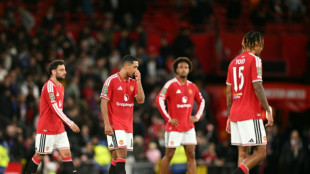 Carrick takes the blame as troubled Man Utd suffer League Cup misery

 Barcelona hit seven in Racing Santander rout
 Amorim's Milan beaten by Benfica, Sunderland make dream European return

 US stocks fall, dollar gains after Fed lifts interest rates
 Seahawks rule out Darnold for Sunday game at Arizona
 Mbappe explains Ceuta shirt stance after criticism
 Improving Atletico cruise to comfortable win over Osasuna

 Candidate for UN chief calls for AI regulation akin to nuclear weapons

 O'Neill expects Celtic recovery after Old Firm misery
 Man City midfield trio backed to emulate Rodri and Silva
Stubborn inflation, exorbitant borrowing costs, bankruptcy risks and a growth slowdown: the Russian economy is facing a slew of negative headlines, as the costs of the Ukraine war and Western sanctions mount.
Since ordering an invasion in February 2022, Russian President Vladimir Putin has repeatedly touted the "failure" of sanctions and hailed strong growth in the face of unprecedented uncertainty.
But going into 2025, that three-year run of mostly good economic news looks in serious doubt.
The latest setback for the Kremlin came last week, when inflation accelerated to 8.9 percent in November, according to official statistics.
Prices have been rising despite the central bank having hiked interest rates to a two-decade high of 21 percent.
Russian media, usually reluctant to report on any sign of social discontent, are turning increasing attention to hard-pressed families.
The price of butter, up a third since the start of the year, has become emblematic, with a slew of reports on rising thefts from supermarkets.
- 'Root cause' -
Most independent analysts say the invasion is to blame.
"The root cause of the economy's problems is labour starvation and sanctions ... the symptom is an inflationary surge," said Anton Tabakh, chief economist at the Russian ratings agency Expert RA.
Both those factors are directly related to the war.
Labour shortages, already pressing due to Russia's demographic problems, have been exacerbated by hundreds of thousands of men joining the army, being employed by arms manufacturers or fleeing the country, as well as a tightening of migration rules.
"This is holding back GDP growth," said economist Yevgeny Nadorshin, a former advisor to the economic development ministry.
He estimates Russia lacks around one million workers.
That has contributed to rising wages, pushing up prices set by businesses.
So too has the Kremlin's massive increase in military spending.
State expenditure is set to be 67.5 percent higher in 2025 compared to 2021, before Russia's military offensive.
Up against those huge sums, interest rate rises have so far had only a limited effect.
Central Bank Governor Elvira Nabiullina -- who has stressed the need to stop the "disease" of inflation "becoming chronic" -- has signalled she will hike rates again on Friday.
High rates have triggered outcry from bosses, including at state-run companies, with market borrowing costs running at 25-30 percent.
"The economy can't survive like this for long," German Gref, CEO of Russia's largest lender, state-run Sberbank, said this month.
Russian Railways said it will cut investment by 40 percent next year.
Even Putin's closest allies have complained.
Sergei Chemezov, head of the Rostec military-industrial conglomerate and a close friend of the president, described interest rates of more than 20 percent as "madness".
Analysts expect many firms, unable to refinance, will go under.
"The number of bankruptcies is about to rise sharply, especially among small and medium businesses. But there will be some among large businesses as well," said Nadorshin.
- Growth slowdown -
Faced with such an onslaught, the central bank predicts a sharp slowdown in growth next year -- to below 1.5 percent, from over 3.5 percent this year.
It has ruled out the prospect of stagflation -- low growth and high inflation -- yet the word is being used more and more frequently in Moscow.
Adding to those worries has been fresh volatility for the Russian currency, which slid to its weakest against the dollar since March 2022.
The ruble tumbled after the United States introduced sanctions on key financial institution Gazprombank, which had been handling all payments for Russian gas exports.
For the Kremlin, however, there are still some bright spots.
Chinese companies have filled many of the gaps left by Western firms that fled the market and Moscow has obtained sanctioned goods using friendly intermediaries.
The budget deficit is low by international standards and tax revenues from sources other than energy exports are rising.
"There are certainly no reasons to panic," Putin said last month amid the currency crisis.
Y.Zaher--SF-PST