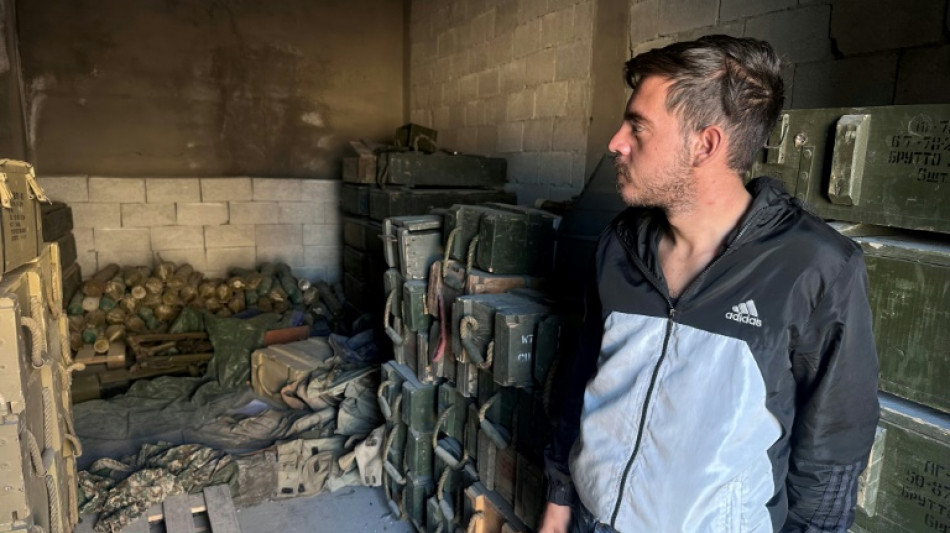
A week after Assad's fall, Syria faced with brutal legacy / Photo: Bakr ALKASEM - AFP

 Russians vote as Ukraine war drags on for fifth year

 Backpackers fret over Australian visa crackdown
 Most Asian stocks track Wall St rally, yen drops after BoJ rate hike
 Russians begin voting in controlled election as war drags on
 Trump 'clearly' wants dialogue with Pyongyang: South Korean President

 Bank of Japan hikes rates to 31-year high to battle inflation
 Thailand's Muslim separatists vow to fight to the end

 Mideast turmoil, AI set to dominate UN gathering of world leaders

 Australia to detain tourists who overstay visa, minister says

 Championship rivals brace for renewal of bitter feuds

 In Brazil's Amazon, the hunt for oil fuels hopes and fears
 Australian athlete who soiled herself apologises for continuing Hyrox race

 Baby orangutans in India expose 'frightening' scale of trafficking
 Doom Loop? Ed Sheeran struggles against Gaza tide
 Sudanese women hold fast to threatened henna body art

 Man Utd misery puts Carrick under pressure, Spurs feeling the heat
 Prized Mexican relic returns on loan, two centuries on

 Venezuela unblocks some censored news sites

 Samba stars on debut in Man City rout of Norwich

 Oversight Board blasts 'inadequate' Meta safeguards for AI deepfakes

 The Easter Island origins of buzzy Malkovich drama 'Wild Horse Nine'

 Third body recovered after Grand Canyon flash flood

 Harry makes first public appearance since return to UK

 Abhishek hits record T20 ton as India sweep series 3-0

 Abhishek hits record T20 ton as India sweep T20 series 3-0

A week after a lightning offensive toppled longtime leader Bashar al-Assad, Syrians are only beginning to scratch the surface of the atrocities committed under his rule, as the country's new rulers seek to reassure the international community.
UN special envoy for Syria Geir Pedersen arrived in Damascus on Sunday, his spokesperson said, declining to give details of his agenda.
Calm is slowly returning to the streets of the capital, with dozens of children streaming back to school on Sunday for the first time since Assad fled.
"The school has asked us to send middle and upper pupils back to class," said mother of three Raghida Ghosn, 56.
"The younger ones will go back in two days," she told AFP.
An official at one Damascus school said "no more than 30 percent" were back on Sunday, but that "these numbers will rise gradually".
Assad fled Syria last weekend following an 11-day rebel offensive led by the Islamist militant group Hayat Tahrir al-Sham (HTS), bringing to a dramatic end more than 50 years of brutal Assad clan rule.
His fall comes over 13 years into the civil war sparked by Assad's violent crackdown on pro-democracy protests in 2011.
The war has killed upwards of 500,000 people and displaced more than half the country's population.
In the week since the rebels took Damascus, each day has seen more light shed on the depths of the despair visited upon Syria's people over the past five decades.
Journalist Mohammed Darwish was one of those held in the so-called Palestine Branch, or Branch 235, a jail that was run by Syria's feared intelligence services.
"I was one of those they interrogated the most," Darwish told AFP as he returned to the prison years after his ordeal in 2018. He said he was questioned "every day, morning and night" for 120 days.
- 'Inclusive, representative' -
On Saturday, US State Secretary Antony Blinken said Washington had "been in contact with HTS and with other parties," without specifying how this contact occurred.
Meanwhile Western and Arab states along with Turkey -- a key backers of anti-Assad rebels -- called for a united peaceful Syria following a meeting between Blinken and top diplomats in Jordan.
In a joint statement, diplomats from the United States, Turkey, the European Union and Arab countries called for a Syrian-led transition to "produce an inclusive, non-sectarian and representative government formed through a transparent process", with respect for human rights.
A Qatari delegation was due in Syria Sunday to meet transitional government officials for talks on aid and reopening its embassy.
Unlike other Arab states, Qatar never restored diplomatic ties with Assad after a rupture in 2011.
Sunni Muslim HTS is rooted in Syria's branch of Al-Qaeda and is designated a "terrorist" organisation by many Western governments.
Although it has sought to moderate its rhetoric in recent years, its seizure of power has sparked concerns both domestically and internationally over the protection of religious and ethnic minorities.
The interim government insists that the rights of all Syrians will be protected, as will the rule of law.
On Sunday, Syrian Christians attended their first church service since Assad's fall.
Pubs and stores selling alcohol in Damascus initially closed following the rebel victory, but are now tentatively reopening.
Safi, landlord of the Papa bar in the Old City, said the rebels told him: "'You have the right to work and live your life as you did before'."
- Israeli strikes -
Assad was propped up by Russia -- to where a former aide told AFP he had fled -- as well as Iran and Lebanon's Hezbollah militant group.
The rebels began their offensive on November 27, the same day a ceasefire took effect in the Israel-Hezbollah war in Lebanon, in which Assad's ally suffered staggering losses.
Naim Qassem, the leader of Iran-backed Hezbollah, admitted Saturday that with Assad's fall, his group could no longer be supplied militarily through Syria.
He also said he hoped Syria's new rulers saw Israel "as an enemy" and do not normalise ties with the country.
Both Israel and Turkey have carried out military strikes inside Syria since Assad's fall.
The Syrian Observatory for Human Rights on Sunday reported fresh Israeli strikes near Damascus, after 60 strikes across Syria on Saturday.
The Britain-based Observatory, which relies on a network of sources in Syria, reported strikes on Syrian army tunnels and arms depots in the Damir area near Damascus on Sunday.
Israel has also ordered troops into a UN-patrolled buffer zone separating Israeli and Syrian forces on the Golan Heights, a move the UN said violated a 1974 armistice.
But "the general exhaustion in Syria after years of war and conflict does not allow us to enter new conflicts," he said in an online statement.
C.AbuSway--SF-PST