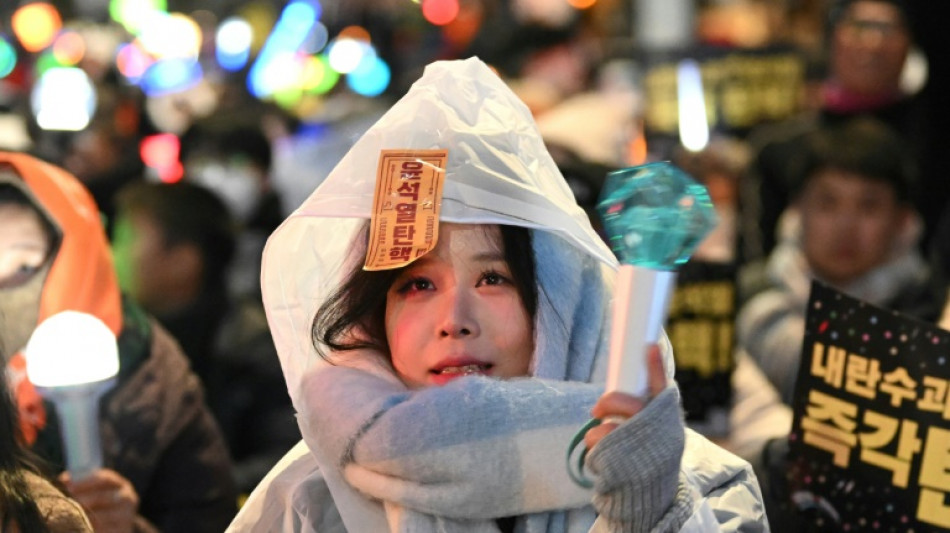
South Korean democracy holds firm against Yoon's martial law bid / Photo: Jung Yeon-je - AFP

 Russians vote as Ukraine war drags on for fifth year

 Backpackers fret over Australian visa crackdown
 Most Asian stocks track Wall St rally, yen drops after BoJ rate hike
 Russians begin voting in controlled election as war drags on
 Trump 'clearly' wants dialogue with Pyongyang: South Korean President

 Bank of Japan hikes rates to 31-year high to battle inflation
 Thailand's Muslim separatists vow to fight to the end
 Mideast turmoil, AI set to dominate UN gathering of world leaders
 Australia to detain tourists who overstay visa, minister says

 Championship rivals brace for renewal of bitter feuds
 In Brazil's Amazon, the hunt for oil fuels hopes and fears
 Australian athlete who soiled herself apologises for continuing Hyrox race

 Baby orangutans in India expose 'frightening' scale of trafficking
 Doom Loop? Ed Sheeran struggles against Gaza tide
 Sudanese women hold fast to threatened henna body art

 Man Utd misery puts Carrick under pressure, Spurs feeling the heat

 Prized Mexican relic returns on loan, two centuries on

 Venezuela unblocks some censored news sites
 Samba stars on debut in Man City rout of Norwich

 Oversight Board blasts 'inadequate' Meta safeguards for AI deepfakes

 The Easter Island origins of buzzy Malkovich drama 'Wild Horse Nine'

 Third body recovered after Grand Canyon flash flood
 Harry makes first public appearance since return to UK

 Abhishek hits record T20 ton as India sweep series 3-0

 Abhishek hits record T20 ton as India sweep T20 series 3-0

South Korea's swift rebuke of martial law and removal of President Yoon Suk Yeol from office have been hailed in the country as evidence of the strength of its young democratic institutions.
Yoon's bid to suspend civilian rule and claims of a communist conspiracy harkened back to the dark days of dictatorship in South Korea four decades ago, when human rights abuses by military and security forces were widespread.
But the fallout from the failed attempt was immediate and South Korea's institutions kicked in -- Yoon's inner circle were swiftly placed under police investigation and hauled before a parliament demanding answers.
Lawmakers rapidly launched impeachment proceedings against Yoon for his alleged "insurrection" and attempt to override the country's democratic constitution.
And on Saturday he was removed by a secret ballot in a tense vote in the ornate parliamentary chamber.
The vote sparked wild jubilation on the streets of Seoul -- opinion polls suggested more than 75 percent of the public supported impeachment.
"This situation has provided the Korean people with an invaluable lesson on what democracy truly entails and how our democratic republic can be protected," lawyer Yun Bok-nam, president of Lawyers for a Democratic Society, told AFP.
"For the people this has been a transforming experience in building a more powerful democratic consciousness among them."
- Red line drawn -
Bordering isolated, totalitarian North Korea and separated by a strip of sea from vast and authoritarian China, South Korea has for years been a posterchild for boisterous, democratic rule in East Asia.
Forged in the chaos and bloodshed of the 1980s anti-dictatorship movement -- from which many of the country's current crop of politicians emerged -- South Koreans have long sought to challenge their leaders in raucous street protests and vibrant displays of dissent.
And its strong rebuke of authoritarian rule this week again saw it buck a global trend towards autocratic politics, from the re-election this year of Donald Trump in the United States to a surge in right-wing populism in Europe.
That trend has seen UN Secretary-General Antonio Guterres warn that democratic values are "under assault" globally -- pointing to rising attacks and restrictions on media and human rights defenders.
But for many South Koreans, there was never any doubt that the country would turn back the clock.
"What we have witnessed over the past two weeks is a testament to the fact that it is now impossible to regress the country to its authoritarian past," said Bae Kang-hoon, co-founder of political think tank Valid.
"There is a red line drawn in the minds of the Korean people: that the country should never regress back to military rule," Bae told AFP.
"Yoon's martial law proclamation clearly crossed that line for many."
- Reform needed -
Should the Constitutional Court remove him from power, Yoon will gain the ignominious distinction of being only the second South Korean president to have been impeached.
Fellow conservative Park Geun-hye -- who Yoon, as chief prosecutor, played a key role in removing -- was also impeached under very similar circumstances.
But in the wake of that impeachment, South Korea "failed" to ensure the popular momentum that brought down Park translated into real change, Kim Jeong-min of analysis service Korea Pro told AFP.
"For this popular will to translate into better government will require a wholesale review of the constitution and the system," she said.
And Lim Ji-bong, constitutional law professor at Sogang University, stressed that "too much power" has been concentrated in the presidency.
Reforms could see the country "weaken the so-called 'imperial presidency' by getting rid of many of the president's powers and investing them in the legislature", he suggested.
Yoon has remained defiant throughout the turmoil that followed his martial law declaration.
He doubled down Thursday on allegations that "anti-state" forces were seeking to undermine South Korea's national security and electoral system.
"Yoon's speech was basically him sending out the impeachment invitation letter... like: 'Please impeach me'," Kang Won-taek, political science professor at Seoul National University, said.
"When the president said those things, it convinced lawmakers that he needed to be impeached."
W.Mansour--SF-PST