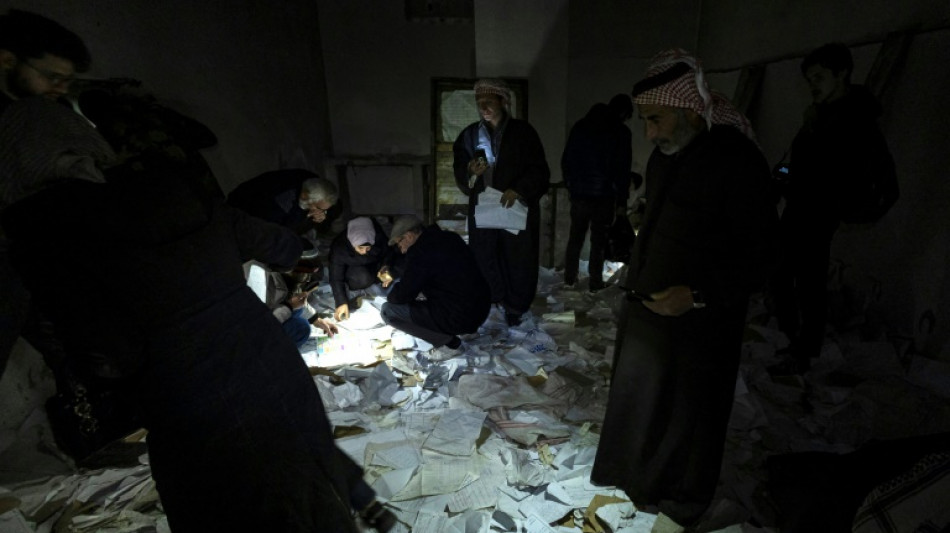
How an ex-inmate of brutal Syria jail overcame trauma by helping others / Photo: Sameer Al-DOUMY - AFP

 'A disaster' if Man City do not win says Maresca after flawless start
 Kerry James Marshall: American 'blackness' painter celebrated in Europe

 Spain coach De la Fuente offers 'full support' to people of Ceuta

 Russia seizes assets of Nestle, French firms over West's Ukraine support
 England can build on World Cup 'spirit', says Tuchel

 UNESCO can be 'moderator' in AI debate: chief to AFP

 Infantino 'must go', says German FA vice-president

 Russia seizes assets of Nestle, French firms

 Japan's busiest rail station tests robot bins
 Anthropic says AI systems moving towards building themselves
 Asian stocks boosted by falling oil, yen weakens after BoJ rate hike
 Pakistan court blocks expulsion of Afghan medical college students
 Athletes 'can't take it any more' as Asian Games issues mount

 Allen lights up Bills' new stadium with 41-31 win over Lions
 Afghan medical students in Pakistan hope court stops college expulsions
 AI doomsday warnings unlikely to slow IPOs but questions linger
 ICC eyes China in bid to expand cricket
 Nkunku craving freedom and fun on RB Leipzig return
 Bhutan's traditional archers lose ground to development
 Asian stocks track Wall St rally as oil prices drop

 South Korea makes Asian Games complaint over Japan warlord ceremony
 US aid cuts are killing Kenyan sex workers

 October 7 survivors, families take centre stage in Israel vote
 Captain Mat Ryan axed from Socceroos squad for Brazil games

 US approves sale of 48 F-35 jets to Saudi Arabia
Riyad Avlar spent 20 years languishing in Syria's jails, including a decade in the infamous Saydnaya prison, the scene of some of the Bashar al-Assad government's most brutal abuses.
Those long years behind bars have left him with one obsession: documenting and healing the atrocities committed inside the prison where he himself was locked up.
"I am sure we'll see Bashar al-Assad in court one day," predicted Avlar, who is Turkish.
In 2017, just months after he was freed, he co-founded the Association of Detainees and Missing Persons of Saydnaya Prison (ADMSP), which advocates for those jailed for daring to defy Assad's rule.
"We don't want revenge, we want justice," he told AFP at the organisation's headquarters in Gaziantep, southeastern Turkey.
It is here that Avlar and others who survived the brutalities of Saydnaya collect and compile documentation and testimonies relating the horrors that occurred inside an institution Amnesty International has described as a "human abattoir".
Thousands of inmates in the prison just north of Damascus, some held since the 1980s, were freed on Sunday by Syrian rebels who seized the capital in a lightning advance.
Images of the former captives walking free, haggard and emaciated, some needing help even to stand, were beamed around the world as a symbol of Assad's fall.
"It made me so happy to see them (freed) but when I saw images of the walls and the cells, it took me straight back there," said Avlar, who was arrested in 1996 while studying in Damascus over a letter sent to relatives relating the government's abuses in Syrian prisons.
"I can still feel the trauma."
- 'So many people died' -
Even today, he sometimes jolts awake at night believing himself to still be behind bars -- he was once held inside a cell in pitch darkness for two months.
"I saw people die in front of my eyes, many from starvation," said the activist with fine-rimmed black glasses, whose salt-and-pepper beard hides a scar from the torture he was subjected to 25 years ago.
The guards, he said, would often throw scraps of food into the toilet in front of starving prisoners.
"The prisoners ate it because they had to stay alive," he said.
Part of his recovery was through theatre and learning the saz, a long-necked lute popular in Turkey -- which for him was "art therapy".
But it has also helped being part of the association's work, through which he has been able to help countless families acquire proof of life for loved ones held inside Saydnaya.
That was thanks to "insiders", prison employees who secretly passed internal documents to the organisation, he said, without giving further details.
- 'No more' -
Saydnaya, where hundreds of Syrians rushed this week in the desperate hope of finding their loved ones, now stands empty.
More than 4,000 inmates were freed by the Islamist-led rebels, the ADMSP said.
The group estimates that more than 30,000 people were either executed or died as a result of torture, starvation or lack of medical care between 2011 and 2018.
And with so many bodies, the authorities were forced to use rooms lined with salt as makeshift morgues to make up for the lack of cold storage.
Haunted by his grisly memories, Avlar has no interest in going back there but acknowledges he has long dreamed of the day when "Saydnaya would be turned into a place of remembrance".
"I am so happy there is not a single prisoner left in there," Avlar said.
"And I just hope there won't ever be any again."
S.Abdullah--SF-PST