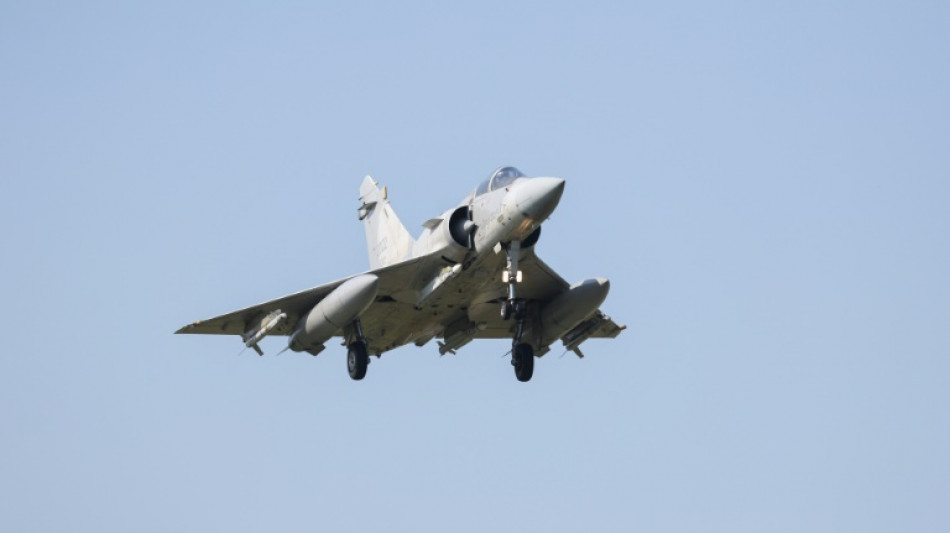
The Taiwan Strait: crucial waterway and military flashpoint / Photo: I-Hwa CHENG - AFP

 'A disaster' if Man City do not win says Maresca after flawless start

 Kerry James Marshall: American 'blackness' painter celebrated in Europe

 Spain coach De la Fuente offers 'full support' to people of Ceuta

 Russia seizes assets of Nestle, French firms over West's Ukraine support
 England can build on World Cup 'spirit', says Tuchel

 UNESCO can be 'moderator' in AI debate: chief to AFP

 Infantino 'must go', says German FA vice-president

 Russia seizes assets of Nestle, French firms

 Japan's busiest rail station tests robot bins

 Anthropic says AI systems moving towards building themselves

 Asian stocks boosted by falling oil, yen weakens after BoJ rate hike
 Pakistan court blocks expulsion of Afghan medical college students

 Athletes 'can't take it any more' as Asian Games issues mount
 Allen lights up Bills' new stadium with 41-31 win over Lions

 Afghan medical students in Pakistan hope court stops college expulsions

 AI doomsday warnings unlikely to slow IPOs but questions linger
 ICC eyes China in bid to expand cricket
 Nkunku craving freedom and fun on RB Leipzig return

 Bhutan's traditional archers lose ground to development
 Asian stocks track Wall St rally as oil prices drop

 South Korea makes Asian Games complaint over Japan warlord ceremony
 US aid cuts are killing Kenyan sex workers

 October 7 survivors, families take centre stage in Israel vote
 Captain Mat Ryan axed from Socceroos squad for Brazil games

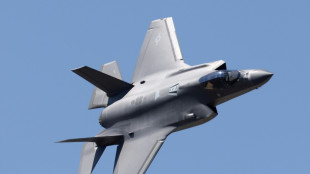 US approves sale of 48 F-35 jets to Saudi Arabia

Taiwan accused China on Tuesday of holding its biggest maritime mobilisation around the island in years, though Beijing has stayed tight-lipped over its latest show of force.
Here, AFP looks at the Taiwan Strait, a critical waterway and growing military flashpoint:
- Where is the Taiwan Strait? -
The strait separates the eastern Chinese province of Fujian from the main island of Taiwan, home to around 23 million people.
At its narrowest point, just 130 kilometres (about 80 miles) of windswept water separates the two major landmasses, and several outlying Taiwanese islands -- including Kinmen and Matsu -- lie just a few kilometres from the Chinese coastline.
China and Taiwan have been governed separately since Mao Zedong's communist army won a civil war and sent the opposition nationalist forces fleeing across the strait in 1949.
Beijing has maintained ever since that the island is part of its territory, and has not ruled out using force to bring it under control.
- Why is it important? -
The strait is a critical artery for global shipping through which a huge volume of trade passes every day.
Around $2.45 trillion of goods -- more than a fifth of global maritime trade -- transited the strait in 2022, according to the Center for Strategic and International Studies, a Washington-based think tank.
Taiwan plays an outsized role in the global economy thanks to producing over 90 percent of the world's most advanced computing chips, used in everything from smartphones to cutting-edge military equipment.
Analysts say a Chinese invasion would deal a catastrophic blow to these supply chains.
More minor disruptions, such as a blockade of the island, would cause costly shipping cancellations and diversions that would impact worldwide consumers.
"In the event of a long conflict over Taiwan, financial markets would tank, trade would shrivel, and supply chains would freeze, plunging the global economy into a tailspin," Robert A. Manning, a China expert at Washington's Stimson Center, wrote this year.
A report by the Rhodium Group estimated that a blockade of the island could cost firms dependent on Taiwan's chips $1.6 trillion in revenue annually.
An invasion would also endanger Taiwan's way of life, embodied by its democratic freedoms and boisterous elections.
It would also risk a wider conflict because the United States, while not recognising Taiwan diplomatically, has an agreement to help the island defend itself.
- What do we know about the drills? -
Unlike previous exercises, Beijing has not announced any drills.
But a senior Taiwanese security official told AFP on Tuesday that "nearly 90" Chinese naval and coast guard ships were currently in waters along the so-called first island chain, which includes Japan's Okinawa, Taiwan and the Philippines.
Taiwan's defence ministry said earlier it had also detected 47 Chinese aircraft near the island in the 24 hours to 6:00 am (2200 Monday GMT), the highest number since October.
China's foreign ministry declined to answer questions about the drills on Tuesday, referring reporters to the "competent authorities".
But ministry spokeswoman Mao Ning said at a regular press conference that Beijing would "resolutely defend its national sovereignty and territorial integrity".
The developments came after Taiwanese President Lai Ching-te visited the US last week, a visit strongly criticised by Beijing.
- Has this happened before? -
China has ramped up pressure on Taiwan in recent years and has staged four large-scale military exercises around the island since 2022.
In October, Chinese forces deployed fighter jets, bombers and warships in areas to the north, south and east of Taiwan, and simulated a rocket strike in drills called "Joint Sword-2024B".
The manoeuvres came after Lai gave a speech on Taiwan's national day that Beijing viewed as a provocative move towards independence.
Beijing launched other drills -- "Joint Sword-2024A" -- in May following Lai's inauguration, and encircled Taiwan in April last year after his predecessor Tsai Ing-wen met with then US Speaker Kevin McCarthy.
But a spokesperson for Taipei's defence ministry has said the scale of the maritime forces in the current operation "exceeds the four drills since 2022".
Several major crises flared across the strait in preceding decades, most recently in 1995-6, when China conducted missile tests around Taiwan.
W.AbuLaban--SF-PST