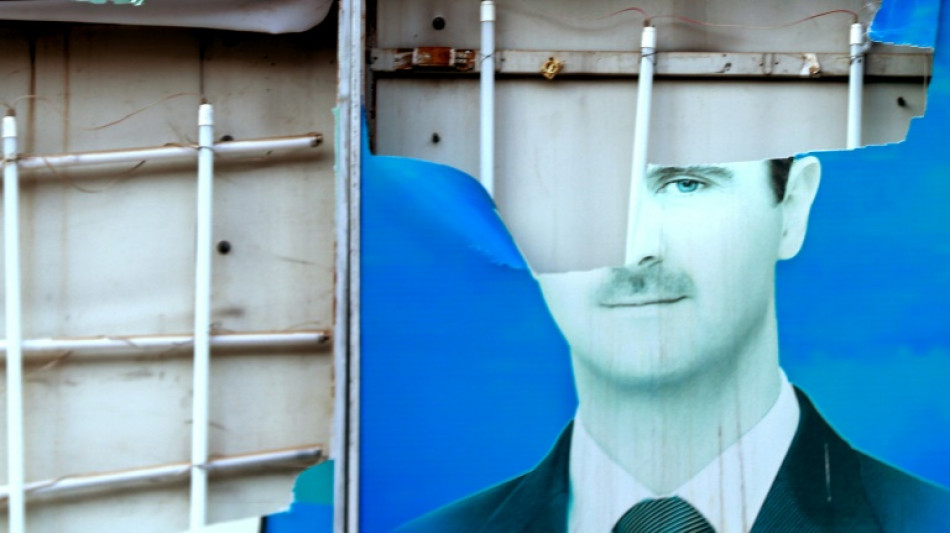
Wary Europe eyes Syria with hope -- and fear / Photo: Delil SOULEIMAN - AFP

 Macron warns of Russian 'hybrid' threat after meeting presidential hopefuls
 UN holds third informal poll for new chief
 Kulusevski return can spark Spurs: De Zerbi
 Shakira to cap off world tour with Madrid 12-gig run
 Isolated Syrian-Druze city blames Damascus for shortages
 Isolated Syrian-Druze city shortages
 Dutch drop Depay for Germany match in Xavi's first pick
 Ronaldo named in Portugal squad for Nations League
 Stock markets diverge after central bank rate hikes
 Anti-Assad music star makes triumphant return to Syria
 In-form Fernandez included in Spain Nations League squad
 Arteta buries hatchet with Hurzeler ahead of Brighton clash
 Alexander-Arnold and Palmer return to England squad for Nations League
 Russians vote as Ukraine war drags on for fifth year
 Backpackers fret over Australian visa crackdown
 Most Asian stocks track Wall St rally, yen drops after BoJ rate hike
 Russians begin voting in controlled election as war drags on
 Trump 'clearly' wants dialogue with Pyongyang: South Korean President

 Bank of Japan hikes rates to 31-year high to battle inflation
 Thailand's Muslim separatists vow to fight to the end
 Mideast turmoil, AI set to dominate UN gathering of world leaders
 Australia to detain tourists who overstay visa, minister says
 Championship rivals brace for renewal of bitter feuds

 In Brazil's Amazon, the hunt for oil fuels hopes and fears
 Australian athlete who soiled herself apologises for continuing Hyrox race
European leaders have hailed the end of Bashar al-Assad's brutal rule in Syria as a moment of hope -– but they also view his sudden toppling as fraught with dangers.
As the war-torn country charts a new course, Europe is anxious to avoid fresh turmoil that could send migrants and jihadists once again heading to the continent.
"This historic change in the region offers opportunities but is not without risks," European Commission President Ursula von der Leyen wrote on X.
"Europe is ready to support safeguarding national unity and rebuilding a Syrian state that protects all minorities."
For now, still just hours after the end of more than five decades of domination by the Assad family, some initial signs appear promising.
As jubilant Syrians celebrated what they prayed would be the end of over 13 years of civil war, streams of refugees headed back home across the border from neighbouring countries.
Meanwhile, the Islamist-led rebels who swept into Damascus after a lightning advance have vowed to maintain state institutions, restore order and protect all citizens.
But it is still very early days for those yearning to heal the festering wound in the heart of the Middle East.
There are profound suspicions about Syria's new would-be leaders. The Hayat Tahrir al-Sham group (HTS) that spearheaded the takeover is rooted in Syria's Al-Qaeda branch but broke ties with the group in 2016. It is currently listed as a "terrorist" organisation by Western governments.
After years of fighting the country is controlled by a rag-tag assortment of armed groups often backed by rival international powers.
"There are already concerns over what comes next, given the profound failure of recent regional transitions such as in Libya," said Julien Barnes-Dacey of the European Council on Foreign Relations.
But, he insisted: "Europeans need, first and foremost, to concentrate on the great opportunity presented by Assad's demise, recognising (that) the core driver of instability, brutal violence and refugee outflows from Syria has departed the scene."
- 'Biggest hope' -
The war in Syria -- unleashed by Assad's bloody crackdown on protests in 2011 -- helped spark a migrant crisis that saw over one million people arrive in Europe in 2015.
The vast influx tested EU unity and continues to reverberate today, as far-right parties tap anti-migrant sentiment to rise in the polls.
Some in Europe were quick to jump on the changes in Syria to try to halt arrivals of asylum seekers from the country and look to start sending people back.
Austria on Monday said it was suspending all Syrian asylum applications and preparing the "deportation" of refugees back to Syria.
Germany said it was freezing asylum requests due to the "unclear situation".
"The situation is extremely volatile. We were taken by surprise," said one EU official.
"We of course want to avoid a Libyan-style scenario, which would cause a massive migration crisis."
Barnes-Dacey said Europe should throw its weight behind a renewed United Nations-backed political process for Syria, ramp up humanitarian support, engage key player Turkey and try to encourage HTS to be moderate.
"Although European states need to approach the situation with considerable caution and modesty, they should nonetheless quickly and meaningfully work to incentivise a positive trajectory," he said.
"The biggest hope should now lie in the agency of Syrians themselves."
- 'Difficult equation' -
A key concern for Europe, the United States and other regional powers is to prevent any power vacuum in Syria allowing a resurgence of the Islamic State jihadist group.
IS -- which had seized control of swathes of Syria and Iraq during the civil war -- lost territorial control of its "caliphate" at the hands of US-led forces in 2019.
But jihadist fighters still operate in remote desert areas of Syria.
Foreign fighters from IS launched a string of attacks on European soil including in 2015 in Paris and 2016 in Brussels.
Thousands of jihadists from the West and their families, who their home countries have so far refused to repatriate, are also detained in camps in Syria run by Kurdish forces.
In a sign of the concern, US warplanes on Sunday carried out strikes on 75 IS targets in Syria, warning it would "remain vigilant" against the emergence of "terrorist" groups.
"I think there will be a continuing US-led effort to push back against a re-emergence of IS," said Ian Lesser, of the German Marshall Fund think tank.
Lesser said that on a broader issue, Europe faced a "difficult equation" if it sought to engage with the new leadership in Syria, given its previous links to jihadist extremists.
"Europe will need to balance trying to get a more secular outcome and not provoking conflict with any nascent regime," he said.
HTS and its leader are under EU sanctions and Brussels said Monday it was "not currently engaging" with the group.
"We will need to assess not just their words but also their actions," an EU spokesman said.
A.AlHaj--SF-PST