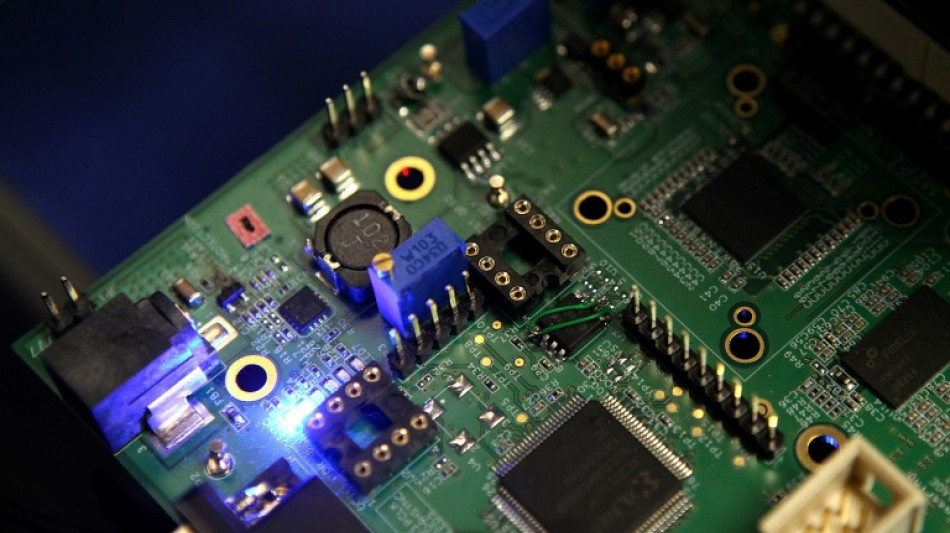
US clean energy, defense to be impacted by China export curbs / Photo: JUSTIN SULLIVAN - GETTY IMAGES NORTH AMERICA/AFP/File

 Macron warns of Russian 'hybrid' threat after meeting presidential hopefuls

 UN holds third informal poll for new chief

 Kulusevski return can spark Spurs: De Zerbi

 Shakira to cap off world tour with Madrid 12-gig run

 Isolated Syrian-Druze city blames Damascus for shortages

 Isolated Syrian-Druze city shortages

 Dutch drop Depay for Germany match in Xavi's first pick

 Ronaldo named in Portugal squad for Nations League

 Stock markets diverge after central bank rate hikes

 Anti-Assad music star makes triumphant return to Syria

 In-form Fernandez included in Spain Nations League squad

 Arteta buries hatchet with Hurzeler ahead of Brighton clash

 Alexander-Arnold and Palmer return to England squad for Nations League

 Russians vote as Ukraine war drags on for fifth year

 Backpackers fret over Australian visa crackdown

 Most Asian stocks track Wall St rally, yen drops after BoJ rate hike

 Russians begin voting in controlled election as war drags on

 Trump 'clearly' wants dialogue with Pyongyang: South Korean President

 Bank of Japan hikes rates to 31-year high to battle inflation

 Thailand's Muslim separatists vow to fight to the end

 Mideast turmoil, AI set to dominate UN gathering of world leaders

 Australia to detain tourists who overstay visa, minister says

 Championship rivals brace for renewal of bitter feuds

 In Brazil's Amazon, the hunt for oil fuels hopes and fears

 Australian athlete who soiled herself apologises for continuing Hyrox race

China's retaliatory export controls could take a toll on the growing US clean energy sector and its defense industry, analysts say, as a trade tussle escalates between the world's two biggest economies.
Beijing announced this week it would ban exports of gallium, germanium and antimony to the United States, targeting materials used for everything from semiconductors to solar cells.
China also tightened restrictions on graphite, which is key to the electric vehicle industry.
The moves, which Beijing said were to safeguard national security, swiftly followed Washington's own curbs to hobble China's ability to make advanced computer chips.
While trade tensions have been simmering, US President-elect Donald Trump's arrival at the White House in January is likely to ratchet up the temperature on trade -- with the Republican already vowing sweeping tariffs on Chinese imports.
Analysts say it would take time to assess the impact of the new Chinese curbs on US industries, though any immediate hit should be limited.
Some see Beijing's moves as symbolic for now, even as ramifications depend on how China enforces the new rules.
"This certainly could drive up costs," said Arun Seraphin of the National Defense Industrial Association. "It could create situations where you can't produce what you need."
"It's certainly going to drive a lot of uncertainty for companies who want to plan out their supply chain," he told AFP.
China is a major producer of the three metals in question.
In August, it unveiled export controls on some antimony products and since then, shipments have plunged.
Restrictions announced in 2023 on gallium and germanium also hit exports to the United States.
- Defense tech -
"Gallium, germanium, and antimony are vital inputs for defense technologies," said Gracelin Baskaran and Meredith Schwartz of the Center for Strategic and International Studies (CSIS) in a recent analysis.
Gallium and germanium are increasingly preferred over traditional silicon for high-performance chips used in defense applications, CSIS added.
It noted these materials have properties that boost device performance, speed, and energy efficiency.
Antimony is used in fireproofing and has defense-related uses, too.
While China is investing in munitions and buying high-end weapons systems more rapidly than the United States, the US industrial base lacks capacity to meet defense tech production needs, the report warned.
"Bans on vital mineral inputs will only further allow China to outpace the United States in building these capabilities," it said.
The US Geological Survey estimates that if China's net exports of gallium and germanium were completely restricted simultaneously, US GDP could decrease by $3.4 billion.
- Clean energy -
Besides defense, gallium-based semiconductors are used in radio frequency electronics, LEDs for lighting and high-efficiency solar cells, the US Geological Survey noted.
Although gasoline vehicles do not call for graphite, electric vehicles (EVs) require an average of 136 pounds (61.7 kilograms) of the material, CSIS said.
This could prove dicey for the United States, which has spurred billions in private sector investments for its domestic EV supply chain through subsidies via the Inflation Reduction Act.
The act is a package of energy transition policy and social reforms under President Joe Biden.
Seraphin told AFP that although Washington also pushed to attract investment and build up US semiconductor manufacturing capacity through the CHIPS and Science Act, these efforts do not yet target components such as germanium.
- Challenges -
Beijing's retaliation this week steps up the restrictions on gallium and germanium announced in 2023 -- as China hit back at previous US semiconductor export controls.
"The industry was likely somewhat surprised by the swiftness of the imposition of a broader ban, but has been conditioned over the past year to expect some restrictions," Paul Triolo of Albright Stonebridge Group told AFP.
He noted that China's commerce ministry had already implemented a licensing regime around these key minerals, including "rolling three-month licenses to try and prevent stockpiling."
While there has been some effort to stockpile minerals like graphite and gallium, this does not appear to be coordinated between US authorities and allies to reduce reliance on China over the long haul.
It will be tricky to create capacity for processing and producing products based on these minerals outside China, Triolo believes, due to costs and regulatory challenges.
"Companies are reluctant to enter these markets without long-term guarantees of subsidies, given the dominance of Chinese firms," he said.
H.Nasr--SF-PST