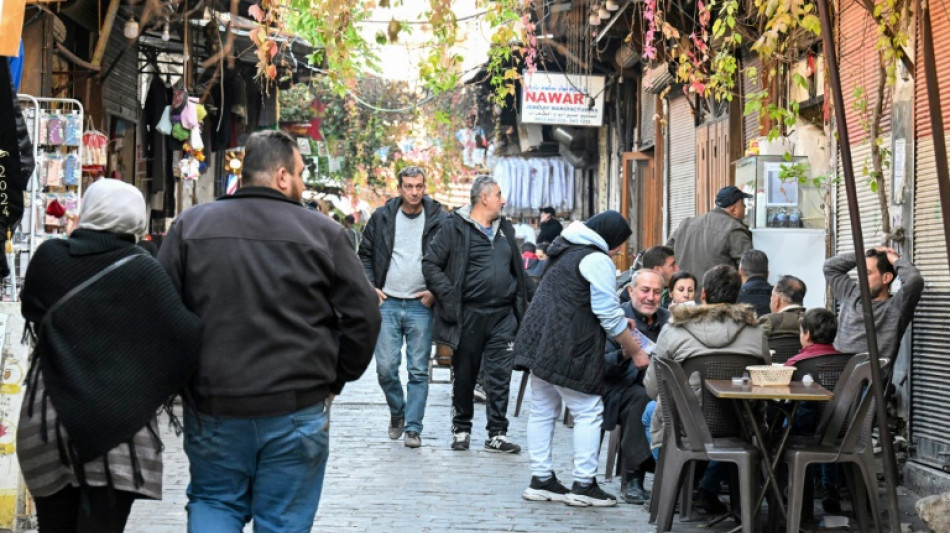
Damascus gripped by anxiety in face of rebel offensive / Photo: LOUAI BESHARA - AFP

 Crisis-wracked Volkswagen warns of 10-bn-euro hit to profits

 Costa Rica's Grynspan tops third informal poll for UN chief: diplomat

 Stock markets retreat after central bank rate hikes

 Russia labels director of Cannes Grand Prix winner a 'foreign agent'

 Macron warns of Russian 'hybrid' threat after meeting presidential hopefuls

 UN holds third informal poll for new chief

 Kulusevski return can spark Spurs: De Zerbi

 Shakira to cap off world tour with Madrid 12-gig run

 Isolated Syrian-Druze city blames Damascus for shortages

 Isolated Syrian-Druze city shortages
 Dutch drop Depay for Germany match in Xavi's first pick

 Ronaldo named in Portugal squad for Nations League
 Stock markets diverge after central bank rate hikes

 Anti-Assad music star makes triumphant return to Syria

 In-form Fernandez included in Spain Nations League squad

 Arteta buries hatchet with Hurzeler ahead of Brighton clash
 Alexander-Arnold and Palmer return to England squad for Nations League
 Russians vote as Ukraine war drags on for fifth year

 Backpackers fret over Australian visa crackdown
 Most Asian stocks track Wall St rally, yen drops after BoJ rate hike
 Russians begin voting in controlled election as war drags on
 Trump 'clearly' wants dialogue with Pyongyang: South Korean President

 Bank of Japan hikes rates to 31-year high to battle inflation
 Thailand's Muslim separatists vow to fight to the end

 Mideast turmoil, AI set to dominate UN gathering of world leaders

Like many others in the Syrian capital Damascus, student Shadi chose to stay home so he could keep up with the pace of events since rebels launched a shock offensive last week.
"I had no wish to go out and everyone chose to stay in to follow the news surrounded by their loved ones," said Shadi, who did not wish to give his full name.
As the rebels have taken city after city in quick succession, many Syrians have been wracked by uncertainty, fearing a revival of the worst days of Syria's grinding civil war now in its 14th year.
"We don't understand anything anymore. In just one week, the twists and turns have been so overwhelming that they are beyond all comprehension," the young man said.
"The worry is contagious but we have to keep our cool," he said, never once taking his eyes off the alerts on his mobile phone.
Syrian rebels, led by Islamist militant group Hayat Tahrir al-Sham (HTS), launched the shock offensive on November 27, sweeping from their stronghold in the northwest to capture swathes of northern and central Syria including the major cities of Aleppo and Hama.
Government forces have launched a counteroffensive seeking to repel the rebels but at the cost of relaxing their grip on other parts of the country, notably the east where Kurdish-led forces have taken over.
"Whenever rumours spread, people rush to buy various products, bread, rice, sugar and detergents," said Amine, 56, who runs a grocery store in the Sheikh Saad neighbourhood of the capital.
"Today, I bought twice from my wholesaler to keep up with demand."
- Exams delayed -
The offensive has already sent food prices skyrocketing by 30 percent in Damascus, according to residents.
The Syrian pound is trading at an all-time low of 19,000 to the dollar, down from 15,000 before the rebels launched their offensive on Wednesday of last week.
Security measures -- already strict before the offensive -- have been beefed up, with extra car searches, particularly on vehicles coming from outside the capital, according to residents.
Concerns have been further driven by the spread of disinformation and rumours.
The Syrian defence ministry has denounced "fabricated" videos, including of explosions at the headquarters of the general staff, calling on citizens not to fall prey to "lies" that "aim to sow chaos and panic among civilians".
In the usually lively neighbourhood of Bab Sharqi, restaurants and cafes are near-deserted in the evening, with some even closing up early due to the absence of customers.
Damascus University has delayed end-of-term exams and the Syrian football federation has postponed matches until further notice.
State news agency SANA reported that at Friday prayers, imams called on the faithful "not to panic... and to stand as one behind the Syrian Arab Army to defend the homeland".
Georgina, 32, said she had "heard a lot of rumours".
"I went to Old Damascus and saw a normal situation," she said, adding that nonetheless "everyone was keeping an eye on the news".
Meanwhile, some radio stations have switched from variety programming to non-stop news segments.
On state television, programmes host analysts and witnesses on the ground, including those denying "rumours" of fresh territorial losses to the advancing rebels.
F.Qawasmeh--SF-PST