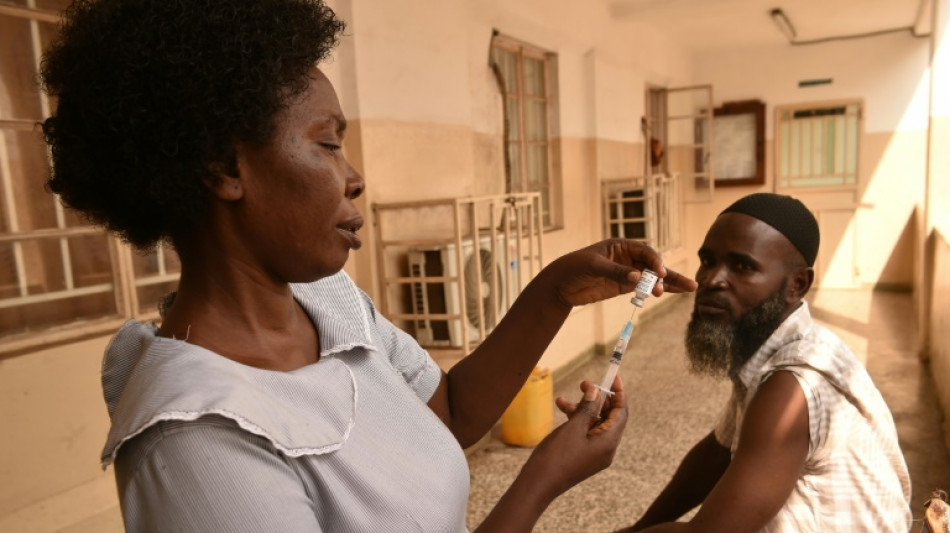
Pandemic treaty talks round wrapping up without a breakthrough / Photo: Saidu BAH - AFP

 Crisis-wracked Volkswagen warns of 10-bn-euro hit to profits
 Costa Rica's Grynspan tops third informal poll for UN chief: diplomat
 Stock markets retreat after central bank rate hikes
 Russia labels director of Cannes Grand Prix winner a 'foreign agent'

 Macron warns of Russian 'hybrid' threat after meeting presidential hopefuls
 UN holds third informal poll for new chief
 Kulusevski return can spark Spurs: De Zerbi

 Shakira to cap off world tour with Madrid 12-gig run

 Isolated Syrian-Druze city blames Damascus for shortages

 Isolated Syrian-Druze city shortages

 Dutch drop Depay for Germany match in Xavi's first pick

 Ronaldo named in Portugal squad for Nations League
 Stock markets diverge after central bank rate hikes
 Anti-Assad music star makes triumphant return to Syria

 In-form Fernandez included in Spain Nations League squad
 Arteta buries hatchet with Hurzeler ahead of Brighton clash
 Alexander-Arnold and Palmer return to England squad for Nations League

 Russians vote as Ukraine war drags on for fifth year

 Backpackers fret over Australian visa crackdown
 Most Asian stocks track Wall St rally, yen drops after BoJ rate hike

 Russians begin voting in controlled election as war drags on
 Trump 'clearly' wants dialogue with Pyongyang: South Korean President

 Bank of Japan hikes rates to 31-year high to battle inflation

 Thailand's Muslim separatists vow to fight to the end
 Mideast turmoil, AI set to dominate UN gathering of world leaders
A bonus round of talks striving to finish a landmark global agreement on handling future pandemics was set to close Friday without a breakthrough.
The week of talks at the World Health Organization's headquarters in Geneva opened Monday -- almost exactly three years to the day after countries decided, in the heat of the Covid-19 crisis, to draft a new accord on pandemic prevention, preparedness and response.
The closed-door session was added on to the 12th round of negotiations held last month in the hope of nailing down a deal by the end of the year.
But amid grinding incremental progress, the talks were set to roll into 2025 without resolving some of the toughest sections.
Co-chair Anne-Claire Amprou urged countries to approve "as much as we can" by the end of Friday.
The objective, she told an open session with non-governmental organisations, was "to finalise a negotiation and get this pandemic agreement, even if it's not perfect".
- 'Real protection for everyone' -
The WHO's 194 member states negotiating the treaty have agreed on most of what it should include, but are stuck on the practicalities.
A key fault-line lies between Western nations with major pharmaceutical industry sectors and poorer countries wary of being sidelined when the next pandemic strikes.
While the outstanding issues are few, they include the heart of the agreement: the obligation to quickly share emerging pathogens, and then the pandemic-fighting benefits derived from them such as vaccines.
They also include vital issues like how to ensure pandemic threat surveillance; the interconnection between human and animal health and the environment; and the transfer of technology and knowledge allowing for the broad production of pandemic-fighting products.
The Medicines, Law and Policy NGO said some "very difficult issues... remain largely absent, or are at best weak" in the agreed sections of the text.
Oxfam, on behalf of 26 NGOs, stressed that countries "still have the opportunity to be on the right side of history", with an instrument providing "real protection for everyone".
- Framework idea -
The Panel for a Global Public Health Convention NGO urged countries to keep up the momentum in the New Year, emphasising the need for "give and take".
The talks process is charged with wrapping up in time for the next World Health Assembly -- the WHO's decision-making body -- in May.
One option is striking a skeleton agreement that could be fleshed out later.
"Not all challenges will be resolved before May, so we ask you to focus on establishing a solid framework with equity as its cornerstone," said the Four Paws animal welfare NGO.
Action for Animal Health reminded countries that pandemic threats could spring up at any time.
"Outbreaks of avian influenza, H5N1 in cattle and its spillover to humans, and the new strain of mpox in central Africa send us a very clear message -- and one that we ignore at our peril," it said.
- Return of Trump -
Countries are mindful of Donald Trump's return to the US presidency on January 20.
Trump is hostile towards the WHO. In his first term, he began pulling the United States out of the organisation.
His pick for health secretary is the leading vaccine sceptic and conspiracy theorist Robert F. Kennedy Jr.
The WHO has regularly hit out at misinformation and disinformation surrounding the accord negotiations, and accusations that the deal could enable the UN health agency to encroach on countries' sovereignty.
The draft specifies that "nothing" in the agreement should be interpreted as giving the WHO "any authority to direct, order, alter or otherwise prescribe" national or domestic laws, or impose other requirements such as travel bans, vaccination mandates or lockdowns.
B.AbuZeid--SF-PST