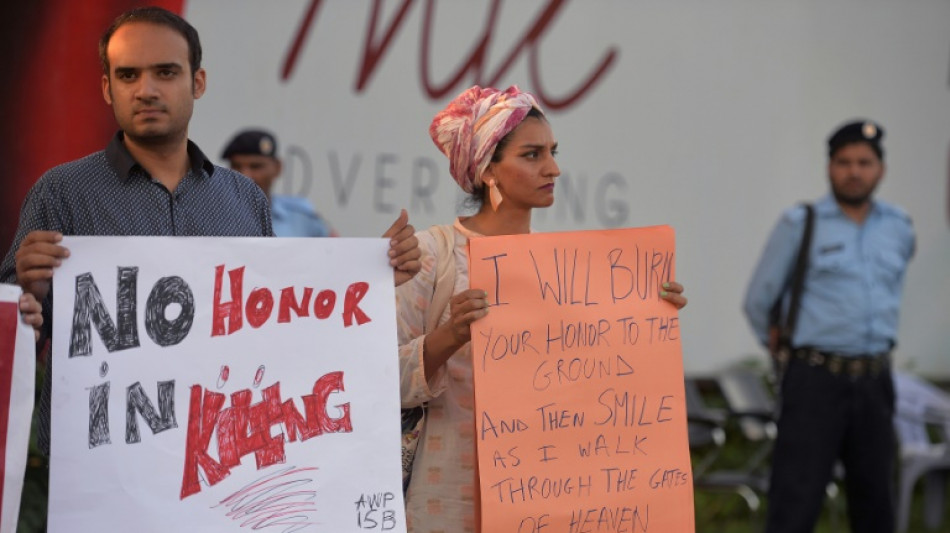
Getting away with murder in Pakistan / Photo: AAMIR QURESHI - AFP/File

 Kings' Ben Simmons tears Achilles in training

 Lula, Bolsonaro set for first debate showdown in bitter election race

 Mbappe hits two as Real Madrid rout Sevilla

 Browns edge Ravens for division lead, Texans beat Jags

 Lyon go top of Ligue 1 as Monaco fall to first defeat of the season

 Venezuela opposition alliance reaffirms Nobel laureate Machado as leader

 'Street Fighter' wins N. America box office, buzzy doc stuns in 2nd

 NFL: Paris game to go ahead despite protests in France

 Arteta hails Arsenal 'finishers' after Madueke fells Forest

 Trump backs ally Netanyahu ahead of Israel's tight election

 Madueke strikes late as below-par Arsenal sink Forest
 Second day of street clashes in Milan

 Dupont's Toulouse hold off Exeter as English Champions Cup woes continue

 Zelensky speaks to US envoys amid Trump spat

 Paris police in new battles with protesters and looters

 Multiple deaths, injuries at western Canada military base: minister

 Boland strikes twice for Australia in rain-hit South Africa Test

 Marseille put Angers to the sword in Ligue 1

 Albanian PM refuses to quit as violent protests enter sixth day

 Chwalinska fights back to win Wuhan Open in title breakthrough
 Kulusevski on brink of return for Spurs after 17-month absence

 Ukraine sets Saint Petersburg refinery ablaze in large-scale drone attack
 Spain's in-form Chacarra wins DP World India Championship

 Robertson and Selby chase rare Home Nations sweep in Belfast

 Arteta backs Kai Havertz to become a 30-goal Arsenal forward

When social media star Qandeel Baloch was strangled by her brother for unapologetically challenging Pakistan's attitudes towards women, activists fought for her murder to trigger a new era of justice over so-called "honour" killings.
Her killer's release in February, less than three years into a life sentence, has instead underlined how the country's legal system still allows for men to abuse, rape and murder women with impunity.
In Pakistan, overlapping legal systems riddled with loopholes and a deeply patriarchal society combine to ensure women survivors of violence are unlikely to get justice, activists, lawyers and survivors told AFP.
"The whole process from the moment a crime is committed against a woman to registering it with the police -- and then the court procedure -- is structured in such a way that justice remains elusive," said Nayab Gohar Jan, a prominent rights activist.
"Add to that societal pressures and stigmas, and you can see the odds are clearly stacked against them."
Much of Pakistani society operates under an "honour" code where women can be killed for bringing "shame" on their families by acts such as interacting with men or marrying someone they choose themselves.
More than 470 cases of "honour" killings were reported to police in 2021, according to the Human Rights Commission of Pakistan (HRCP), though many cases go unreported by families who collude with the killers -- often male relatives.
Pakistan ranked 153 out 156 countries on the World Economic Forum's Global Gender Gap index in 2021, which noted stark disparities in access to justice, education and employment.
- Biased courts -
Baloch both captivated and scandalised Pakistan with her short skirts and provocative dancing on Facebook.
Her murder in 2016 was arguably Pakistan's most high-profile case of an "honour" killing.
Days after killing her, Muhammad Waseem defiantly told journalists that he strangled his sister because of her "intolerable" behaviour.
The government responded to public outrage with new laws against such crimes, including -- crucially -- a ban on victims' families being allowed to pardon relatives or reach out-of-court "blood money" settlements.
Waseem was convicted and sentenced to life in jail, but his lawyers found a loophole.
They successfully argued on appeal that the murder could not be classed as an "honour" killing –- rendering the legal changes inapplicable, and allowing for his mother to pardon him.
That decision is being challenged by the state.
Lawyers and activists blamed patriarchal mindsets within the justice system and a lack of women lawyers and judges for allowing "honour" killing verdicts to be overturned.
Pakistani courts are dominated by men, with less than a fifth of judges and only 12 percent of prosecutors being women, the HRCP says.
Lawyer Nida Usman Chaudhary, who founded a collective for women jurists, said male judges often show bias in their interpretation of the honour killing laws.
"You've had the Supreme Court literally coming up with case law after case law where they developed an entire defence... to give impunity to the person who is accused," she told AFP.
- Victim-blaming -
Khadija Siddiqi, who was stabbed 23 times and left for dead by her ex-boyfriend, said her legal case was "delayed so much that we were actually on the verge of giving up".
Her attacker was convicted of attempted murder, acquitted on appeal, reconvicted, and then freed early for good behaviour.
Like many instances of violence against women, Siddiqi's case was dominated by a culture of victim-blaming, pervasive throughout the police, the courts and the wider community, she told AFP.
Allegations of domestic abuse are often viewed as a family matter, and victims of gender-based crimes are treated with suspicion.
Victim-blaming attitudes go to the very top.
Last year, former prime minister Imran Khan repeatedly linked a rise in sexual assaults to women wearing "very few clothes".
In 2020, a provincial police chief publicly admonished a gang-rape victim for driving at night without a male companion.
"I was made to feel I had done something wrong and I got what I deserved," said Siddiqi.
Social media's power to challenge the indolence of the justice system is growing, but often limited to high-profile cases.
Last year, Noor Mukadam, the daughter of a former ambassador, was kidnapped, raped and beheaded by her boyfriend in Islamabad.
In February, a court sentenced Zahir Jaffer to death, in a trial that was exceptional for its pace, concluding just eight months after his arrest.
The case garnered huge attention, in part because of the brutal nature of the murder and the pair's elite status, but also because her friends were able to mobilise without fear of a backlash.
"We built the pressure... and used (social media) as a tactic," said Shafaq Zaidi, a friend of Mukadam who helped lead the campaign.
Days before Mukadam was killed, at the other end of the country Quratulain Baloch was tortured and murdered, but her case garnered little attention.
Her husband, who denies killing her, was only formally charged in March.
"As the verdict in the Noor Mukadam case was read out, Quratulain's murder trial hadn't even begun. Why has there not been the same urgency here?" bristled Sanaullah Buledi, her brother.
- Local retribution -
In Muslim-majority Pakistan, a British common law-based system uses interpretations of Islamic law, particularly in cases dealing with gender-based violence and family disputes.
In rural areas, women victims often do not get the opportunity for a trial at all.
Justice can be meted out through village councils comprising local elders –- always men –- that operate extrajudicially and often order abuse against women as a means of upholding "honour".
Although supported by many Pakistanis for their swiftness, these tribunals offer no means of appeal.
The country's powerful religious clergy has also been responsible for quashing reform.
Last year, the Council of Islamic Ideology –- a body that previously proposed legislation allowing husbands to "lightly" beat their wives -- struck down a tough new law against gender-based violence.
The appointment of the first female justice to the 17-member Supreme Court earlier this was welcomed as important step in improving the quality of justice for women.
Ayesha Malik was a Lahore High Court judge when she banned an invasive "two-finger virginity test" for rape survivors last year.
Tough new anti-rape laws have also been introduced, though their impact has yet to be seen.
For those who have gone through the system, however, the toll remains high.
"There were times when I would wish the ground would just open up and I'd hide myself there, away from the gaze of the men in court," said Siddiqi, the survivor.
L.Hussein--SF-PST