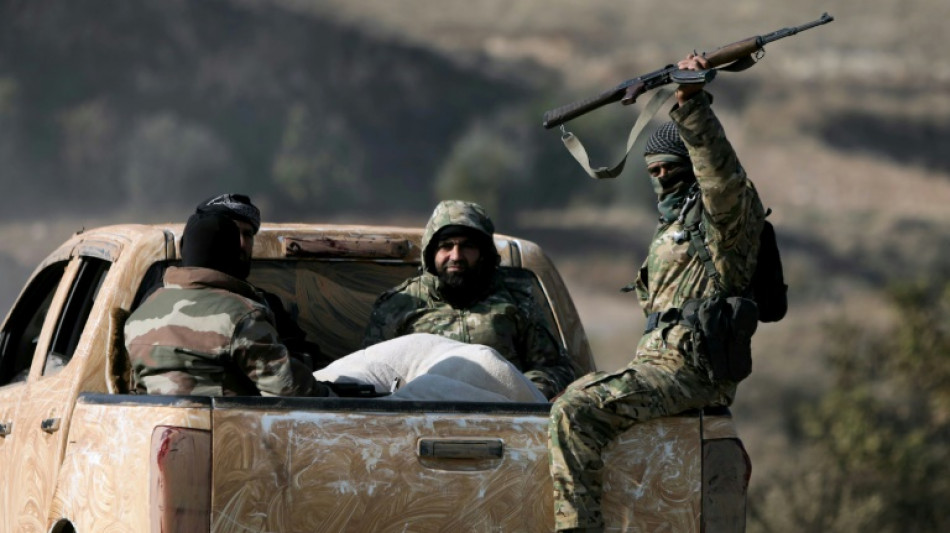
Syrian army fights rebel offensive with counterattack / Photo: Bakr ALKASEM - AFP

 England quick Carse to face no charges over alleged nightclub assault

 Mancini brings nine newcomers into the first squad of his Italy comeback

 Czechs level Davis Cup tie against USA as South Korea eye Finals

 New France boss Zidane confirms Mbappe as captain after naming first squad

 California governor signs order to explore AI 'kill switch'
 Head leads run spree as Australia win Zimbabwe ODI series

 In-form Raphinha wants to finish career at Barcelona

 Warren Buffett steps down as Berkshire Hathaway chairman

 Carrick confident Man Utd can 'work through' tough time

 Mbappe ends Nike partnership to join Swiss brand On

 Liverpool boss Iraola puts Bournemouth love affair on hold
 'A disaster' if Man City do not win says Maresca after flawless start
 Kerry James Marshall: American 'blackness' painter celebrated in Europe

 Spain coach De la Fuente offers 'full support' to people of Ceuta

 Russia seizes assets of Nestle, French firms over West's Ukraine support
 England can build on World Cup 'spirit', says Tuchel

 UNESCO can be 'moderator' in AI debate: chief to AFP

 Infantino 'must go', says German FA vice-president

 Russia seizes assets of Nestle, French firms

 Japan's busiest rail station tests robot bins
 Anthropic says AI systems moving towards building themselves

 Asian stocks boosted by falling oil, yen weakens after BoJ rate hike
 Pakistan court blocks expulsion of Afghan medical college students
 Athletes 'can't take it any more' as Asian Games issues mount

 Allen lights up Bills' new stadium with 41-31 win over Lions

Syrian government forces pressed a counterattack against Islamist-led rebels around the key city of Hama on Wednesday after suffering a string of staggering losses further north, a war monitor said.
Hama is strategically located in central Syria and, for the army, it is crucial to safeguarding the capital and seat of power Damascus.
The fighting around Hama follows a lightning offensive by Islamist-led rebels who in a matter of days wrested swathes of territory from President Bashar al-Assad's grasp.
Key in the rebels' successes since the start of the offensive last week was the takeover of Aleppo, Syria's second city, which in more than a decade of war had never fallen out of government hands.
Wassim, a 36-year-old delivery driver from Hama city, said the sounds were "really terrifying" and the continuous bombing was clearly audible.
"I'll stay home because I have nowhere else to flee to," he said.
While the advancing rebels found little resistance earlier in their offensive, the fighting around Hama has been especially fierce.
Rebel forces reached the gates of Hama city on Tuesday, according to the Syrian Observatory for Human Rights monitor, and the fighting sparked a wave of displacement.
AFP images showed people fleeing the town of Suran, between Aleppo and Hama, many lugging whatever they could fit in their vehicles.
The Britain-based Observatory said government forces backed by aerial support launched a counterattack on the Tahrir al-Sham (HTS) rebels and allied factions in Hama province on Wednesday.
By the afternoon, the government forces had secured several villages in the province and the area around the northeastern entrance into the provincial capital, the monitor added.
German news agency DPA announced the killing on Wednesday of award-winning Syrian photographer Anas Alkharboutli in an air strike near Hama.
"Our photographer Anas Alkharboutli, who documented the civil war in Syria in a unique visual language, has been killed in an air strike near the Syrian city of Hama. Anas was just 32 years old," DPA said.
- 'Close contact' -
Syria's official SANA news agency also reported the battle around Hama, saying the army was conducting operations against "terrorist organisations" in the north of the province.
The city was the scene of a massacre by the army under Assad's father in the 1980s targeting people accused of loyalty to the banned Muslim Brotherhood.
Decades on, the scars of the massacre that sent thousands of Syrians into exile have yet to heal, and Hama saw some of the biggest protests early in the democracy revolt that began in 2011.
While Hama city was a bastion of opposition to Assad's rule early in the war, the province is also home to a sizeable Alawite community, followers of the same offshoot of Shiite Islam as the president.
The rebels launched their offensive on November 27, the day a ceasefire took effect in the war between Israel and Lebanese armed group Hezbollah.
Iran-backed Hezbollah is a key backer of Assad's government and earlier in the war helped prop up his rule.
But it suffered a series of heavy blows in its year-long war with Israel, which began after the group launched cross-border attacks in support of its Palestinian ally Hamas.
During the war in Lebanon, Hezbollah had to pull back some of its fighters from Syria to focus on its home front.
Russia has also been key to keeping Assad in power, directly intervening in Syria's war in 2015, but it too has been mired in its own war in Ukraine.
Russia, Iran and Turkey are in "close contact" over the conflict in Syria, Moscow said Wednesday.
While Russia and Iran both back Assad, Turkey has backed the opposition.
Until last week the war in Syria had been mostly dormant for several years, but analysts have said violence was bound to flare up as it was never truly resolved.
According to the United Nations, 50,000 people have been displaced by the latest fighting since it began last week.
The Observatory says the violence has killed 704 people, mostly combatants but also 110 civilians.
- 'Spread very thin' -
Since 2011, Syria's war has killed more than 500,000 people and forced millions more to flee their homes.
Many of those who took part in the initial protests that sparked the war are now dead, in jail or living in exile.
"Many policymakers thought, well, Assad won, there is no war," said Rim Turkmani, director of the Syria Conflict Research Programme at the London School of Economics.
But "we've been worrying about this for years, that the fact that there is no intense violence doesn't mean that the conflict is over," she told AFP.
While the rebels may have advanced swiftly, it does not mean they will have the capacity to hold onto the territory they have captured.
Spearheading the rebel alliance is HTS, which is rooted in Syria's Al-Qaeda branch.
"It's very well organised, very ideologically driven," Turkmani said.
"However, they spread very quickly and very thin. And I think very quickly they're going to realise it's beyond their capacity to maintain these areas and, most importantly, to govern them."
H.Darwish--SF-PST