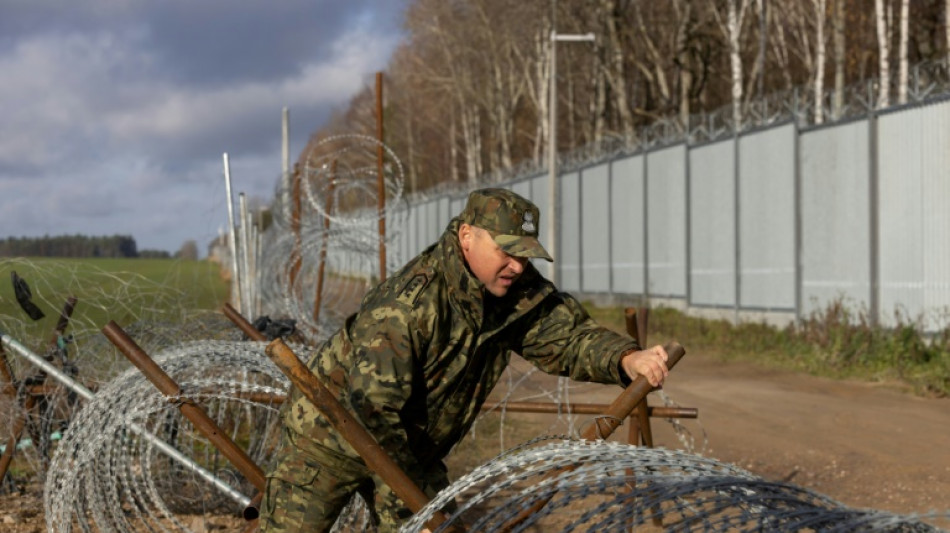
Poland border fence divides officials and rights groups / Photo: Wojtek RADWANSKI - AFP

 Trump claims 'infinite' Greenland security deal with Denmark

 Helicopters battle wildfire threatening Ecuador's capital

 Brentford batter Chelsea to undo Alonso's promising start
 Kane hits Bundesliga century as Bayern rout Union
 Trump says CNN, MS NOW, Politico banned from White House
 Hushing and hedging: US companies retreat on climate

 Springboks to face Fiji before 2027 Rugby World Cup
 Nigeria miners struggled to breathe in cell before 37 died: survivors

 McIlroy on the charge at PGA Championship as Reed withdraws

 McIlroy on the charge at PGA Championship

 Crisis-wracked Volkswagen warns of 10-bn-euro hit to profits

 Costa Rica's Grynspan tops third informal poll for UN chief: diplomat

 Stock markets retreat after central bank rate hikes

 Russia labels director of Cannes Grand Prix winner a 'foreign agent'

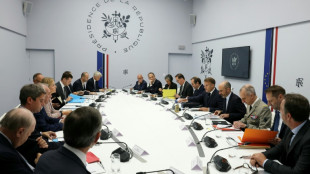 Macron warns of Russian 'hybrid' threat after meeting presidential hopefuls

 UN holds third informal poll for new chief

 Kulusevski return can spark Spurs: De Zerbi

 Shakira to cap off world tour with Madrid 12-gig run

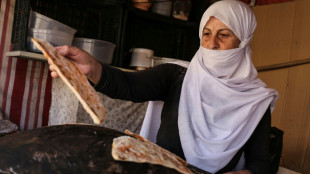 Isolated Syrian-Druze city blames Damascus for shortages

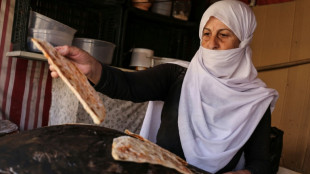 Isolated Syrian-Druze city shortages

 Dutch drop Depay for Germany match in Xavi's first pick

 Ronaldo named in Portugal squad for Nations League

 Stock markets diverge after central bank rate hikes

 Anti-Assad music star makes triumphant return to Syria

 In-form Fernandez included in Spain Nations League squad
An impenetrable barrier against irregural migration for some, a deadly trap for others: a metal fence erected on the Polish-Belarusian border is dividing Poland's authorities and human rights groups.
At its foot, Polish soldiers, hooded and carrying machine guns, patrol the border -- a flashpoint between Warsaw and Minsk whom Poland had blamed for orchestrating the influx of migrants.
"Migration is artificially directed here," said Michal Bura, a spokesman for the Podlasie region border guards, joining the patrol in his four-wheel drive.
"The Belarusian services help the migrants, transport them from one place to another, and equip them with tools they need to cross this barrier, such as pliers, hacksaws, and ladders," he added.
This month, the five-metre-high (16-foot) metal barrier along the border built in 2022 has been reinforced with metal bars and another layer of barbed wire.
Warsaw has also installed new cameras every 200 metres along the fence to detect migrants before they even attempt to cross it.
Since 2021, Poland has seen thousands of migrants and refugees, mainly from the Middle East and Africa, attempting to enter the EU and NATO country through Belarus.
Warsaw has called it a hybrid operation by Belarus and its ally Russia to increase migratory pressure and thereby destabilise the EU.
Bura said the modernisation of the fence, due to be completed by the end of the year, was already having an effect.
"Crossings have decreased significantly" along the reinforced stretches, he said.
- Water, food, dry clothes -
Fearing Russia, Poland has also announced it would spend over 2.3 billion euros on an "eastern shield" -- a system of military fortifications along the border, which will make it even more difficult for migrants to cross.
But, according to border guards, while the overall number of crossings fell as winter arrived, it had already reached 28,500 by mid-November compared with 26,000 in total last year.
Right in the middle of the Europe's largest primeval forest of Bialowieza, Aleksandra Chrzanowska packed into plastic bags what remained of a former makeshift migrant camp -- a torn emergency blanket, medicines, shoes hidden under leaves wet from the snow.
"The border is about 20 kilometres away," she said, pointing to the east and the thick forest.
"It takes migrants between 30 hours and a week to get here. It all depends on their physical condition, whether they have children with them, and what the weather is like," said Chrzanowska, a member of Grupa Granica, a nonprofit helping migrants in distress.
Its volunteers bring them water, food, dry clothes, and medicine.
In case of emergency or threat to life, they administer first aid, help migrants fill out asylum application forms or serve as translators in communication with the authorities.
"In the long term, this barrier, these electronic installations, do not change anything," said Chrzanowska, who added no real migration policy was implemented by the government.
- 'Mental trauma' -
According to rights groups, migrants at the border are increasingly subjected to police violence, with some suffering injuries inflicted by dog bites or rubber bullets.
Some migrants have also injured themselves by jumping from the top of the fence.
"Half of the patients we treat have physical injuries and mental trauma resulting from crossing the border," Uriel Mazzoli, head of Doctors Without Borders Mission in Poland (MSF), told AFP.
Border guards deny the accusations, saying that they limit themselves to responding to violence coming from migrants.
Poland said at least 63 soldiers have been injured since the beginning of the year while stopping migrants from crossing the border. In June, a Polish soldier was fatally stabbed through the fence.
According to the rights groups' estimates, at least 88 migrants have died on the Polish-Belarusian border since the migration influx has intensified.
Last month, Polish Prime Minister Donald Tusk announced a migration rules overhaul involving a temporary suspension of asylum rights for irregular migrants.
For Chrzanowska, this announcement was "very worrying", as it would mean "an absolute violation of fundamental human rights, of the right to seek international protection."
According to the MSF official, the infrastructure installed by Poland on its eastern border traps people in a no-man's-land between the two countries.
It is "a trap into which people are constantly pushed with no possibility of getting out on either side," said Mazzoli.
E.Qaddoumi--SF-PST