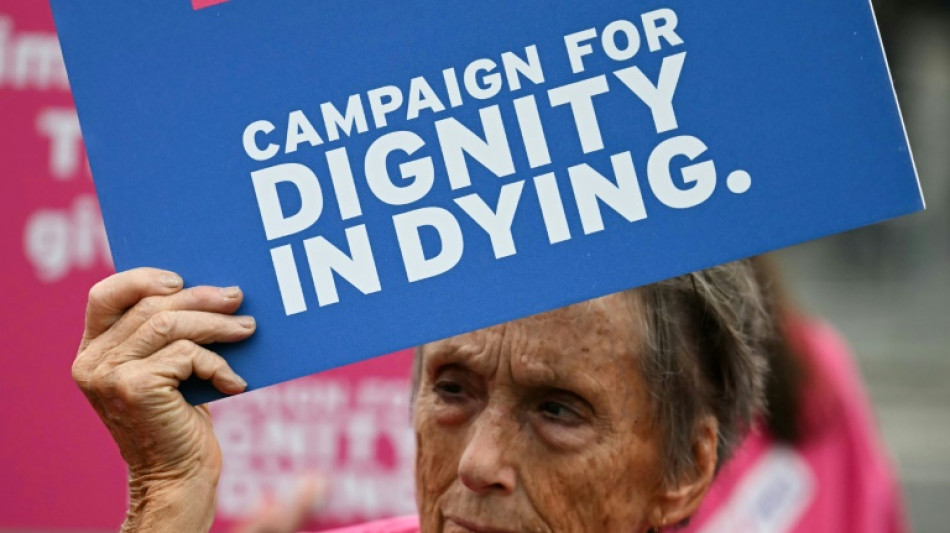
British MPs to debate contentious assisted dying law / Photo: JUSTIN TALLIS - AFP

 Trump claims 'infinite' Greenland security deal with Denmark

 Helicopters battle wildfire threatening Ecuador's capital

 Brentford batter Chelsea to undo Alonso's promising start

 Kane hits Bundesliga century as Bayern rout Union

 Trump says CNN, MS NOW, Politico banned from White House

 Hushing and hedging: US companies retreat on climate

 Springboks to face Fiji before 2027 Rugby World Cup

 Nigeria miners struggled to breathe in cell before 37 died: survivors

 McIlroy on the charge at PGA Championship as Reed withdraws

 McIlroy on the charge at PGA Championship

 Crisis-wracked Volkswagen warns of 10-bn-euro hit to profits

 Costa Rica's Grynspan tops third informal poll for UN chief: diplomat

 Stock markets retreat after central bank rate hikes

 Russia labels director of Cannes Grand Prix winner a 'foreign agent'

 Macron warns of Russian 'hybrid' threat after meeting presidential hopefuls
 UN holds third informal poll for new chief

 Kulusevski return can spark Spurs: De Zerbi

 Shakira to cap off world tour with Madrid 12-gig run

 Isolated Syrian-Druze city blames Damascus for shortages
 Isolated Syrian-Druze city shortages

 Dutch drop Depay for Germany match in Xavi's first pick

 Ronaldo named in Portugal squad for Nations League

 Stock markets diverge after central bank rate hikes

 Anti-Assad music star makes triumphant return to Syria

 In-form Fernandez included in Spain Nations League squad
UK lawmakers will Friday debate and likely vote on whether to advance divisive and emotive legislation to allow assisted dying for terminally ill people in England and Wales.
Parliament last debated, and defeated, a euthanasia bill in 2015, but public support for giving terminally ill people the choice to end their lives has since shifted in favour.
Two polls last week indicated that a majority of Britons back changing the law, which would see England and Wales emulate several European and other countries.
Supporters say allowing assisted suicide would make some deaths more dignified and less painful.
However, faith leaders are among the stringent opponents, with nearly 30 signing a joint letter last weekend arguing they are "deeply concerned" by the plans.
Critics insist it could lead some people to feel pressurised into ending their life, while some say the healthcare system is not ready for such a landmark change.
The bill would allow assisted suicide in England and Wales for adults with an incurable illness who have a life expectancy of fewer than six months and are able to take the substance that causes their death themselves.
Any patient's wish to die would have to be signed off by a judge and two doctors.
The measures are stricter than assisted dying laws in other European countries and also proposed legislation that is being considered in France.
MPs will debate the draft legislation -- introduced by a Labour lawmaker as a so-called private members' bill, which is not part of the government's agenda -- from 9:30 am (0930 GMT).
The debate will last until 2.30 pm at the latest.
A vote on progressing the bill to its next parliamentary stage is highly likely but not guaranteed.
- 'Right to choose' -
The legislation follows Prime Minister Keir Starmer's vow, before winning power in July, to allow parliament to revisit the issue.
The UK leader, who voted in favour of allowing assisted suicide in 2015 but with "robust" safeguards, has not revealed his current view.
The country's most senior civil servant has told cabinet members they "should not take part in the public debate" given the government is remaining neutral on the bill.
However, a number of senior ministers have aired their opinions, with Health Secretary Wes Streeting and Justice Secretary Shabana Mahmood both saying they are opposed.
Mahmood, the country's most senior Muslim politician, argued in a recent letter to constituents that "the state should never offer death as a service", while noting that her faith was informing her stance.
Broadcaster Esther Rantzen, who is terminally ill and has spearheaded the campaign for a law change, on Thursday urged other MPs to be honest about whether faith was the basis for any opposition.
"They have the right to choose but please be honest about your real motivation," she told LBC radio.
Meanwhile former prime minister David Cameron, who opposed the 2015 law change, revealed he had changed his mind on the issue.
"As campaigners have convincingly argued, this proposal is not about ending life. It is about shortening death," he wrote in The Times newspaper on Thursday.
However other ex-premiers -- including Liz Truss, Boris Johnson, Theresa May and Gordon Brown -- have all said they oppose the legislation.
Assisted suicide is currently banned in England, Wales and Northern Ireland, and carries a maximum prison sentence of 14 years.
In Scotland, which has a separate legal system and devolved powers to set its own health policy, it is not a specific criminal offence. But it can leave a person open to other charges, including murder.
M.AbuKhalil--SF-PST