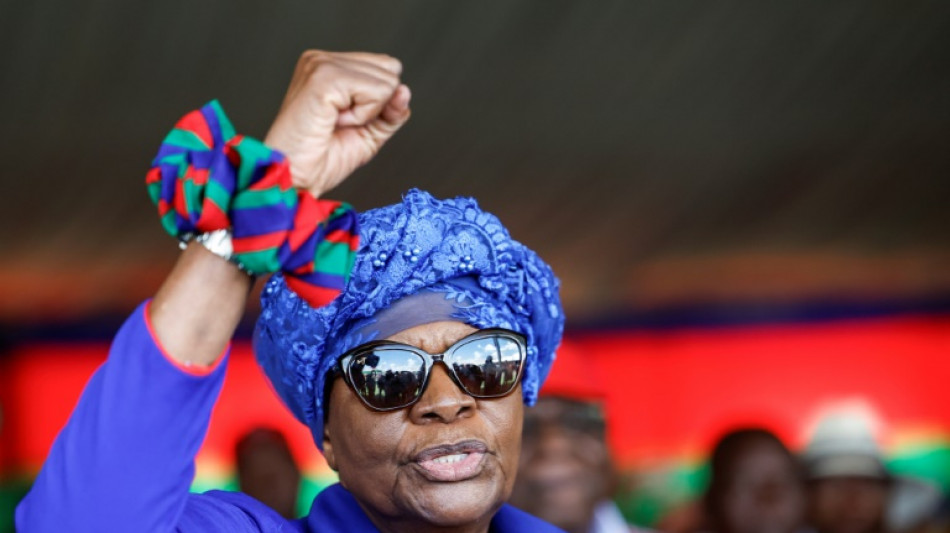
Namibia votes with ruling party facing its toughest race yet / Photo: SIMON MAINA - AFP

 Kennedy Center: future unclear for iconic Washington arts hub
 Trump claims 'infinite' Greenland security deal with Denmark

 Helicopters battle wildfire threatening Ecuador's capital

 Brentford batter Chelsea to undo Alonso's promising start
 Kane hits Bundesliga century as Bayern rout Union
 Trump says CNN, MS NOW, Politico banned from White House
 Hushing and hedging: US companies retreat on climate

 Springboks to face Fiji before 2027 Rugby World Cup
 Nigeria miners struggled to breathe in cell before 37 died: survivors

 McIlroy on the charge at PGA Championship as Reed withdraws

 McIlroy on the charge at PGA Championship

 Crisis-wracked Volkswagen warns of 10-bn-euro hit to profits

 Costa Rica's Grynspan tops third informal poll for UN chief: diplomat

 Stock markets retreat after central bank rate hikes
 Russia labels director of Cannes Grand Prix winner a 'foreign agent'

 Macron warns of Russian 'hybrid' threat after meeting presidential hopefuls
 UN holds third informal poll for new chief
 Kulusevski return can spark Spurs: De Zerbi

 Shakira to cap off world tour with Madrid 12-gig run

 Isolated Syrian-Druze city blames Damascus for shortages
 Isolated Syrian-Druze city shortages
 Dutch drop Depay for Germany match in Xavi's first pick

 Ronaldo named in Portugal squad for Nations League
 Stock markets diverge after central bank rate hikes

 Anti-Assad music star makes triumphant return to Syria

Namibia's vice president was among the first voters in elections Wednesday that could see her become the desert nation's first woman leader, even as her ruling SWAPO party faces a strong challenge to its 34-year grip on power.
Netumbo Nandi-Ndaitwah, a 72-year-old veteran of the South West Africa People's Organisation, cast her ballot in the capital Windhoek as polls opened at 7:00 am (0500 GMT).
She urged the country's roughly 1.5 million registered voters to do the same before polls close at 9:00 pm.
The vote "will have an impact for the next five years in your life and in the life of every Namibian and any person who's visiting this country," said the candidate popularly known as NNN.
SWAPO has governed the mineral-rich country since independence in 1990 but, amid complaints about high unemployment and enduring inequalities, Nandi-Ndaitwah could be forced into a second-round run-off if she fails to garner at least half the vote.
Waiting in the early morning sun to cast her ballot, Frieda Fillipus, 31, said she wanted to see a woman run the country.
"The future is female," said Fillipus, who works in the key mining sector.
"The outcome will be tight," said self-employed Hendry Amupanda, 32, who had been queuing since 9:00 pm the night before.
"I want the country to get better and people to get jobs," said Amupanda, wearing slippers and equipped with a chair, blanket and snacks.
Nandi-Ndaitwah has four main challengers including Panduleni Itula, 67, a former dentist and lawyer who founded the Independent Patriots for Change party in 2020.
Itula took 29 percent of votes in the 2019 elections, losing to SWAPO leader Hage Geingob, who garnered 56 percent of votes.
Despite the loss, his performance was remarkable considering Geingob, who died in February, took almost 87 percent five years earlier.
For the first time in the southern African nation's recent history, a second round is "a somewhat realistic option", said Henning Melber, of the Nordic Africa Institute at the University of Uppsala.
A run-off would take place within 60 days of the announcement of the results of the first round due on Saturday, according to the election calendar.
Namibia is a major uranium and diamond exporter but not all of its nearly three million people have benefitted from that wealth.
"There's a lot of mining activity that goes on in the country, but it doesn't really translate into improved infrastructure, job opportunities," said independent political analyst Marisa Lourenco, based in Johannesburg.
"That's where a lot of the frustration is coming from, (especially) the youth," she added.
Unemployment among 15- to 34-year-olds is estimated at 46 percent, according to the latest figures from 2018. This is almost triple the national average.
- 'Immediate needs' -
Though the party's founders led the country to independence from white-ruled South Africa in 1990, its current leaders are nervous about suffering the same fate as other liberation-era movements in the region.
In the past six months, South Africa's African National Congress lost its parliamentary majority and the Botswana Democratic Party was ousted after almost six decades in power.
In Mozambique, though the ruling Frelimo won recent elections, civil society and opposition groups have protested for weeks claiming fraud and demanding change.
"Young people have been feeling the brunt of the current economic downturn in a lot of African countries," said Nic Cheeseman, a professor specialised in African politics at the University of Birmingham.
"It's not just that they're young and it's not just that they don't remember, it's also that they really feel the pinch of the economic crisis."
"The challenges affecting Namibia, similar to the challenges affecting other African countries, are shifting the political landscape drastically," said Tendai Mbanje, an election expert at the Johannesburg-based African Centre for Governance.
"Elections are (now) about the immediate needs of the citizens, and particularly young people."
A.AbuSaada--SF-PST