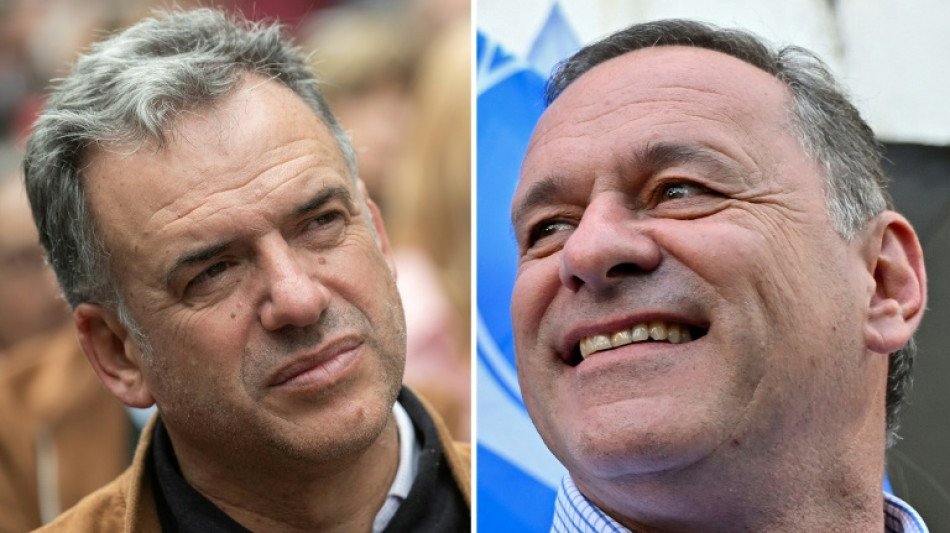
Uruguayans head to polls with left hoping for comeback / Photo: SANTIAGO MAZZAROVICH - AFP

 Trump says Denmark to give US 'permanent control' over Greenland security
 Kennedy Center: future unclear for iconic Washington arts hub

 Trump claims 'infinite' Greenland security deal with Denmark

 Helicopters battle wildfire threatening Ecuador's capital

 Brentford batter Chelsea to undo Alonso's promising start
 Kane hits Bundesliga century as Bayern rout Union
 Trump says CNN, MS NOW, Politico banned from White House
 Hushing and hedging: US companies retreat on climate

 Springboks to face Fiji before 2027 Rugby World Cup

 Nigeria miners struggled to breathe in cell before 37 died: survivors

 McIlroy on the charge at PGA Championship as Reed withdraws

 McIlroy on the charge at PGA Championship

 Crisis-wracked Volkswagen warns of 10-bn-euro hit to profits

 Costa Rica's Grynspan tops third informal poll for UN chief: diplomat

 Stock markets retreat after central bank rate hikes
 Russia labels director of Cannes Grand Prix winner a 'foreign agent'

 Macron warns of Russian 'hybrid' threat after meeting presidential hopefuls

 UN holds third informal poll for new chief
 Kulusevski return can spark Spurs: De Zerbi

 Shakira to cap off world tour with Madrid 12-gig run

 Isolated Syrian-Druze city blames Damascus for shortages
 Isolated Syrian-Druze city shortages

 Dutch drop Depay for Germany match in Xavi's first pick

 Ronaldo named in Portugal squad for Nations League
 Stock markets diverge after central bank rate hikes

Uruguayans go to the polls Sunday, with the leftist alliance of celebrated ex-president Jose "Pepe" Mujica hoping to reclaim the country's top job five years after a right-wing victory driven by concerns over crime and taxes.
Former history teacher Yamandu Orsi of the leftist Frente Amplio (Broad Front) will go head-to-head with ex-veterinarian Alvaro Delgado of the National Party, a member of outgoing President Luis Lacalle Pou's center-right Republican Coalition.
Orsi, 57, is seen as the understudy of 89-year-old Mujica, a former guerrilla lionized as "the world's poorest president" during his 2010-2015 rule because of his modest lifestyle.
Orsi had garnered 43.9 percent of the October 27 first-round vote -- short of the 50-percent cutoff to avoid a runoff but ahead of the 26.7 percent of ballots cast for Delgado, 55.
The pair came out on top of a crowded field of 11 candidates seeking to replace Lacalle Pou, who has a high approval rating but is barred constitutionally from seeking a second consecutive term.
Polls point to a tight race Sunday, with Orsi only marginally ahead in stated voter intention in South America's second-smallest country.
Other parties within the Republican Coalition have thrown their support behind Delgado since the first round, boosting his numbers.
"Conditions are in place for us to take charge... to make the changes the country needs," Orsi told a closing campaign rally Wednesday.
Delgado, for his part, told supporters Uruguay was better off today thanks to the Republican Coalition in charge, adding: "I am prepared" to lead.
- Liberal mold-breaker -
A victory for Orsi would see Uruguay swing left again after five years of center-right rule in the country of 3.4 million inhabitants.
The Frente Amplio coalition broke a decades-long conservative stranglehold with an election victory in 2005, and held the presidency for three straight terms.
It was voted out in 2020 on the back of concerns about rising crime blamed on high taxes and a surge in cocaine trafficking through the port of Montevideo.
Polling numbers show perceived insecurity remains Uruguayans' top concern five years later.
"For workers, these past five years have not been good at all. I'm on the street all day, and what worries me the most is insecurity," Orsi voter Gustavo Maya, a 34-year-old vendor of gas cylinders told AFP.
"I see many robberies, more and more homicides, and few police officers. That's what worries me the most."
For Delgado backer and stonemason William Leal, 38, the center-right is the best option for workers.
"I want this government to continue because in the construction sector there was much more work than in previous governments," he said.
The first round of voting was accompanied by a referendum in which Uruguayans were asked whether police should be allowed to carry out nighttime raids on homes as part of the fight against drug trafficking. The initiative failed.
Voting is compulsory in Uruguay, one of Latin America's most stable democracies which boasts comparatively high per-capita income and low poverty levels.
During the heyday of leftist rule, Uruguay legalized abortion and same-sex marriage, became the first Latin American country to ban smoking in public places and the world's first nation, in 2013, to allow recreational cannabis use.
K.AbuTaha--SF-PST