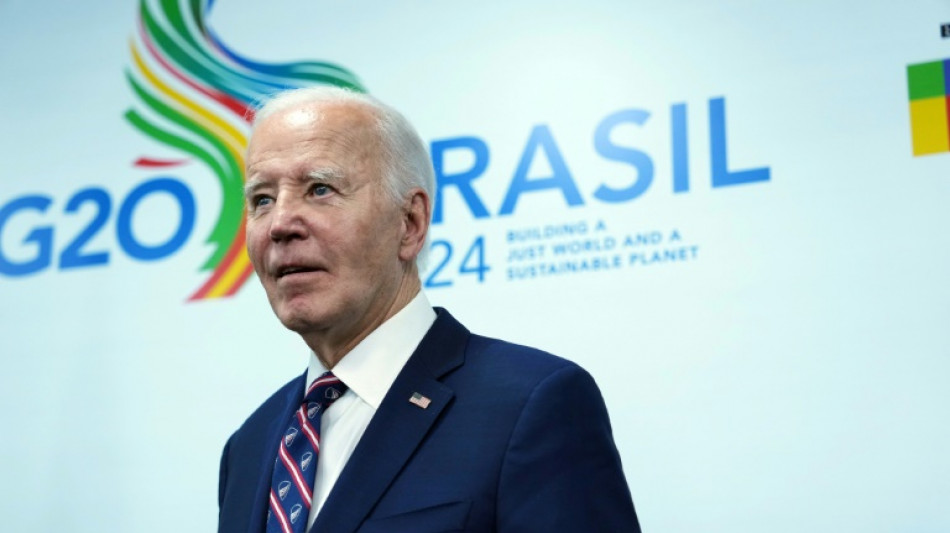
US cites new Russian tactics for decision to supply landmines to Ukraine / Photo: ERIC LEE - POOL/AFP

 Ed Sheeran returns to stage after Palestinian controversy

 Asian Games to open in Japan after troubled build-up
 Drone owners rush to offload devices ahead of Beijing ban
 Trump's beef policies irk Texas ranchers, testing their loyalty

 Nvidia, OpenAI CEOs to attend Xi dinner at White House
 Anthropic picks Accenture for in-house AI safety evaluation
 Balogun returns as Monaco beat Lens to continue strong Ligue 1 start

 'Pause' on overt repression in Venezuela, but reforms still needed: HRW

 Global stocks mixed as yen falls despite Bank of Japan rate hike
 Cuba hit with seventh major blackout of the year
 Murray out with concussion so Wentz will start for Vikings

 UN chief 'deeply regrets' US visa refusal to Abbas for annual meeting

 England quick Carse to face no charges over alleged nightclub assault

 Mancini brings nine newcomers into the first squad of his Italy comeback

 Czechs level Davis Cup tie against USA as South Korea eye Finals

 New France boss Zidane confirms Mbappe as captain after naming first squad

 California governor signs order to explore AI 'kill switch'

 Head leads run spree as Australia win Zimbabwe ODI series

 In-form Raphinha wants to finish career at Barcelona
 Warren Buffett steps down as Berkshire Hathaway chairman

 Carrick confident Man Utd can 'work through' tough time

 Mbappe ends Nike partnership to join Swiss brand On

 Liverpool boss Iraola puts Bournemouth love affair on hold

 'A disaster' if Man City do not win says Maresca after flawless start

 Kerry James Marshall: American 'blackness' painter celebrated in Europe

The US decision to send anti-personnel landmines to Ukraine -- in a major policy shift -- was triggered by a change in Russian battlefield tactics favoring infantry over mechanized units, US Defense Secretary Loyd Austin said Wednesday.
"They don't lead with their mechanized forces anymore," Austin told reporters while on a visit to Laos. "They lead with dismounted forces who are able to close and do things to kind of pave the way for mechanized forces."
The Ukrainians "have a need for things that can help slow down that effort on the part of the Russians."
President Joe Biden's reversal of his previous curbs on US landmines comes just days after Washington gave Ukraine the green light to use US-made long-range missiles on targets within Russia, as the outgoing administration aims to give Kyiv an upper hand before President-elect Donald Trump enters office.
Biden in 2022 said the United States would mostly ban its use of landmines, at the time specifically drawing a contrast with Russia's use of the weapons in Ukraine.
The reversal comes amid concerns about the incoming Trump administration's lack of support for Kyiv.
Trump is entering office having repeatedly criticized US assistance for Ukraine, claiming he could secure a ceasefire within hours -- comments that have triggered fears in Kyiv and Europe about Ukraine's ability to withstand the Russian attacks without American support.
Both Russia and the United States -- neither of which are signatories to the UN Mine Ban Treaty -- have been criticized for their past use of anti-personnel mines in the past. Ukraine is a signatory of the treaty.
- Battlefield tensions -
Austin said the US-supplied mines would be so-called "nonpersistent" mines that can self-destruct or render themselves inactive after losing battery charge -- in theory limiting the risk to civilians.
But the decision was immediately slammed by rights groups.
Mary Wareham, deputy director at the crisis, conflict and arms division at Human Rights Watch, said Ukraine's use of the mines would contravene the Mine Ban Treaty, and questioned safety of the aging stocks Washington would be supplying.
"From a clearance perspective, de-miners have to approach any type of explosive object with the knowledge that it may explode," Wareham told AFP, adding that the self-deactivation feature is "not enough."
Amnesty International called Washington's decision "reckless" and "a deeply disappointing setback."
The Biden administration was similarly criticized last year for supplying Ukraine with cluster munitions.
Both Moscow and Kyiv are jockeying to secure battlefield advantage before Trump assumes office next January.
This week, Kyiv fired US-supplied ATACMS missiles at Russian territory for the first time.
On Tuesday, Russian President Vladimir Putin signed a decree lowering the threshold for when Russia could use nuclear weapons.
Laos, where Austin made his comments, is still recovering from heavy US bombing during the Vietnam War.
More than 20,000 people have been killed or injured from unexploded ordnance in the half century since, according to The Halo Trust, a demining group.
S.Abdullah--SF-PST