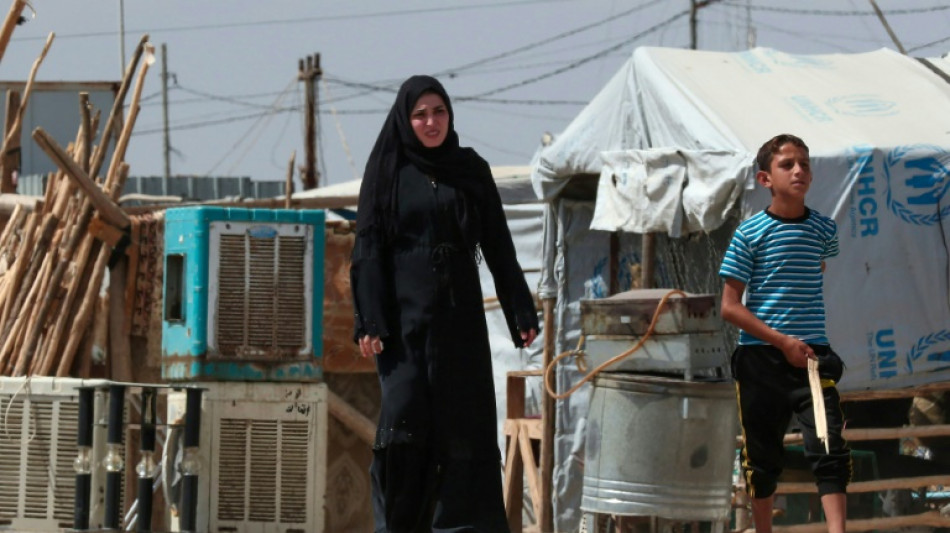
Iraqis face tough homecoming a decade after IS rampage / Photo: Safin HAMID - AFP

 Ed Sheeran returns to stage after Palestinian controversy
 Asian Games to open in Japan after troubled build-up
 Drone owners rush to offload devices ahead of Beijing ban

 Trump's beef policies irk Texas ranchers, testing their loyalty
 Nvidia, OpenAI CEOs to attend Xi dinner at White House

 Anthropic picks Accenture for in-house AI safety evaluation
 Balogun returns as Monaco beat Lens to continue strong Ligue 1 start

 'Pause' on overt repression in Venezuela, but reforms still needed: HRW

 Global stocks mixed as yen falls despite Bank of Japan rate hike

 Cuba hit with seventh major blackout of the year

 Murray out with concussion so Wentz will start for Vikings

 UN chief 'deeply regrets' US visa refusal to Abbas for annual meeting
 England quick Carse to face no charges over alleged nightclub assault

 Mancini brings nine newcomers into the first squad of his Italy comeback

 Czechs level Davis Cup tie against USA as South Korea eye Finals

 New France boss Zidane confirms Mbappe as captain after naming first squad

 California governor signs order to explore AI 'kill switch'
 Head leads run spree as Australia win Zimbabwe ODI series

 In-form Raphinha wants to finish career at Barcelona

 Warren Buffett steps down as Berkshire Hathaway chairman

 Carrick confident Man Utd can 'work through' tough time

 Mbappe ends Nike partnership to join Swiss brand On

 Liverpool boss Iraola puts Bournemouth love affair on hold
 'A disaster' if Man City do not win says Maresca after flawless start
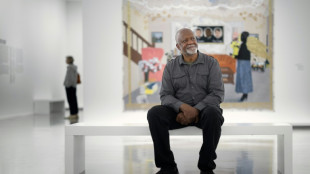 Kerry James Marshall: American 'blackness' painter celebrated in Europe

A decade after Islamic State group extremists rampaged through northern Iraq, Moaz Fadhil and his eight children finally returned to their village after languishing for years in a displacement camp.
Their home, Hassan Shami, is just a stone's throw from the tent city where they had been living, and it still bears the scars of the fight against IS.
The jihadists seized a third of Iraq, ruling their self-declared "caliphate" with an iron fist, before an international coalition wrestled control from them in 2017.
Seven years on, many of the village's homes are still in ruins and lacking essential services, but Fadhil said he felt an "indescribable joy" upon moving back in August.
Iraq -- marred by decades of war and turmoil even before the rise of IS -- is home to more than a million internally displaced people.
Baghdad has been pushing for the closure of the displacement camps, with the country having attained a degree of comparative stability in recent years.
Most of the camps in federal Iraq have now been closed, but around 20 remain in the northern autonomous Kurdistan region, which according to the United Nations house more than 115,000 displaced people.
But for many, actually returning home can be a difficult task.
After getting the green light from Kurdish security forces to leave the camp, Fadhil moved his family into a friend's damaged house because his own is a complete ruin.
- 'Beautiful memories' -
"Water arrives by tanker trucks and there is no electricity," said the 53-year-old.
Although the rubble has been cleared from the structure he now lives in, the cinder block walls and rough concrete floors remain bare.
Across Hassan Shami, half-collapsed houses sit next to concrete buildings under construction by those residents who can afford to rebuild.
Some have installed solar panels to power their new lives.
A small new mosque stands, starkly white, beside an asphalt road.
"I was born here, and before me my father and mother," said Fadhil, an unemployed farmer.
"I have beautiful memories with my children, my parents."
The family survives mainly on the modest income brought in by his eldest son, who works as a day labourer on building sites.
"Every four or five days he works a day" for about $8, said Fadhil.
In an effort to close the camps and facilitate returns, Iraqi authorities are offering families around $3,000 to go back to their places of origin.
To do so, displaced people must also get security clearance -- to ensure they are not wanted for jihadist crimes -- and have their identity papers or property rights in order.
But of the 11,000 displaced people still living in six displacement camps near Hassan Shami, 600 are former prisoners, according to the UN.
They were released after serving up to five years for crimes related to membership of IS.
- Not that simple -
For them, going home can mean further complications.
There's the risk of ostracism by neighbours or tribes for their perceived affiliation with IS atrocities, potential arrest at a checkpoint by federal forces or even a second trial.
Among them is 32-year-old Rashid, who asked that we use a pseudonym because of his previous imprisonment in Kurdistan for belonging to the jihadist group.
He said he hopes the camp next to Hassan Shami does not close.
"I have a certificate of release (from prison), everything is in order... But I can't go back there", he said of federal Iraq.
"If I go back it's 20 years" in jail, he added, worried that he would be tried again in an Iraqi court.
Ali Abbas, spokesperson for Iraq's migration ministry, said that those who committed crimes may indeed face trial after they leave the camps.
"No one can prevent justice from doing its job", he said, claiming that their families would not face repercussions.
The government is working to ensure that families who return have access to basic services, Abbas added.
In recent months, Baghdad has repeatedly tried to set deadlines for Kurdistan to close the camps, even suing leaders of the autonomous region before finally opting for cooperation over coercion.
Imrul Islam of the Norwegian Refugee Council said displacement camps by definition are supposed to be temporary, but warned against their hasty closure.
When people return, "you need schools. You need hospitals. You need roads. And you need working markets that provide opportunities for livelihoods," he said.
Without these, he said, many families who try to resettle in their home towns would end up returning to the camps.
B.Mahmoud--SF-PST