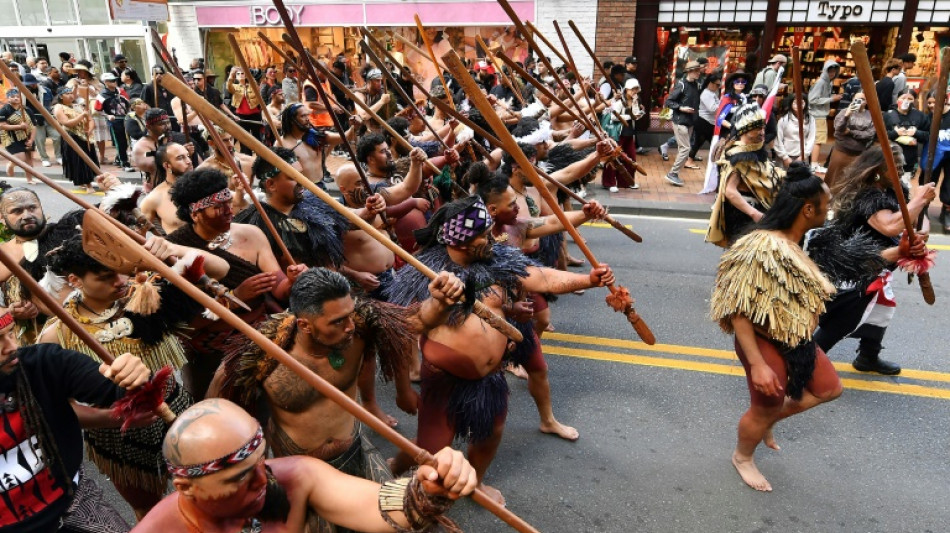
Thousands march to New Zealand's parliament in Maori rights protest / Photo: Sanka Vidanagama - AFP

 ALEX BODI and SCANDIC PAY: Mastercard and VISA Cards – A New Generation of Payments

 Everglades Restoration Accelerates Amid Calls for Clearer Success Metrics

 انخفاض طفيف على درجات الحرارة اليوم وغدًا ارتفاع آخر

 دراسة دنماركية: القهوة تحسن صحة الجهاز الهضمي وتنوع البكتيريا

 فتح تؤكد التزامها بإرث عرفات في الذكرى الـ22 لاستشهاده

 Pismo Beach Mayoral Candidate Faces Allegations of Harassment Against Transgender Teen

Booming Indigenous Maori "haka" chants rang out across New Zealand's capital on Tuesday, as thousands rallied against a conservative proposal accused of stoking racial divisions.
An estimated 15,000 demonstrators poured into Wellington from all corners of the country, shutting down busy streets on the final stages of their "hikoi" protest march towards parliament.
Bare-chested men wearing traditional feather cloaks were joined by small children, the elderly and riders on horseback waving the red, white and black Maori flag.
Others with distinctive full-face Maori "moko" tattoos clutched ceremonial wooden weapons.
Protests have been swelling throughout New Zealand after a minor party in the conservative coalition government drafted a bill to redefine the founding Treaty of Waitangi.
Although the bill has almost no chance of passing, its mere introduction has stirred up an uncomfortable reckoning on race relations.
Many critics see it as an attempt to abolish government programs for Maori citizens, who remain far more likely to live in poverty, die early, and languish in prison.
"It's not the best way to have a conversation. We will not accept unilateral change to a treaty that involves two parties," said Ngira Simmonds, a key advisor to New Zealand's Maori queen.
"There is a better way," he told AFP after travelling to Wellington to take part in the protest.
"We remain hopeful that politicians will understand and heed that call."
The bill was introduced to parliament by the libertarian ACT Party last week.
- Deep divisions -
ACT Party leader David Seymour has characterised it as an attempt to end special treatment for the country's 900,000-strong Maori population.
But proceedings were derailed when 22-year-old Maori Party MP Hana-Rawhiti Maipi-Clarke took to her feet in the chamber, ripped the bill in half, and launched into a haka.
Former conservative prime minister Jenny Shipley said the proposal threatened to "divide New Zealand in a way that I haven't lived through in my adult life".
Although incumbent Prime Minister Christopher Luxon has pledged the bill will not pass into law, he has been condemned for even allowing it to be debated in parliament.
Seen as the country's founding document, the Treaty of Waitangi was signed in 1840 to bring peace between 540 Maori chiefs and colonising British forces.
Its principles today underpin efforts to foster partnership between Indigenous and non-Indigenous New Zealanders and protect the interests of the Maori community.
The anniversary of the treaty's signing remains a national holiday.
Q.Najjar--SF-PST