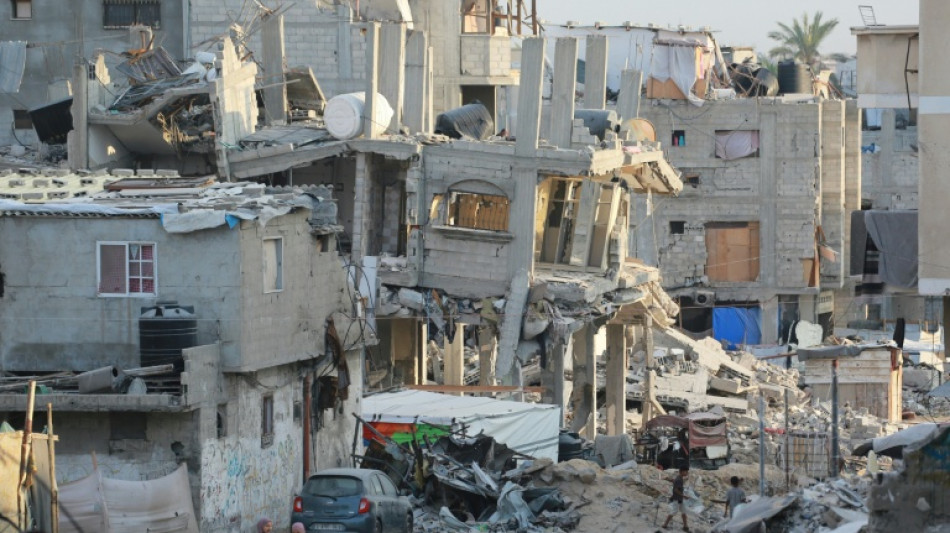
Gazans rebuild homes from rubble in preparation for winter / Photo: BASHAR TALEB - AFP/File

 Denmark hails 'binding' Greenland deal with Trump

 We don't want Games host Japan losing money, says Asian Olympic official
 Ed Sheeran returns to stage after Palestinian controversy
 Asian Games to open in Japan after troubled build-up
 Drone owners rush to offload devices ahead of Beijing ban

 Trump's beef policies irk Texas ranchers, testing their loyalty
 Nvidia, OpenAI CEOs to attend Xi dinner at White House

 Anthropic picks Accenture for in-house AI safety evaluation
 Balogun returns as Monaco beat Lens to continue strong Ligue 1 start

 'Pause' on overt repression in Venezuela, but reforms still needed: HRW

 Global stocks mixed as yen falls despite Bank of Japan rate hike

 Cuba hit with seventh major blackout of the year

 Murray out with concussion so Wentz will start for Vikings

 UN chief 'deeply regrets' US visa refusal to Abbas for annual meeting
 England quick Carse to face no charges over alleged nightclub assault

 Mancini brings nine newcomers into the first squad of his Italy comeback

 Czechs level Davis Cup tie against USA as South Korea eye Finals

 New France boss Zidane confirms Mbappe as captain after naming first squad

 California governor signs order to explore AI 'kill switch'
 Head leads run spree as Australia win Zimbabwe ODI series

 In-form Raphinha wants to finish career at Barcelona

 Warren Buffett steps down as Berkshire Hathaway chairman

 Carrick confident Man Utd can 'work through' tough time

 Mbappe ends Nike partnership to join Swiss brand On

 Liverpool boss Iraola puts Bournemouth love affair on hold

Abdelrahman Abu Anza's family home in war-ravaged Gaza's south has been reduced to rubble, which the Palestinian man is now using to build a shelter to protect from the winter cold.
Israeli bombardment in more than 13 months of war has left "more than 70 percent of civilian housing... either damaged or destroyed", according to the United Nations' humanitarian agency OCHA.
With many residents of the Gaza Strip displaced by the war, often seeking shelter in tent camps, the approaching winter is a major cause for concern.
Some, like Abu Anza, have resorted to building makeshift homes using broken concrete from war-damaged buildings and antiquated techniques to make mortar.
Surrounded by debris in Khan Yunis, southern Gaza's main city, Abu Anza told AFP that "our home was very old, it was built in 1936."
Making mortar by mixing clay sand with water, Abu Anza said he was "able to collect these stones to rebuild a wall to protect us, and then we will rebuild the whole house".
Others are also scrambling to prepare shelters with limited resources, anticipating the cold winter nights in the besieged territory, where temperatures can drop to around 6 degrees Celsius (42 Fahrenheit).
Last year, few months into the war, heavy rains flooded the tents of hundreds of thousands of people displaced by fighting, leaving them even more vulnerable to the effects of the coastal territory's humid nights.
Although temperatures never fall below zero degrees Celsius, nighttime humidity seeps into clothes, creating a damp feeling that is hard to get rid of in such precarious living conditions.
- 'Warmer than a tent' -
Even before the war, triggered by Palestinian militant group Hamas's October 7, 2023 attack, an Israeli blockade meant that very little building material has entered Gaza.
Israeli authorities have drastically restricted cement imports, for example, for fear that armed groups would build tunnels with it that could be used for military purposes.
Now it is virtually banned, despite pleas from several aid groups since the summer to include construction material in the list of products allowed into Gaza.
"There is no cement, so the alternative is that we go back to how it was 70 years ago, to the time of our ancestors, building with clay," said Muhammad Shanino, whose three-storey home had been destroyed.
"They have taken us back to a primitive life," he said, pointing to a wall of mismatched building blocks, roughly mortared.
The Global Shelter Cluster coalition of aid groups said that "when possible, repairing existing houses is the most effective approach" to prepare for winter.
Shanino said he had used some 700 stones from his ruined home to construct a humble shelter, where his family now share a single room.
With a corrugated metal sheet and tarps for a roof, a window covered only by a thin piece of fabric and walls riddled with cracks, their abode is still exposed to the elements.
And although it is much smaller than the house they used to live in, "my children say it's warmer than a tent", Shanino added.
- 'We want to live' -
Users on social media have shared videos of makeshift homes, praising Gazans' ingenuity and resilience as they endure dire humanitarian conditions.
Beyond the widespread destruction, Israel's military campaign has killed at least 43,922 people in Gaza, most of them civilians, according to figures from the Hamas-run territory's health ministry which the United Nations considers reliable.
The Hamas attack on Israel that preceded it resulted in 1,206 deaths, mostly civilians, according to an AFP tally of Israeli official figures.
Palestinian woman Nidaa al-Jarn said she was grateful to have a shelter.
Standing barefoot in a makeshift room "made of stones that we took from demolished houses and reclaimed, and built with mud", Jarn said she had constructed it "because we want to live".
Q.Bulbul--SF-PST