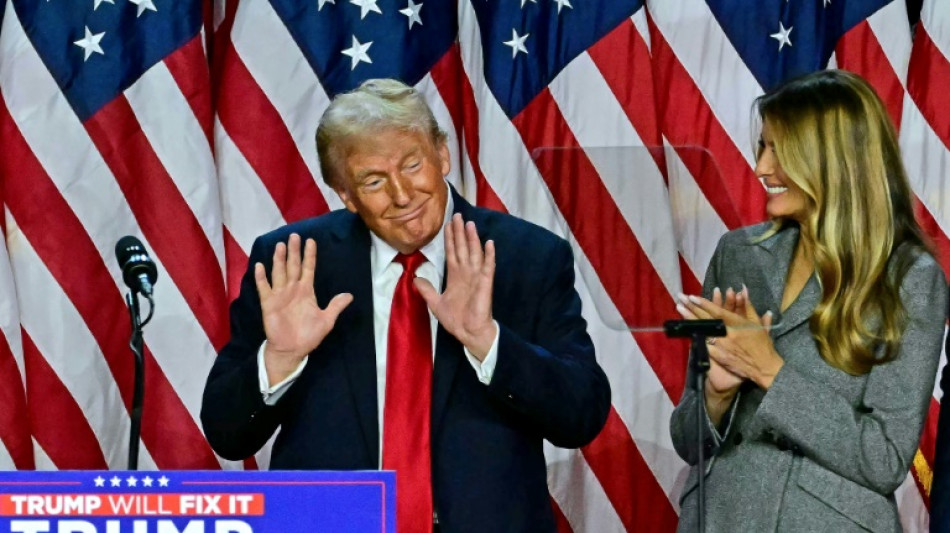
Trump revives 'peace through strength,' but meaning up to debate / Photo: Jim WATSON - AFP/File

 Denmark hails 'binding' Greenland deal with Trump

 We don't want Games host Japan losing money, says Asian Olympic official
 Ed Sheeran returns to stage after Palestinian controversy

 Asian Games to open in Japan after troubled build-up
 Drone owners rush to offload devices ahead of Beijing ban
 Trump's beef policies irk Texas ranchers, testing their loyalty

 Nvidia, OpenAI CEOs to attend Xi dinner at White House
 Anthropic picks Accenture for in-house AI safety evaluation

 Balogun returns as Monaco beat Lens to continue strong Ligue 1 start

 'Pause' on overt repression in Venezuela, but reforms still needed: HRW

 Global stocks mixed as yen falls despite Bank of Japan rate hike
 Cuba hit with seventh major blackout of the year
 Murray out with concussion so Wentz will start for Vikings

 UN chief 'deeply regrets' US visa refusal to Abbas for annual meeting

 England quick Carse to face no charges over alleged nightclub assault

 Mancini brings nine newcomers into the first squad of his Italy comeback

 Czechs level Davis Cup tie against USA as South Korea eye Finals

 New France boss Zidane confirms Mbappe as captain after naming first squad
 California governor signs order to explore AI 'kill switch'
 Head leads run spree as Australia win Zimbabwe ODI series

 In-form Raphinha wants to finish career at Barcelona
 Warren Buffett steps down as Berkshire Hathaway chairman
 Carrick confident Man Utd can 'work through' tough time

 Mbappe ends Nike partnership to join Swiss brand On

 Liverpool boss Iraola puts Bournemouth love affair on hold

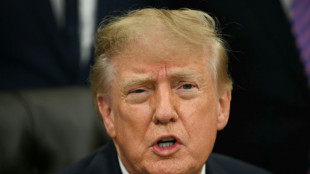
Donald Trump says he will bring "peace through strength," reviving a time-tested phrase, but whether he is pursuing a strategy or just relying on a catchphrase is a matter of dispute.
In invoking "peace through strength," the incoming president appears to be likening himself to Ronald Reagan, who sharply raised military spending before negotiating, late in his 1981-89 presidency, with a newly reform-minded Soviet Union.
Henry Kissinger, the apostle of the cool-minded pursuit of national interests known as realpolitik, had also spoken of "peace through strength" but the idea has much deeper roots.
The fourth-century AD Roman military strategist Vegetius famously wrote, "If you want peace, prepare for war," and before him the Roman emperor Hadrian sought stability by building defensive walls.
Trump, who has both vowed a strong military and to end or avoid wars, promised "peace through strength" in announcements of several key nominees, with Secretary of State-designate Marco Rubio also using the phrase.
Since Trump's victory, "peace through strength" has quickly been embraced in statements by Ukraine -- but with a very different subtext.
Trump has vowed quickly to end the war started with Russia's invasion, with his aides suggesting leveraging US military support to Kyiv -- which totals $60 billion under President Joe Biden -- to force compromise.
President Volodymyr Zelensky, in a speech two days after the US election, said forcing concessions would be "unacceptable."
"The concept of 'peace through strength' has proven its realism and effectiveness more than once. Now, it is needed once more," Zelensky said.
- Eye on China -
Trump has not expanded in depth on what he means.
But Robert O'Brien, a national security advisor to Trump in his first term, in a pre-election essay said it would mean treating China head-on as an adversary.
Writing in Foreign Affairs, O'Brien called for rapid military build-ups across Asia including deploying the entire US Marine Corps to the Pacific.
But O'Brien said that Trump, despite "false portrayals," was a "peacemaker," pointing to his encouragement of Arab normalization with Israel and to his deal with Afghanistan's Taliban that eliminated deaths of US troops.
Biden carried out the deal and withdrew the US military six months into his term, leading the Taliban to return to power swiftly after 20 years.
- 'More than a buzzword' -
"Peace through strength" has a clear domestic appeal, with few voters likely either to say they reject peace or prefer weakness.
But George Beebe, a former CIA analyst, said that while it was unclear how the Trump team would act, "I think this is probably more than just a buzzword."
"My strong impression is that they are serious about using this concept as a guide," said Beebe, director of the grand strategy program at the Quincy Institute for Responsible Statecraft, which favors military restraint.
In the perception of the Trump team, "peace through strength" also likely means less focus on Biden's Pentagon internal priorities, such as increasing diversity, and just "having a capable war-fighting machine," Beebe said.
But Beebe said there needed to be a balance, noting that Reagan combined his military build-up with "smart diplomacy" to promote peace and stability with the Soviets.
"If you veer too far in the direction of extending an olive branch, that can be potentially abused by adversaries," Beebe said.
"On the other hand, if you veer too much in the warrior direction, you can end up with not peace through strength, but war through strength."
Jacob Stokes, a senior fellow at the Center for a New American Security, said "peace through strength" can play out differently in theory and practice.
Even if Trump builds the military, Stokes said, the United States would lose a key advantage if he again questions US allies in Europe and Asia.
And cutting off military aid to Ukraine "might get you the peace part, but not necessarily the strength part," Stokes said.
"The pitfall is that you assume that more strength -- and more demonstrations of it, and willingness to use it perhaps even in irrational ways -- necessarily means more peace. International politics is more complicated than that," he said.
"It's a great political slogan for President Trump. The challenge of translating that effectively into a foreign policy will be a substantial and quite difficult one."
Q.Najjar--SF-PST