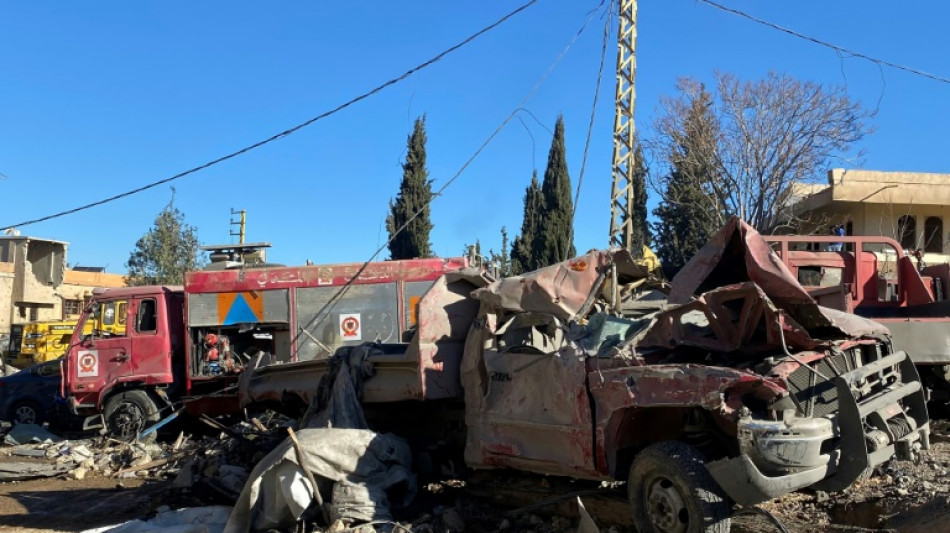
Lebanon rescuer picks up 'pieces' of father after Israel strike / Photo: Sam SKAINEH - AFP

 UK actor Naomi Watts honoured at Spain film festival
 Japan emperor declares Asian Games open after turbulent build-up
 Asian Games open with unity message after troubled build-up
 Denmark hails 'binding' Greenland deal with Trump

 We don't want Games host Japan losing money, says Asian Olympic official
 Ed Sheeran returns to stage after Palestinian controversy
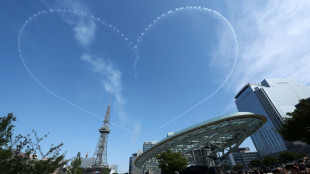 Asian Games to open in Japan after troubled build-up
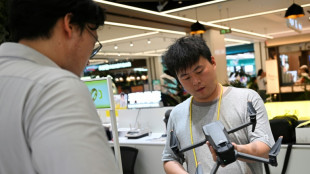 Drone owners rush to offload devices ahead of Beijing ban
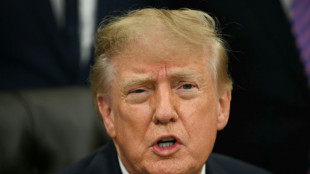
 Trump's beef policies irk Texas ranchers, testing their loyalty
 Nvidia, OpenAI CEOs to attend Xi dinner at White House
 Anthropic picks Accenture for in-house AI safety evaluation
 Balogun returns as Monaco beat Lens to continue strong Ligue 1 start

 'Pause' on overt repression in Venezuela, but reforms still needed: HRW
 Global stocks mixed as yen falls despite Bank of Japan rate hike
 Cuba hit with seventh major blackout of the year
 Murray out with concussion so Wentz will start for Vikings
 UN chief 'deeply regrets' US visa refusal to Abbas for annual meeting
 England quick Carse to face no charges over alleged nightclub assault
 Mancini brings nine newcomers into the first squad of his Italy comeback
 Czechs level Davis Cup tie against USA as South Korea eye Finals

 New France boss Zidane confirms Mbappe as captain after naming first squad
 California governor signs order to explore AI 'kill switch'
 Head leads run spree as Australia win Zimbabwe ODI series
 In-form Raphinha wants to finish career at Barcelona
 Warren Buffett steps down as Berkshire Hathaway chairman
Suzanne Karkaba and her father Ali were both civil defence rescuers whose job was to save the injured and recover the dead in Lebanon's war.
When an Israeli strike killed him on Thursday and it was his turn to be rescued, there wasn't much left. She had to identify him by his fingers.
Karkaba then rushed back to the bombed civil defence centre to search for her fellow first responders under the rubble.
Israel struck the centre, the main civil defence facility in the eastern Baalbek area, while nearly 20 rescuers were still inside, said Samir Chakia, a local official with the agency.
At least 14 civil defence workers were killed, he said.
"My dad was sleeping here with them. He helped people and recovered bodies to return them to their families... But now it's my turn to pick up the pieces of my dad," Karkaba told AFP with tears in her eyes.
Unlike many first-responder facilities previously targeted during the war, this facility in Douris, on the edge of Baalbek city, was state-run and had no political affiliation.
Israel's military did not immediately respond to a request for comment.
Friday morning, dozens of rescuers and residents were still rummaging through the wreckage of the centre. Two excavators pulled broken slabs of concrete, twisted metal bars and red tiles.
Wearing her civil defence uniform at the scene, Karkaba said she had been working around-the-clock since Israel ramped up its air raids on Lebanon's east in late September.
"I don't know who to grieve anymore, the (centre's) chief, my father, or my friends of 10 years," Karkaba said, her braided hair flowing in the wind.
"I don't have the heart to leave the centre, to leave the smell of my father... I've lost a part of my soul."
- 'Now we are targets' -
Beginning on September 23, Israel escalated its air raids mainly on Hezbollah strongholds in east and south Lebanon, as well as south Beirut after nearly a year of cross-border exchanges of fire.
A week later Israel sent in ground troops to southern Lebanon.
More than 150 rescuers, most of them affiliated with Hezbollah and its allies, have been killed in more than a year of clashes, according to health ministry figures from late October.
Friday morning, rescuers in Douris were still pulling body parts from the rubble, strewn with dozens of paper documents, while Lebanese army troops stood guard near the site.
Civil defence worker Mahmoud Issa was among those searching for friends in the rubble.
"Does it get worse than this kind of strike against rescue teams and medics? We are among the first to... save people. But now, we are targets," he said.
On Thursday, Lebanon's health ministry said more than 40 people had been killed in Israeli strikes on the country's south and east.
The ministry reported two deadly Israeli raids on emergency facilities in less than two hours that day: the one near Baalbek, and another on the south that killed four Hezbollah-affiliated paramedics.
The ministry urged the international community to "put an end to these dangerous violations".
More than 3,400 people have been killed in Lebanon since the clashes began last year, according to the ministry, the majority of them since late September.
K.Hassan--SF-PST